682
Editorial
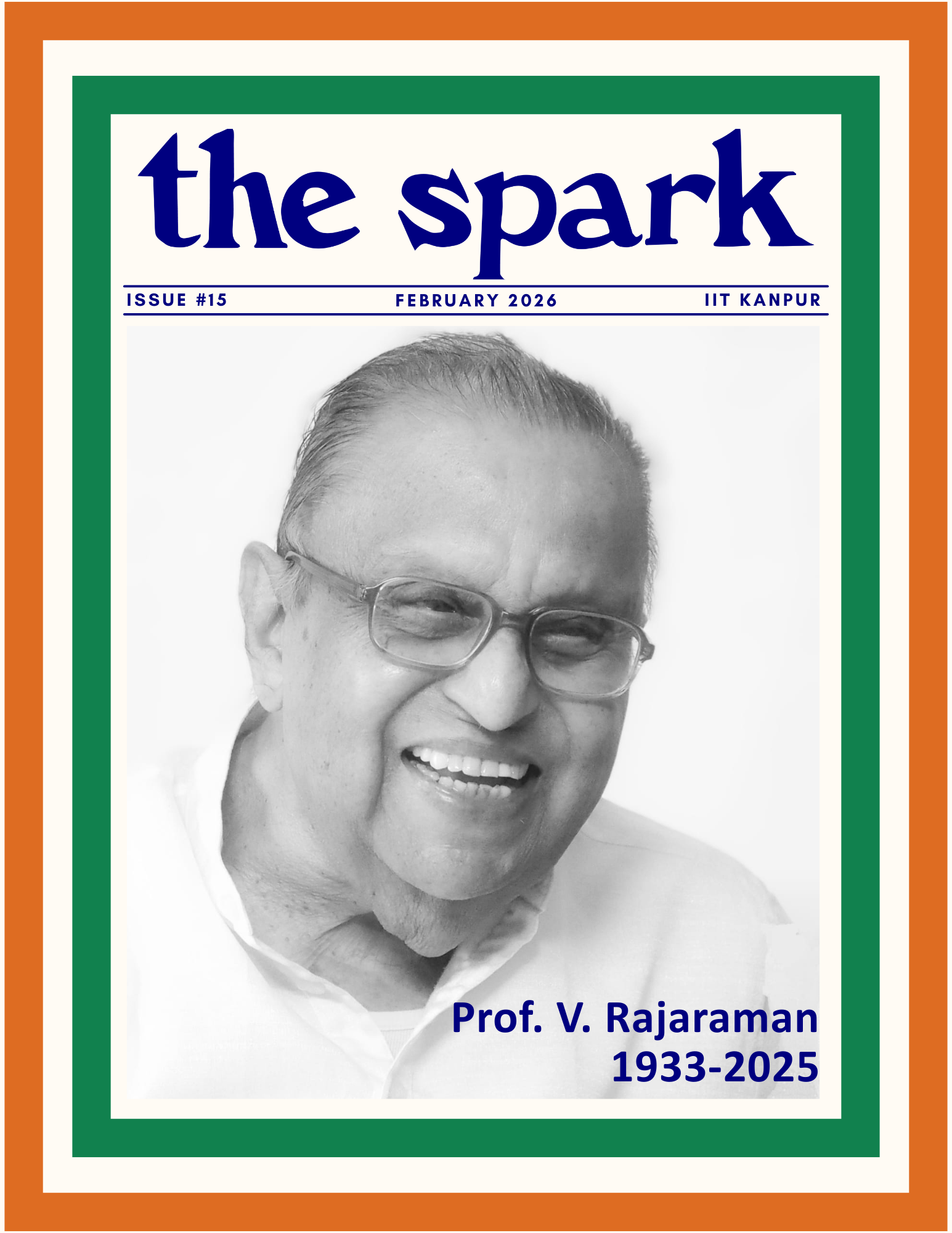
A seed he planted grew into something that was world-nourishing. That is the story of Prof. V. Rajaraman, who cultivated Computer Science at IIT Kanpur from its beginnings in the EE Department—writing foundational textbooks, teaching new instructors, building infrastructure, and attracting students and faculty who would go on to change the world. It is no great exaggeration to say that every modern computing application developed in India can be traced back to his books (such as Principles of Computer Programming) and the academicians he has mentored since the 1960s.
Students and alumni of IITK have had many wonderful teachers and mentors to thank for their success, and Prof. Rajaraman was certainly one of them. What set him apart, however, was that he recognized the coming global revolution in computing and made it happen in India, ceaselessly advocating for computing education in the country, beginning at IITK where deep thinking and novel ideas have always been welcome. He championed computing education tirelessly. Over decades, he produced affordable textbooks, strengthened the Computer Center, created new curricula, recruited exceptional JEE students into a brand-new program, and built a pioneering faculty willing to create a completely new engineering discipline. He transformed India’s technological landscape with grace, clarity, and quiet persuasion.
The IITK community was deeply saddened by his passing on 8 November 2025 in Bangalore. Our heartfelt condolences go to Mrs. Dharma Rajaraman.
This special issue of the Spark honors Prof. V Rajaraman’s life and legacy. In this issue, we hear about him from his students at IITK, his colleagues at IISc, and his family, including his sister, nephews, nieces, and so many others who knew him, first and foremost, as Rajaram, their brother, their uncle, the boss, the co-worker.
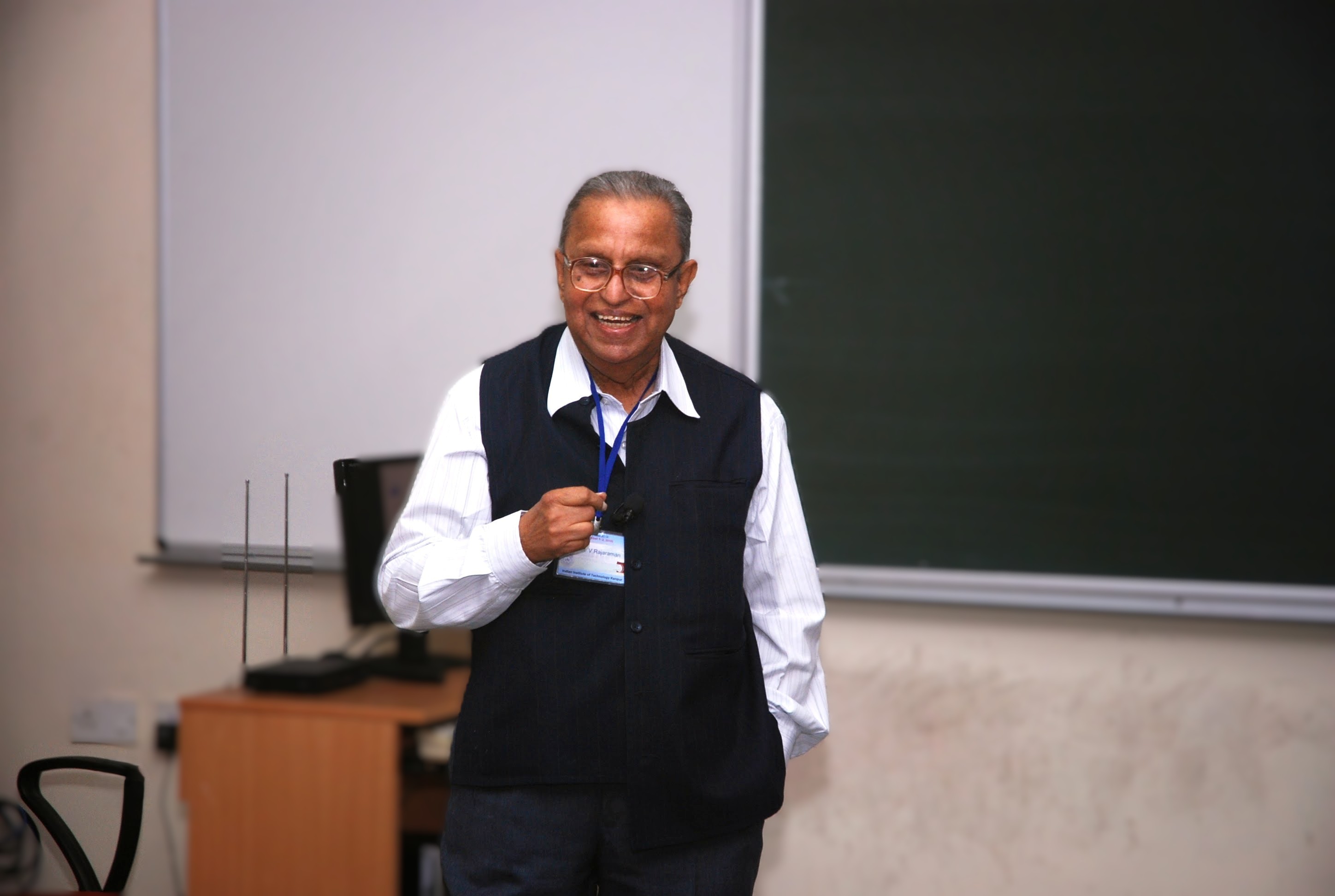
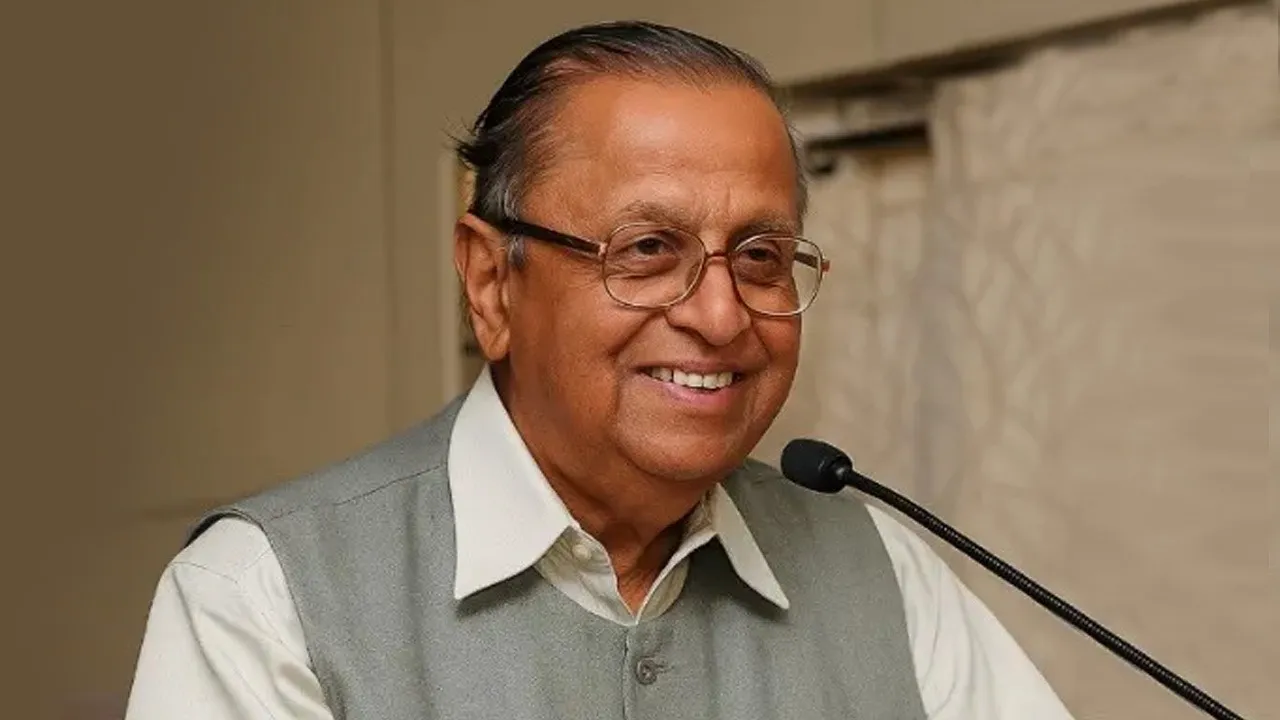
Prof. Rajaraman addressing the IITK Community, 2010. Picture: IITK CSE Archives
683
V. Rajaraman: The teacher who built India’s computing mind
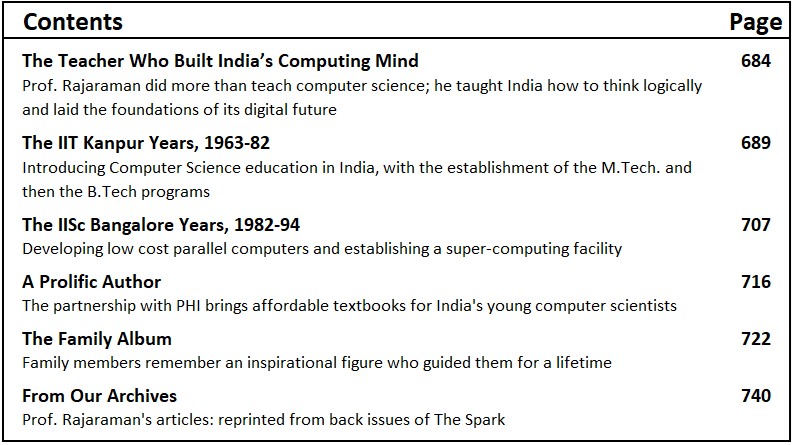
Professor Vaidyeswaran Rajaraman (1933–2025) did more than teach computer science. He taught India how to think logically and laid the foundations of its digital future.
Shrikanth Govindarajan
Editor, Dataquest India
When a teacher departs, the blackboards weep. A generation of learners, spread across the world, pause and go back in time, overwhelmed by a quiet sense of gratitude and loss.
Such is life, and such is India’s timeless Guru–Shishya Parampara (teacher-disciple lineage), where many jambavans (immortal figures) silently walk the corridors of knowledge, leaving behind an imprint that endures long after they are gone.
Professor Vaidyeswaran Rajaraman was one of them.
He passed away on 8 November 2025 in Bengaluru, aged 92. For India’s technology community, it feels as if a quiet light has gone out.
In 1997, Dataquest had the honour of presenting him the Lifetime Achievement Award. It was one of those rare moments when the industry paused to recognise a teacher. Prof Rajaraman accepted it with the calm dignity that defined him, reminding everyone that progress begins not in boardrooms, but in classrooms.
A life well lived
Born on 8 September 1933 to Ramaswami Vaidyeswaran and Sarada in Erode, then part of the Madras Presidency, Prof Rajaraman’s early years reflected the curiosity of a mind destined for discovery. He passed the Higher Secondary Certificate examination in 1949 as part of the first batch of Madras Education Association (now DTEA) Higher Secondary School, New Delhi.
684
He went on to earn a BSc (Honours) in Physics from St Stephen’s College, University of Delhi, in 1952, followed by a Diploma in Electrical Communication Engineering from the Indian Institute of Science (IISc), Bangalore in 1955. He stayed on at IISc to design and construct non-linear units for an analogue computer, applying them to engineering problems. That work earned him an Associateship from IISc in 1957.
Awarded an overseas scholarship by the Government of India, he joined the prestigious Massachusetts Institute of Technology (MIT) and obtained his MSc in Electrical Engineering in 1959. He then pursued doctoral research on adaptive control systems at the University of Wisconsin–Madison, completing his PhD in 1961. His early academic career began there as an Assistant Professor of Statistics, before he returned to India in 1962 to join the Indian Institute of Technology Kanpur (IIT Kanpur) as an Assistant Professor of Electrical Engineering.
IIT Kanpur had been established with US assistance under the Kanpur Indo-American Program in the 1960s. In July 1963, Prof. Harry Huskey of the University of California, Berkeley, brought an IBM-1620, a commonly used computer at American universities, to the IIT Kanpur campus. The IBM 1620 was the first computer in an educational institution in India and also the first computer in India with a high-level programming language, FORGO.
IIT Kanpur introduced a required course for all undergraduates in computer programming. Professor Huskey as the leader of the American group designed what he called the "Ten-Day Intensive Course on Computation", intended for the faculty of IIT Kanpur and also for scientists and engineers from other Universities and research establishments in India. The course consisted of Programming using FORGO, basic numerical methods, and computer logic, along with a laboratory session in which all the participants of the course wrote and executed programs using FORGO.
After Prof. Huskey returned to the US in July 1964, the faculty members of IIT Kanpur, including Prof. Rajaraman, continued to offer this class. The attendees included the Late Mr. F.C. Kohli, co-founder and first CEO of TCS, and widely regarded as the Father of the Indian IT industry. (The Spark, Oct 2021)
At Professor Huskey’s invitation, a visiting stint at the University of California, Berkeley in 1965–66 proved to be a turning point. It was during this period that Prof Rajaraman shifted his focus fully to the then nascent discipline of Computer Science, a choice that would shape the technological destiny of an entire country.
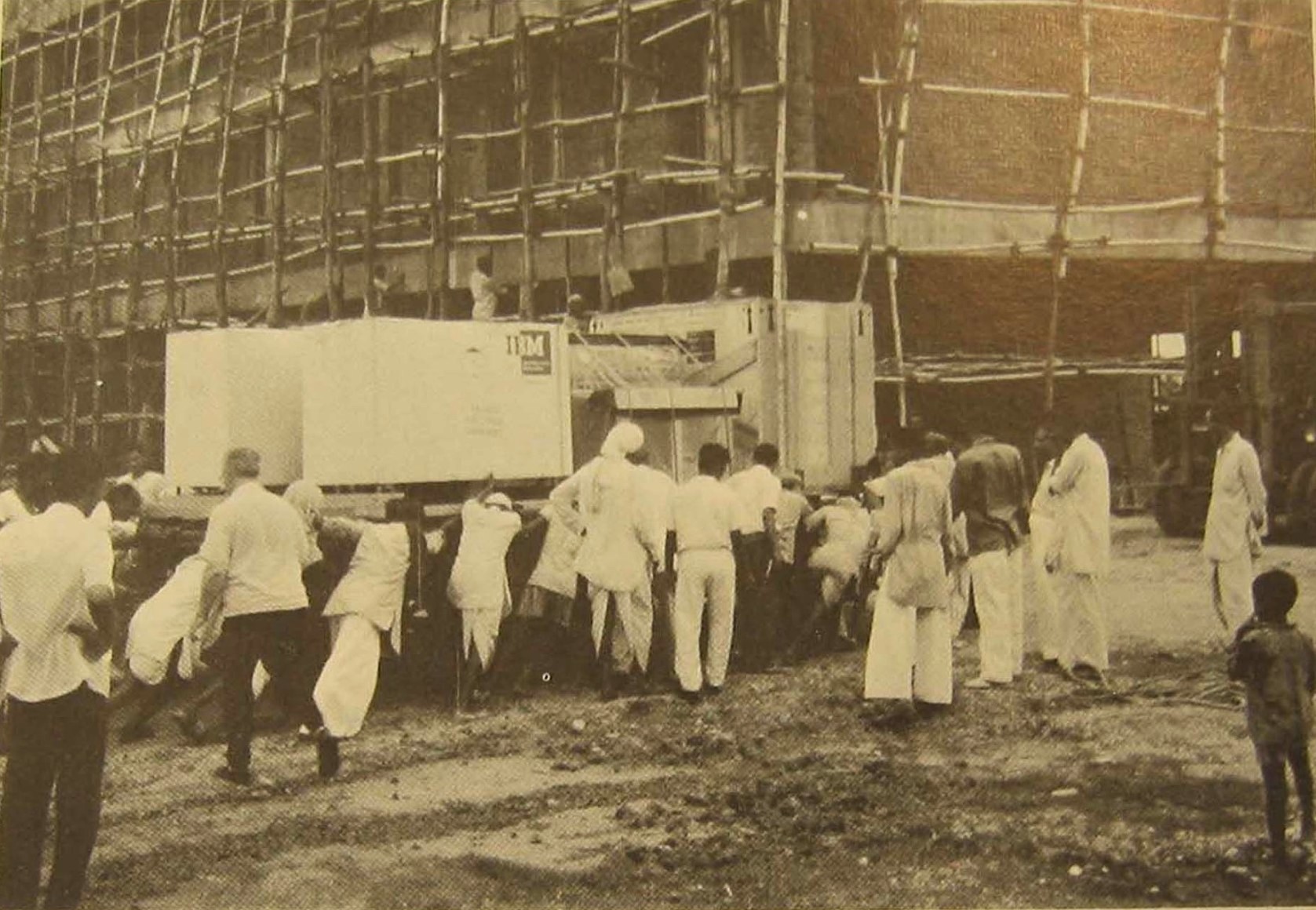
The IBM-1620 arrives at IIT Kanpur, July 1963. Source: Norman C. Dahl, "Revolution on the Ganges: A Report on the Indian Institute of Technology, Kanpur," Institute Archives, MIT Libraries, Cambridge, MA.
685
At IIT Kanpur, with the support of colleagues and leadership, he helped start a new MTech programme with Computer Science as an option in the mid-1960s, the first time the subject was offered as an academic discipline in India. He later helped introduce a doctoral programme in the field, and in 1978, he initiated the BTech programme in Computer Science at IIT Kanpur with an initial batch of 20 students. A group led by him also pioneered the use of decision tables in the development, debugging, and optimisation of complex computer programmes.
He became a Senior Professor at IIT Kanpur in 1974 and stayed there till 1982. During this period, he also contributed to real-time control systems for projects such as the Bhilai Steel Plant and designed training modules for Tata Consultancy Services, while shaping computer science curricula for bodies like the All India Council for Technical Education (AICTE).
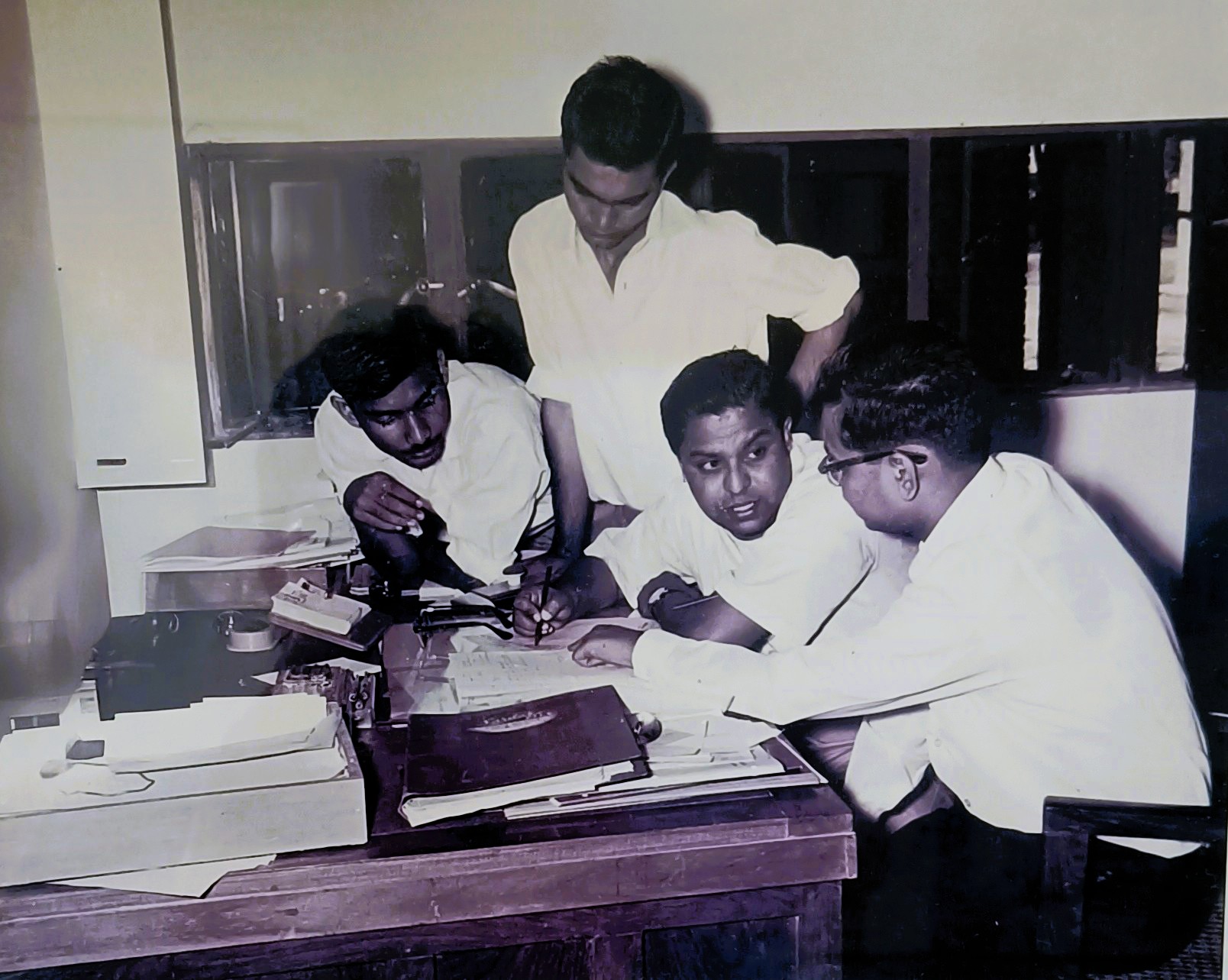
Prof. Rajaraman (third from left) in a discussion at IIT Kanpur, 1960s.
Picture: IIT Kanpur archives, from the collection of the Kelkar family.
Prof. Rajaraman then moved to IISc Bangalore, where he developed low-cost parallel computers and helped build a supercomputing facility, serving as Chairman of the Supercomputer Education and Research Centre (SERC) from 1982 to 1994. During his years at IIT Kanpur and IISc, he guided around 30 doctoral students and published over 70 scientific papers in national and international journals.
His work was never about machines alone. It was about people who could think logically, communicate clearly, and solve problems elegantly. He wrote 23 textbooks that became staples in classrooms across India, including early works on computer programming, numerical methods, computer organisation, digital logic, and parallel computers. His History of Computing in India: 1955–2010, written at the invitation of the IEEE Computer Society, remains a landmark chronicle of how a young nation learned to compute with imagination and purpose.
Beyond academia, he played a quiet but decisive role in policy and institution building. As a member of the Electronics Commission and the Science Advisory Council to the Prime Minister, he chaired the committee that recommended the now-famous Master of Computer Applications (MCA) programme to address the impending talent shortage for the IT industry. The same period saw him chair the committee that proposed the creation of the Centre for Development of Advanced Computing (C-DAC) to build indigenous supercomputers using parallel computing. He later served on C-DAC’s governing council in its formative years.
686
In Karnataka, he advised the state government on several e-governance initiatives, including the Bhoomi land records computerisation project and the Kaveri project for digitising property registration. For him, computing was never an abstract pursuit. It was a tool to make systems fairer, more efficient, and more transparent.
Prof Rajaraman was a Fellow of all four major Indian science academies and held fellowships of professional bodies such as the Computer Society of India and the Institute of Electronics and Telecommunication Engineers. His many honours included the Shanti Swarup Bhatnagar Prize (1976), the Padma Bhushan (1998), the Lifetime Contribution Award in Engineering from the Indian National Academy of Engineering, and Lifetime Achievement Awards from the Computer Society of India, Dataquest, and the Systems Society of India.
Yet his true reward was seeing his students succeed. He believed that teaching was an act of nation-building, and he lived that belief every day.
He taught humanity, and also tech
To measure his legacy only in awards or institutions would be to miss its essence. His real contribution was the mindset he built, one that valued clarity over complexity, thought over noise, and purpose over power.
As we remember him, we remember a teacher who made India think differently.
In an age fascinated by artificial intelligence, his life reminds us that the most powerful intelligence is still human.
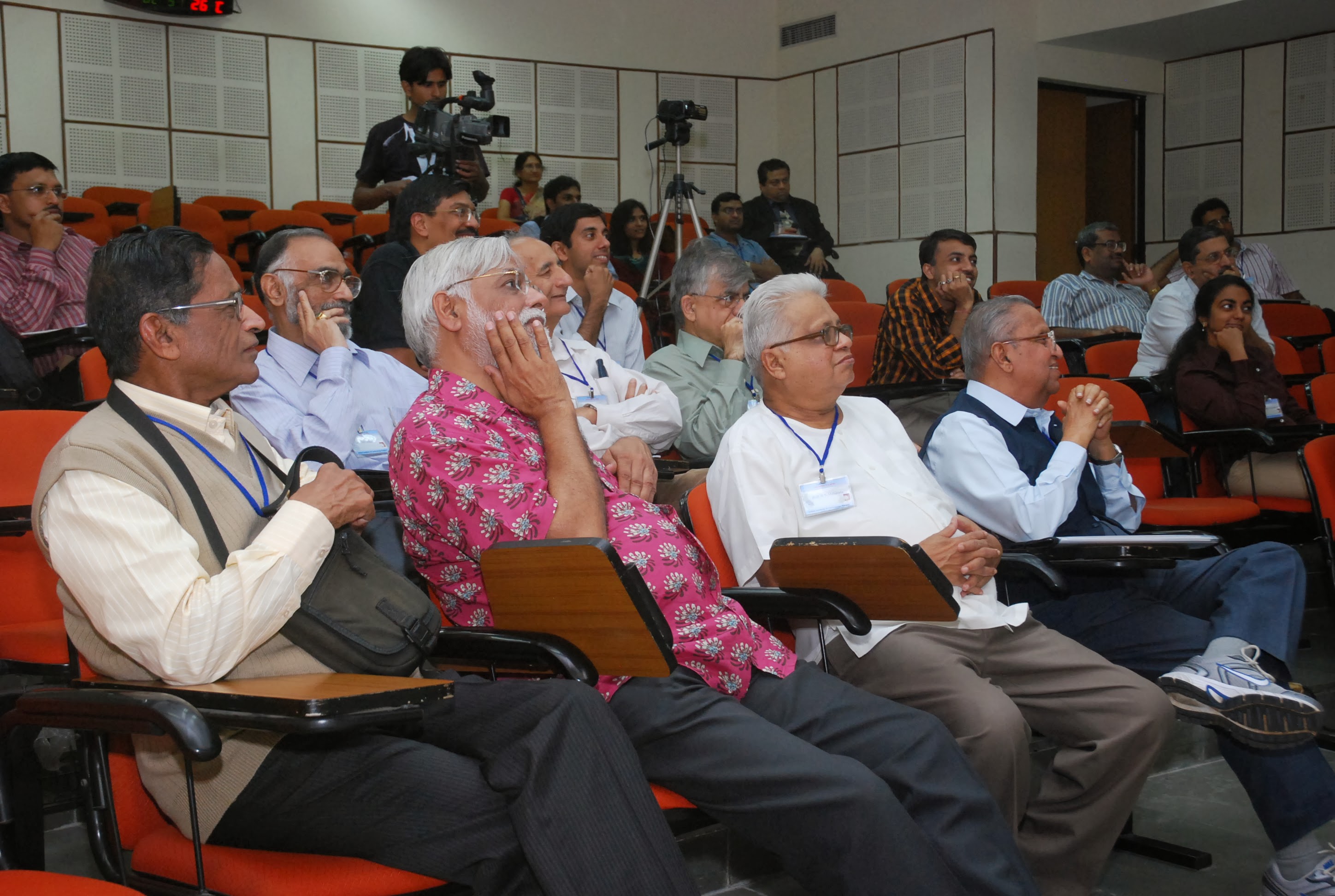
Four legendary teachers of Computer Science. Professors R. Sankar, Kesav Nori, HN Mahabala and V Rajaraman at the IIT Kanpur Golden Jubilee Celebration, 2010. Picture: IITK CSE Archives
687
A Life that was: Prof Vaidyeswaran Rajaraman (1933–2025)
Born: 8 September 1933, Erode, Madras Presidency (now Tamil Nadu)
Died: 8 November 2025, Bengaluru
Parents: Ramaswami Vaidyeswaran and Sarada
Education:
BSc (Honours) in Physics, St Stephen’s College, University of Delhi (1952)
Diploma in Electrical Communication Engineering, IISc Bangalore (1955)
Associateship, IISc (1957)
MSc in Electrical Engineering, MIT (1959)
PhD, University of Wisconsin–Madison (1961)
Academic roles:
Assistant Professor of Statistics, University of Wisconsin–Madison
Assistant / later Senior Professor, IIT Kanpur (1963-1982)
Chairman, Supercomputer Education and Research Centre (SERC), IISc (1982–1994)
Key contributions:
Helped start India’s first MTech and later BTech programmes in Computer Science at IIT Kanpur
Pioneered use of decision tables in software development
Guided around 30 PhD students and published over 70 research papers
Chaired committees that recommended the MCA programme and the creation of C-DAC
Advised Karnataka government on landmark e-governance projects such as Bhoomi and Kaveri
Publications: 23 textbooks and the monograph History of Computing in India: 1955–2010
Honours: Shanti Swarup Bhatnagar Prize (1976); Padma Bhushan (1998); Lifetime Contribution Award in Engineering (INAE); Lifetime Achievement Awards from Computer Society of India, Dataquest, and Systems Society of India.
All heroes do not wear capes. Some stand quietly behind a podium, shaping generations without seeking the spotlight. Professor Rajaraman was one of them. He did not chase greatness; he became it, by simply doing what he was destined for: teaching a nation how to think.
About the author:
Shrikanth Govindarajan is a media and content professional with over 25 years of experience in editorial strategy and executive visibility. He is the Editor of Dataquest and CiOL, published by CyberMedia. He has also worked with the Project Management Institute (PMI) and Nihilent, shaping outcome-driven content across platforms.
This article appeared on the Dataquest website in November 2025. The original is accessible at: dqindia. Reprinted with permission from Dataquest, a CyberMedia publication.
688
The IIT Kanpur Years
1963-1982
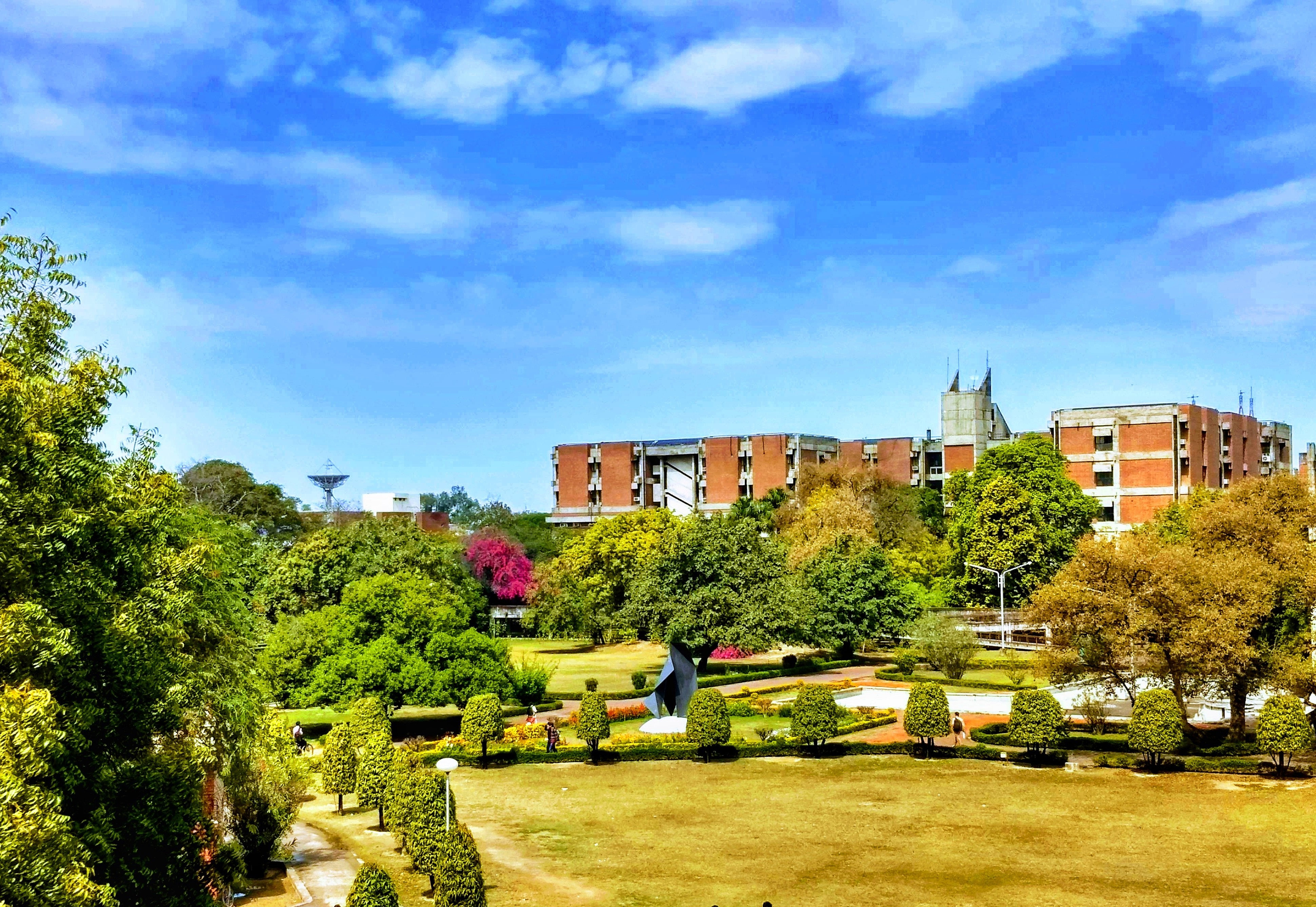
The IIT Kanpur Academic Area, with the Faculty Building visible in the background
Picture: Aditya Raghav Trivedi, clicked from the roof of L-20, 2019.
Professor Rajaraman joined IIT Kanpur in March 1963, while the Institute was still operating in borrowed buildings at the Harcourt Butler Technical Institute in Kanpur city.
He saw the arrival of the IBM-1620 in July 1963, and he played a key role in the acquisition of the IBM-7044 in 1966 and the DEC-1090 in 1979.
His efforts led to the introduction of Computer Science education in India, with the establishment of the M.Tech. program at IITK (the first time this discipline was offered in India) followed by the B.Tech. program in 1978. Today, with India’s global position in the Information Technology age, the results are visible, for all to appreciate.
This section of the Spark includes tributes from some of his students from these years
689
Prof. V. Rajaraman – a Tribute
Pramod Chandra P. Bhatt
Professor, CSE, IIT Delhi, 1969-96
In 1965, I joined Prof. Rajaraman for research and registered for a doctoral program at IIT/K while serving as a lecturer. The courses he recommended were difficult, but he constantly encouraged me to carry on. He very strongly believed that conceptual understanding not only gives one a strong basis for research, but also for any serious efforts made towards a clean implementation of an idea. To keep me grounded and practice oriented, he asked me to assemble and test a Heath-kit Analogue computer and maintain TR 20 Analogue computers acquired through the Kanpur Indo-American Program (KIAP).
My dissertation research began with a steel mill control system project from Bharat Heavy Electricals (BHEL) in Bhopal. The design needed to be validated using an Analogue simulation. BHEL sought IIT Kanpur’s help and Prof. Rajaraman asked me to take up the challenging task. The belief he had in my abilities was good enough to motivate me to work hard to prove worthy of the faith bestowed in me. This was his quiet way of instilling confidence in a young mind. Prof. Rajaraman had the ability to sculpt and chisel out the chaff and enhance self-confidence by offering small step-by-step challenges through mentoring.
At IIT/K he was both the administrative head of the computing centre and a fulltime faculty member of the EE Department. IIT/K was initially a harbinger, which later became the fulcrum, of training and up-skilling of the fledgling information technology industry. The impact was far and wide. Engineers from several public and private sector organisations, especially the defence ministry, came for training and post-graduate education, and later engaged in joint work with IIT/K. They worked in a variety of areas that covered design of systems on board a ship or air or on ground. Prof. Rajaraman’s contributions to teaching and practice of CSE had a far-reaching impact in education, industry, public utilities and defence.
Prof. Rajaraman was a prolific writer. Most Indian professionals learned their first lessons in programming and computer architecture from his books. He meticulously crafted teaching materials in the full range of CSE courses covering the then prevailing computer programming languages and numerical methods to design of computer systems. Prepared initially as hand-out notes and typed painstakingly by Mr. Nathani, these turned into textbooks for use by the undergraduate students throughout our country. Prentice Hall India (PHI) published over 25 books written by Prof. Rajaraman, and Mr. Asoke Ghosh, a PHI executive, promoted this emerging subject area, ensuring that the prices were affordable for undergraduate students. Prof. Rajaraman’s books on FORTRAN programming, computer architecture and design, etc., were the bibles for generations of CSE students. The last few books he wrote traced the evolution of computer technology covering the topics from the early days of Electronic Numerical Integrator And Computer (ENIAC) till the use of Graphics Processing Units (GPUs) to support processing of Artificial Intelligence (AI) systems using Large Language Models (LLMs). He also wrote several articles on the growth of Information Technology in India.
For a long time, Prof. Rajaraman headed the computer centre at IIT/K, handling difficult situations with efficiency and compassion. For instance, as the need for many support personnel became irrelevant, he consulted with the employees to work out an amicable solution, to the satisfaction of all the stakeholders, helping with their reskilling and alternative employment possibilities. This took time and required enormous patience, persuasion skills and accommodation to keep the humanitarian aspect in mind. He was a benevolent administrator who kept the interest of the institution he served without sacrificing the humane approach for the staff that had stood by him and had supported him over the years.
690
The Rajaraman household played a key role towards sharing the community responsibilities. Mrs. Dharma Rajaraman, a trained musician, taught instrumental (Violin) and vocal Carnatic music to the children and members of the community. The children loved to play in the lawns of their house, with the encouragement of both Dharma and Prof. Rajaraman. With their generous hospitality, they were a popular couple and younger faculty and students often visited them to share their concerns, or to be calmed when under emotional stress. The administration asked Dharma to take up the role of a student counsellor, with another colleague’s wife. This was one of the first efforts in the IIT system to address the stress level amongst students.
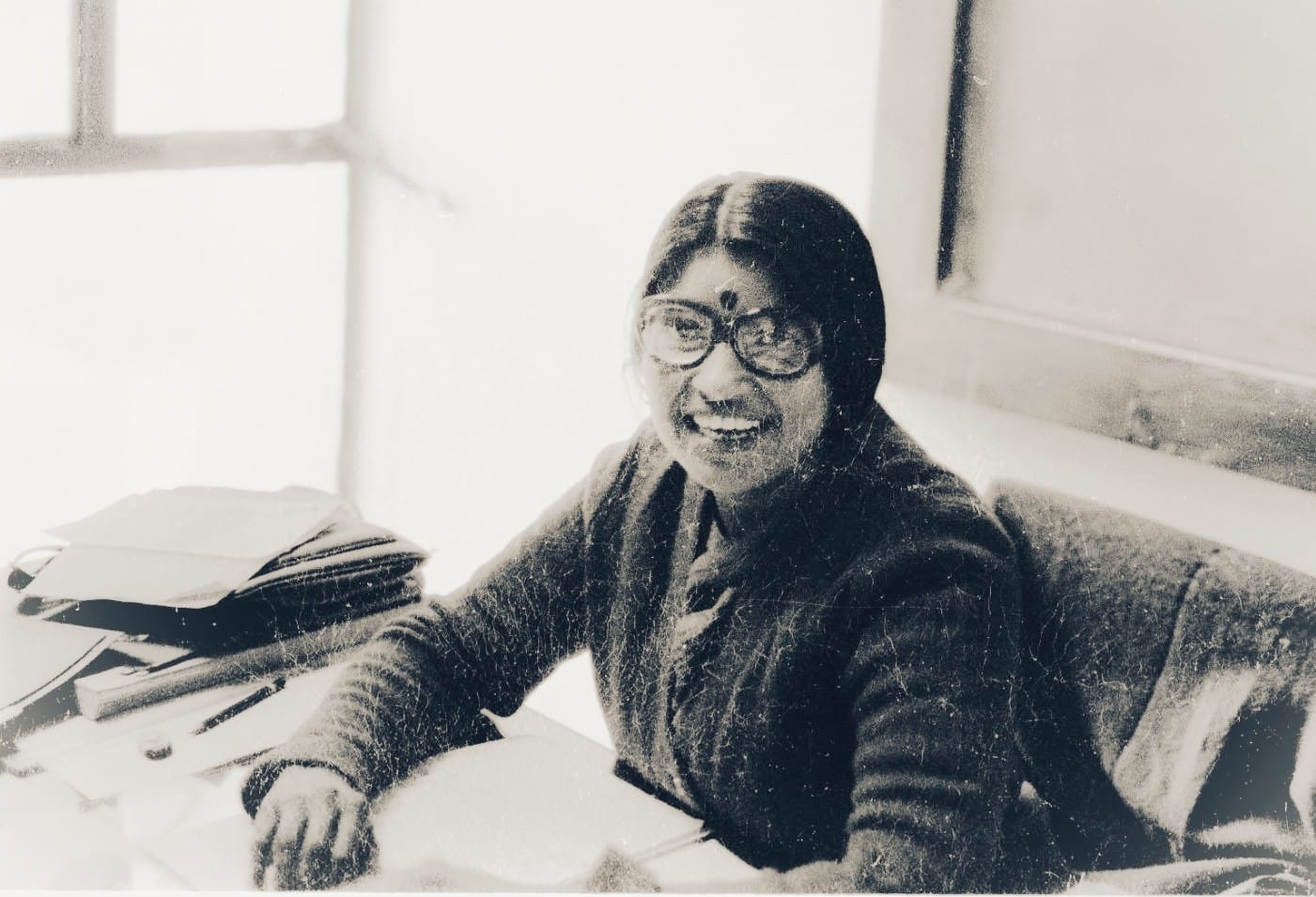
Mrs. Dharma Rajaraman in her Counselling Service office at IITK, c. 1978. Picture: Shirish Joshi
After I moved to IIT/D, our paths converged again in the early 1980s when he was a member of GoI’s Electronics Commission and I was appointed director of Computer Development with the Department of Electronics (now the Ministry of Electronics and Information Technology). While his role was to set the policies and get the cabinet approval my role was to promote computer development within the policy framework and implement the approved programs. We later served on many committees to launch several programs which have contributed immensely. I would like to mention three key initiatives where we worked very closely.
- Software (SW) Export policy for promoting SW development in India using Indian talent and exporting value added services, in 1981,
- Master of Computer Application (MCA) program with the help from University Grants Commission (UGC), promoted by Prof. Dr. D. Shankernarayana of the UGC.
- The establishment of two major centres of excellence: the Centre for Development of Telematics (C-Dot) and Centre for Development of Advanced Computing (C-DAC). Prof. Rajaraman was on the advisory committee of C-DAC and I was in the technical committee that initiated planning of the Param series of computers. He provided the much-needed guidance in the form of gentle mentoring in the initial years. Again, his quiet and gentle nudges instilled the confidence to achieve the task.
691
The last two decades of Prof. Rajaraman’s professional career were at IISc, Bangalore. He headed the Super-computing research centre which supported many key areas in fundamental science and engineering such as computational chemistry, biology, material science, climate and environmental
.JPG)
IITK CSE Golden Jubilee Reunion in 2010. Seated (L to R) are former Professors: Pankaj Jalote, Rajiv Sangal, PCP Bhatt, R Sankar, V Rajaraman, HN Mahabala, KV Nori, VK Vaishnavi, and Gautam Barua. Current faculty members (and alumni/students) are in the standing rows. Picture: CSE Archives.
studies in the sciences and fluid mechanics and aerospace system design. In addition to directing the research in parallel computing, he oversaw the programs for semiconductor R&D in the area of Very Large Scale Integration (VLSI) and Knowledge Based Computing Systems (KBCS), creating a large pool of scientists and researchers. Taking into account the wide canvas of his contributions and the enormous impact he has had, the GoI honoured him with the Padma Bhushan award.
For CSE education and research as well as for the IT industry in India, Prof Rajaraman decisively moved the needle. He will always be remembered, not just for his enormous contributions to computer science and education, but also for touching the lives of so many. For me, and many of my ilk, he remains a beacon and a mentor forever. Amongst all the people I have come across in my life, if someone comes closest to leading a life of equilibrium and synthesis then that would be Prof. Rajaraman.
About the author:
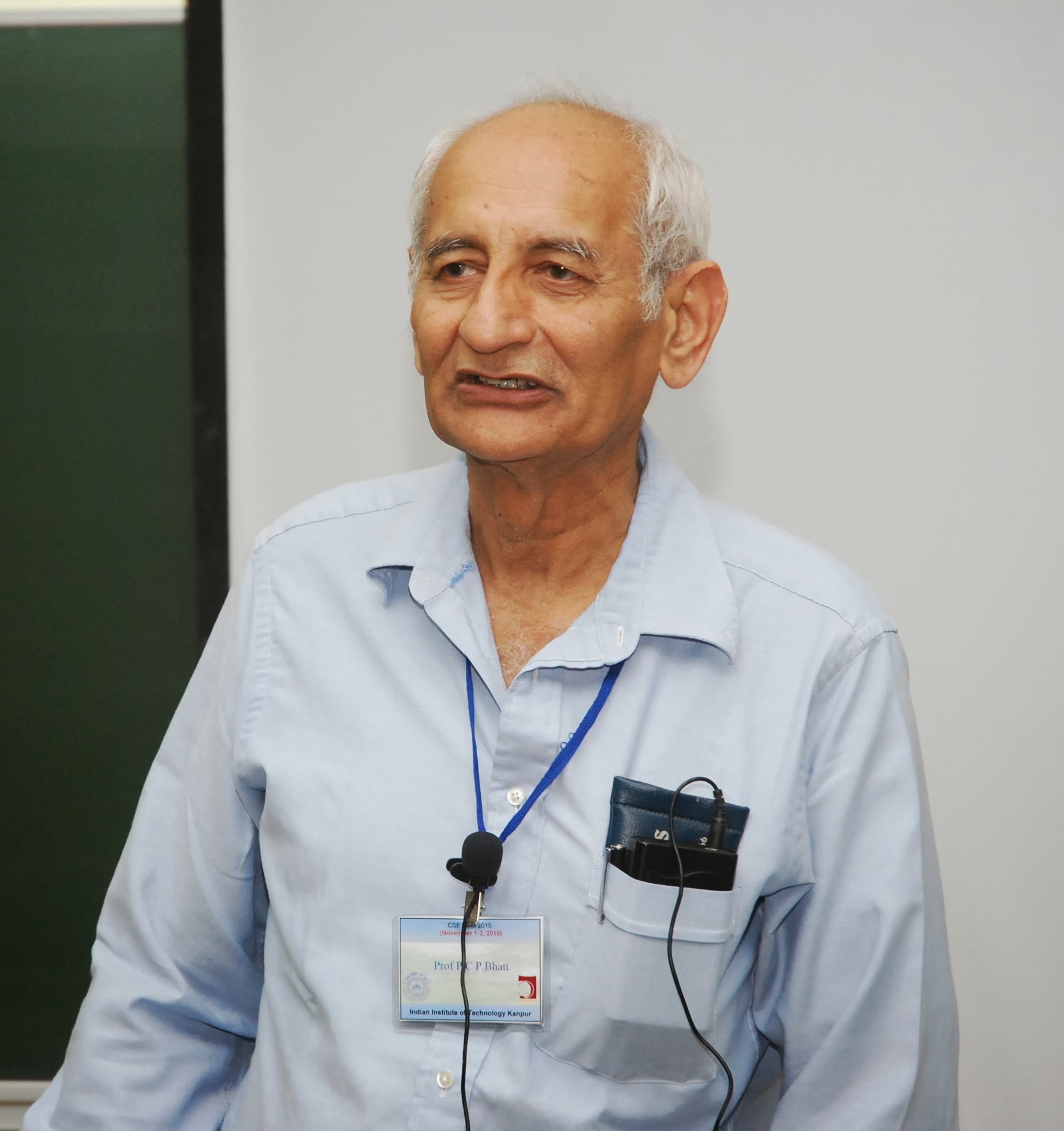
Professor Pramod Chandra P. Bhatt joined the IITK faculty in 1965 and was the first student to register for doctoral research with Prof. Rajaraman. After completing his PhD, he moved to IIT Delhi in 1969 and helped establish the CSE curriculum at IITD. He continued to collaborate with Prof Rajaraman in the later years and retired from IITD in 1996. He and his wife Varsha valued great camaraderie and cordial relationship with Dharma and Prof. Rajaraman and continue to be family friends of the Rajaraman household.
Prof. PCP Bhatt at IIT Kanpur, 2010. Picture: IITK CSE Archives
692
The Classic Textbooks
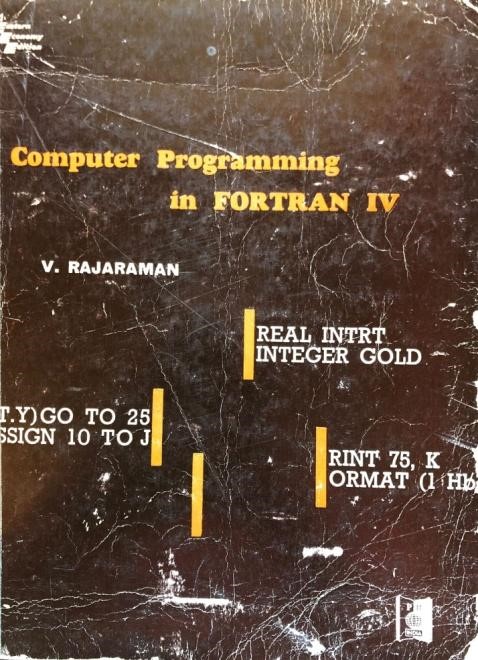
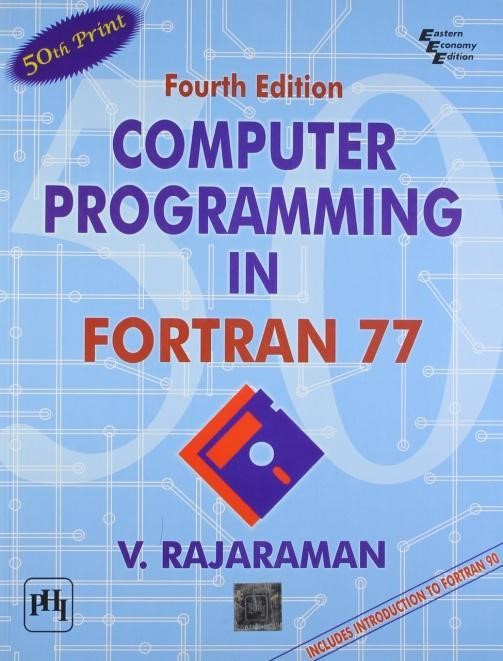
This classic textbook was used for TA-306 at IITK. All students used this for their FORTRAN programming classes, until we switched to Pascal in 1980.
On the left is an original from 1973, saved by Raj Bhattarai (1971-76). Now in its 53rd Printing, the one on the right is a more recent version, available on Amazon.
Three of Professor Rajaraman’s books originated from cyclostyled notes distributed to the 10-day intensive course participants: Computer Programming, Numerical Methods, and Computer Organization. They were probably his first three textbooks on Computer Science in India.
The first book naturally addressed FORTRAN II, for which we had a compiler on the 1620. Later on, as new versions of FORTRAN were released, he kept updating his book. The cover on the left indicates IV, so it is probably his second book on Fortran from the IBM 7044 era.
The larger-than-usual format stayed with Rajaraman's books for a long time. He would type them on an electric typewriter and send them camera-ready to Prentice-Hall, so as to not need multiple cycles of proofreading and finally errata - standard features of book publishing in pre-DTP days.
(shared by Professor Hari Sahasrabuddhe)
693
Prof. V. Rajaraman - the father of computing in India
Narayana Murthy
Founder, Infosys Limited
I first met Prof. V Rajaraman (VR, as most students used to call him at IIT Kanpur), in 1967. He had interviewed me after the written test for my selection to the graduate course in Electrical Engineering at IITK. His calm and helpful demeanor, and kind and encouraging words to get the best answers out of me have been etched in my mind forever. He was critical to the establishment of the Computer Science and Engineering courses at IITK in 1968 and taught me a course called “Introduction to Computer Architecture” at that time.
Our batch had the unique privilege of VR auditing a course on Automata Theory with us. This course was taught by Prof. S V Rangaswamy (SVR) of TIFR – Mumbai. The class was also audited by stars like Dr. H V Sahasrabuddhe and Dr. C R Muthu Krishnan, two scholars who had just finished their PhD at IITK. For people like me, attending this class was more than just learning Automata Theory. Listening to the deeply-thought-out and courteous interactions between SVR and the bright cohorts of the class, and the insightful comments and critical questions that VR asked SVR, enriched me much.
In 1968, VR took over the responsibility for the newly-enlarged computer center (CC) at IITK with an IBM 1620 and an IBM 1401 – IBM 7044 ensemble with its rich variety of languages like FORTRAN, SNOBOL, LISP, SLIP and GPSS, just to mention a few. Under the kind and elder-brotherly care of VR, the CC was kept open to us 24 hours a day.
VR became the go-to person for students who had any problems. He lent a patient and kind ear to any student who brought even personal problems to him, and he found solutions to most of the issues. Often, VR and his wife, Dharma, made their home an open house for the faculty and the students of EE. They were gracious, generous and kind.
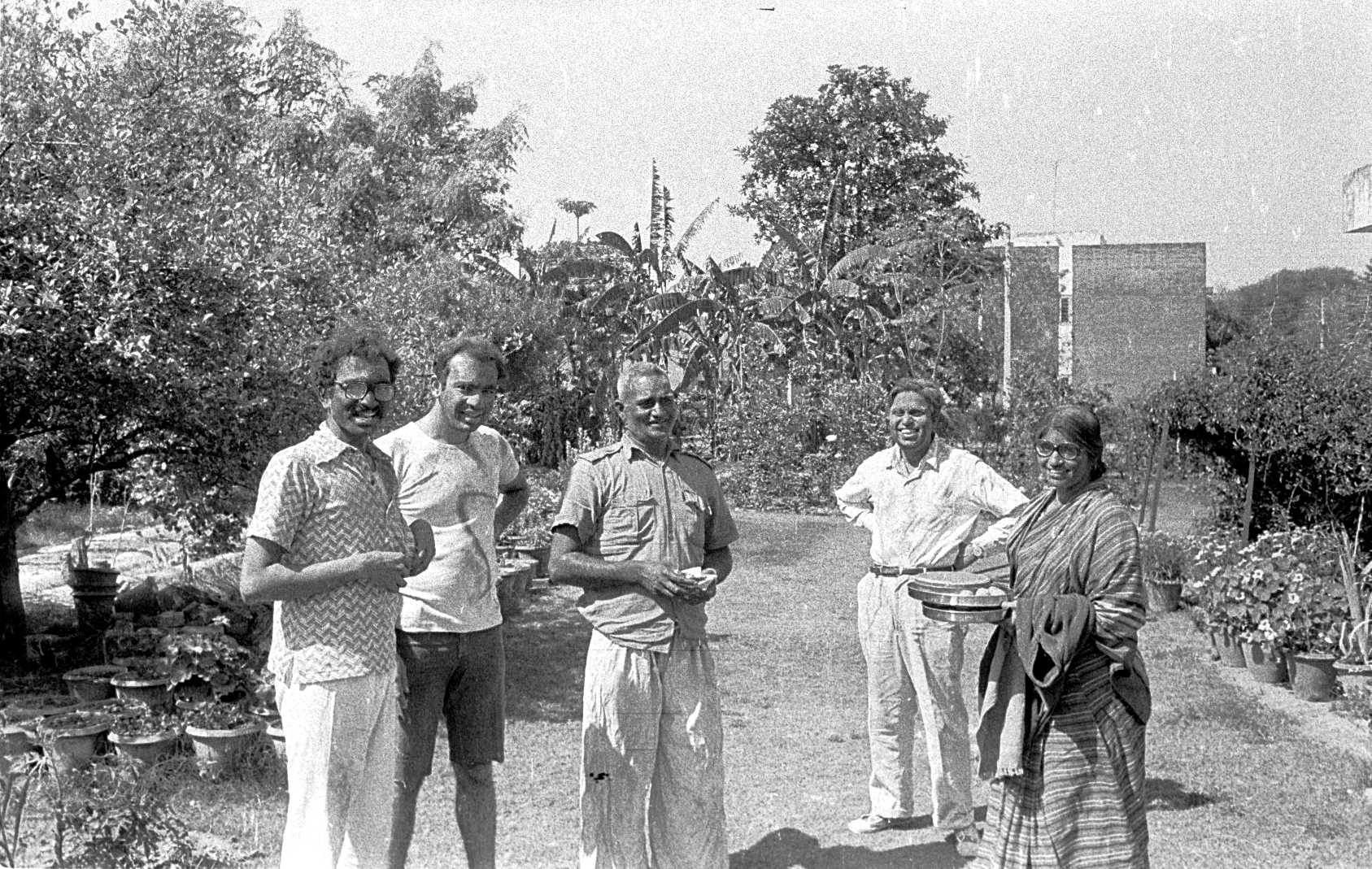
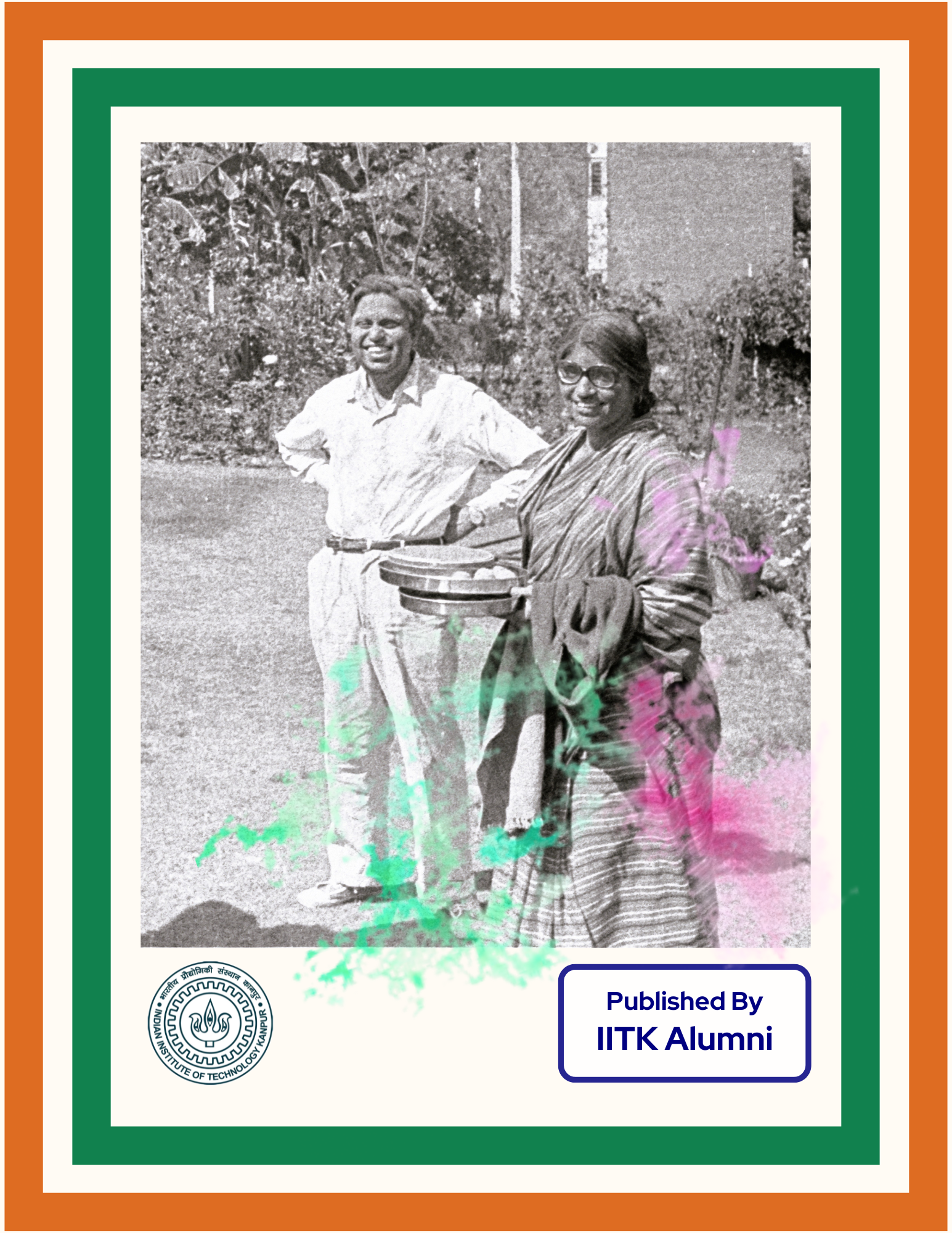
Prof and Mrs Rajaraman, their gardener and two students (D Murali Raju and Shirish Joshi) at Holi time. Mrs. Rajaraman is holding a thali of delicious laddoos, ready to feed the hungry hordes. Picture: Shirish Joshi (1973-78)
694
In my own case, it was VR (and my father) who helped me choose the position of the Chief Systems Programmer of a computer center, with a modern time-sharing computer system, at IIM – Ahmedabad in 1969. I chose this in preference to a job that would have paid me more than double the salary as a programmer-analyst in a large corporation that operated using an obsolete IBM 1401 computer. This momentous decision changed my life for the better. I remain grateful to VR and my father.
VR is the father of India’s software success for various reasons. The Rajaraman committee created the “Computer import against software export commitment by software entrepreneurs” policy for the Government of India. This policy influenced India’s foray into modern software technology in many ways. First, it provided software entrepreneurs (like me) access to the latest computing technology then available in the US, and an opportunity to serve the software application development needs of a fast-growing corporate market in the US. It accelerated the growth of the fledgling Indian software companies in the US software services market. The US market was where corporations used information systems as a competitive advantage. It taught Indian corporations how to use information systems for better efficiency and profitability.
To protect ECIL, a state-owned computer manufacturer of rudimentary computers, the government had banned the import of sophisticated and powerful computers by large Indian corporations. They had made obtaining licenses to import these modern computers an almost impossible and torturous process. Therefore, these large Indian corporations obtained access to modern computer systems through data centers operated by software entrepreneurs. These data centers provided large Indian corporations the “left-over” time (remaining after the computer time used to develop software applications for fulfilling export commitment) of these modern computers that the software entrepreneurs had imported against software export commitment.
VR introduced several training programs in algorithmic thinking and programming at IITK for officers from the government, the public sector and the private sector. This increased awareness of the power of information systems among the decision makers in our economy and was one of the factors influencing India’s emergence from the low growth rate period that had lasted a long time.
VR also wrote several introductory books on computing and programming for the Indian students. These books were simple, lucid and easy to understand.
Thus, there are many reasons to call Prof. Rajaraman the father of computing in India.
May his soul rest in peace.
About the author:
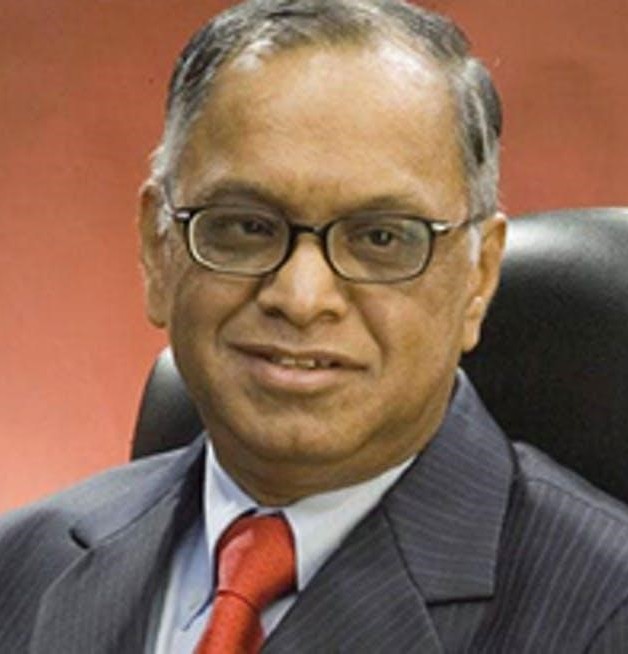
Mr. Narayana Murthy received his Bachelor’s degree in Electrical Engineering (EE) from the National Institute of Engineering, Mysore in 1967, and his Master’s degree in EE from IIT Kanpur in 1969.
In 1981, Mr. Murthy founded Infosys Limited, the first Indian company to be listed on the NASDAQ stock exchange. Under his leadership, the company grew to 260,000 employees and a market capitalization of US $95B by 2021. A global leader, he has received the Legion d’honneur from France, the CBE from Britain, and the Padma Vibhushan from India. IIT Kanpur recognized him as a Distinguished Alumnus in 1998.
695
The Jerusalem Conference, 1971
The IFIP (International Federation for Information Processing) Administrative Data Processing (ADP) Group conference took place in Jerusalem, Israel, from August 16–20, 1971. Prime Minister Golda Meir delivered the opening address at the conference, and Prof. Rajaraman represented India's growing academic and technical interest in international information processing standards.
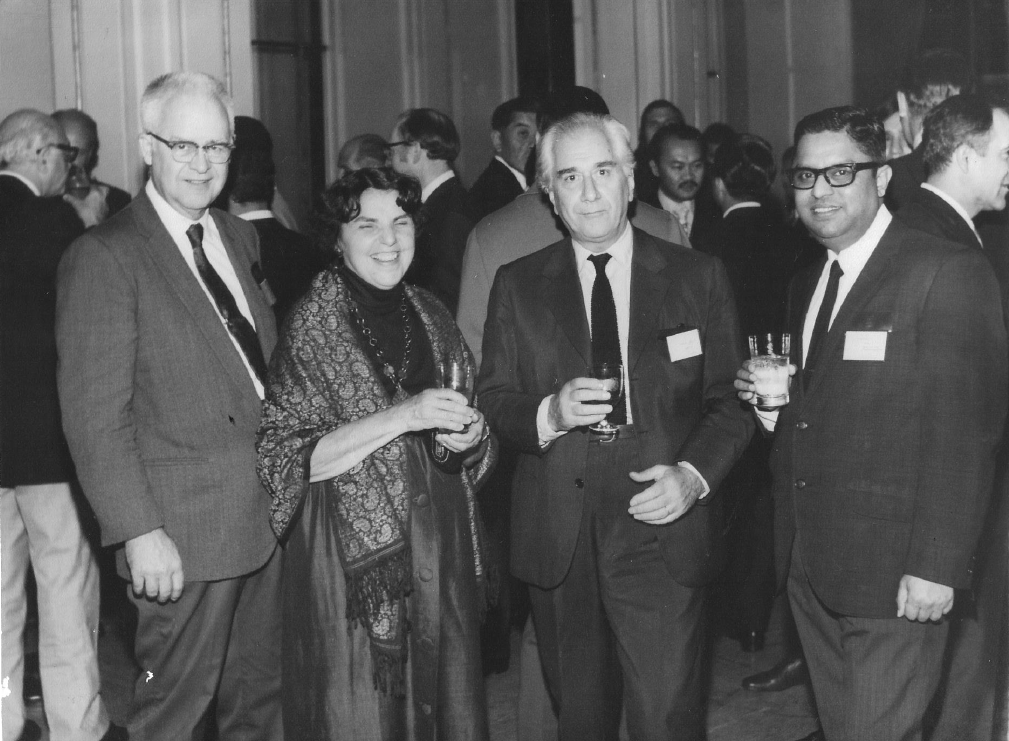
Prof V. Rajaraman, on the far right, with Harry and Velma Huskey on the left, at the Jerusalem Conference. Second from right is one of the Israeli delegates at the conference.
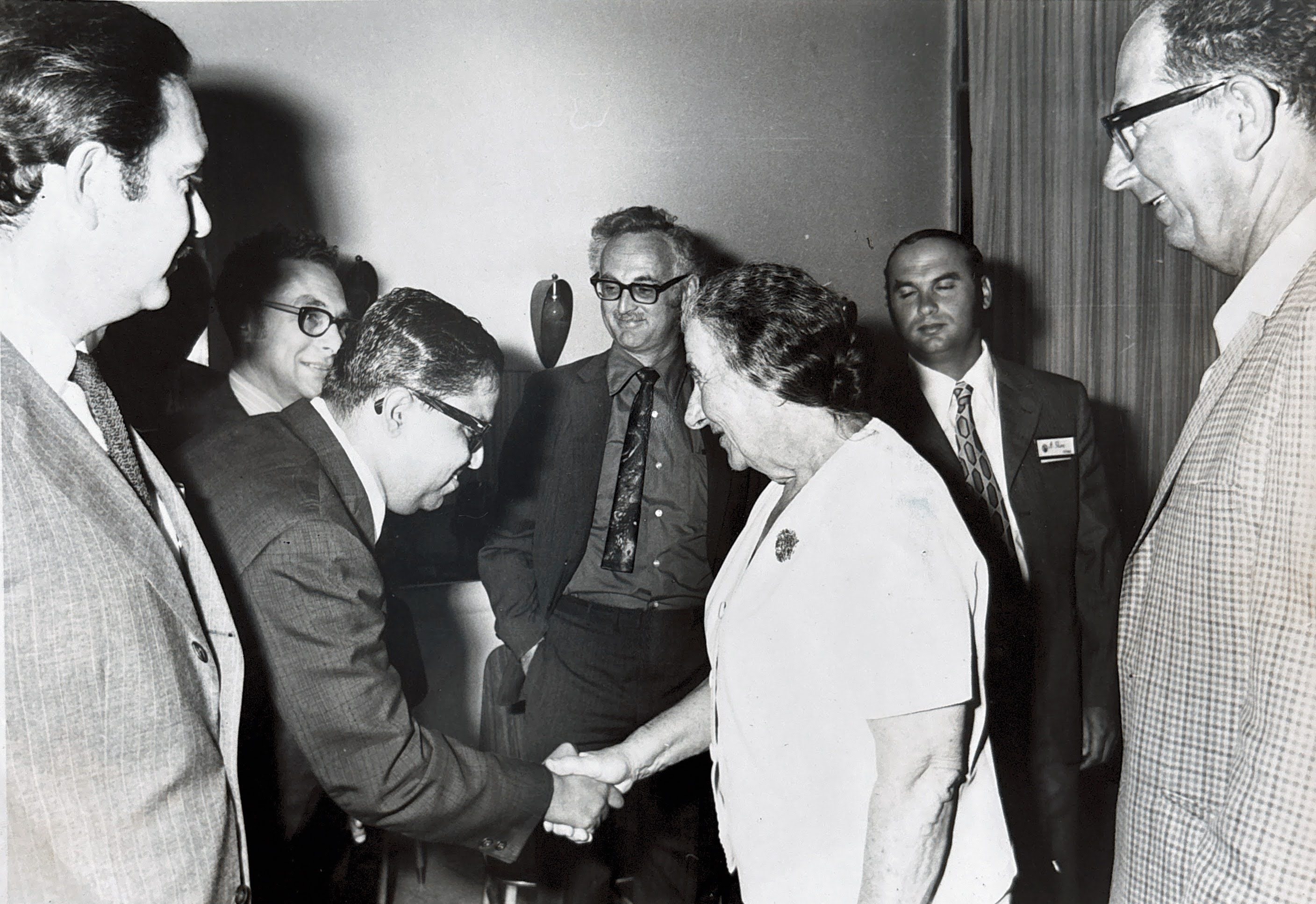
With Israeli Prime Minister, Golda Mier
Professor Rajaraman’s tribute to Prof. Harry Huskey appears in The Spark, Issue 1, October 2021, pg. 11-14, available at: Issue 1
696
Remembering Professor Rajaraman
Somenath Biswas
Professor, CSE, IIT Kanpur, 1980-2018
Professor Rajaraman is truly the father of Computer Science and Engineering in India. Way back in 1963 he could envision the tremendous potential India had in the field of computing, and he devoted his entire life in pursuit of this vision. It is astounding to see how successful this pursuit has been: if India is known today the world over for its excellence in Computer Science and Engineering (CSE) education and research, and if India today is an IT giant, it is to a great extent due to the pioneering contributions of Professor Rajaraman.
I was fortunate to have him as my PhD thesis supervisor, and when I joined the CSE faculty, under his Headship for about two years till he left IITK. Although during our interactions over these years we had many discussions beyond academics, Professor Rajaraman would rarely speak about himself. And yet, in my long association with him, I did learn certain aspects of his life and work which do provide a glimpse into this rare personality. As a child growing up in Delhi, he would often attend Gandhiji’s prayer meetings. He told me that these early exposures to Gandhiji and his teachings had left a deep impression on him. As one looks back now, one sees Professor Rajaraman’s life to be a life of selfless service to the nation. He left, at the first opportunity, the Assistant Professorship of a prestigious US university to return to India in 1963, arriving at IITK which was then being set up.
Later in the same year IITK got its first computer system. It did not take the young Rajaraman long to gain mastery over this new technology. It was possibly then he could envision how tremendously transformative computing could be for the nation. In keeping with this vision, he started many activities to spread the knowledge of computing as widely as possible. He organized short term courses during 1964 to 1975 which attracted people from all over the country, continuing the classes started by three visiting professors of the Kanpur Indo American Program.
697
In those early years, he also wrote several hugely popular introductory books on computing and its applications. His first book ‘Principles of Computer Programming’ was published in 1969, and by preparing a typed camera-ready copy himself, he ensured that its cost would be less than photocopying the book! For one of his early books, he got a desperate letter from a student in Rajasthan saying that he could not find a copy of it anywhere and would commit suicide if he did not get one soon. Professor Rajaraman promptly sent him his personal copy. His passion for writing books explaining new and emerging areas of computing continued lifelong; in fact, his last book on the history of modern computing was published only last year.
Once, in the late 1960s, Professor Rajaraman needed funding for a workshop (on how computers could help in making business decisions) and the Director asked him to get the consent of the Chairman, Board of Governors who was a leading industrialist. The Chairman consented but told Professor Rajaraman ‘Young man, you’re wasting your time on these new-fangled ideas. It’s clear that the country’s future is in jute, and as for decision making, the most important decision I need to make is to estimate the next year’s yield, and that I can do by finding out the depth of the Ganga at a certain place in a certain season.’ This was the general perception of computing at the time!
Professor Rajaraman had great empathy for students. Once, in the late 1970s, a new computer was just installed with a big disc drive whose disc would rotate at a high speed under a cover under low atmospheric pressure. A UG student seeing the new machine in operation was very curious to see the disc and he opened the cover resulting in the disc head crashing. Everyone thought that Professor Rajaraman would mete out some punishment, but he did not do so, saying after all the student was trying to understand something and, in the process, he made a mistake.
.JPG)
Prof. Somenath Biswas felicitating Prof. Rajaraman after a panel discussion at IIT Kanpur, 2010
Professor Rajaraman had remarkable leadership qualities. One has never heard him raise his voice or be angry at anyone. During his Headship the CSE Department (technically, an Inter-Disciplinary Program then) worked in great harmony among faculty, students and staff. Very unobtrusively he made everyone feel like a valuable member of a team working toward a great cause. In fact, we PhD students felt as if we owned the Department!
Professor Rajaraman was the first person in the country, and in fact, was among a very few in the world, to realize that knowledge of computing is as essential as mathematics for all engineers, and he tried to convince the IITK senate to introduce it as a core UG course way back in 1967. Such a course at that time was a rarity anywhere in the world. He also recognized very early that CSE is an independent discipline and due to his efforts, the B.Tech. program in IITK started in 1978. Furthermore, it attracted students with the highest JEE ranks even in the very first year. I had asked him how this happened and he said he had spoken to many parents, and I believe it was his own deep and passionate conviction that convinced the parents also that it was the best choice for their wards.
No account of Professor Rajaraman can be complete without mention of his wife Dharma. They got married in 1964 and she became his staunch partner in all his endeavours, even drawing figures for his early books and acting as his editor. She was also a friend and counsellor to all students and we were all assured of a warm and cheerful welcome whenever we visited their home.
Professor Rajaraman left IITK in 1982 having ensured that it was by then the best place in the country for CSE education and research. He went to IISc Bangalore, invited by the Director there. He made immense contributions there too but that is another story.
About the author:
 v2.JPG)
Prof. Somenath Biswas obtained his B.Tech (Electronics and Electrical Communication Engg.) from IIT Kharagpur in 1973, and his M.Tech and Ph.D in Computer Science, in 1976 and 1980 respectively, both from IIT Kanpur. He joined the faculty of the Computer Science and Engineering Department of IIT Kanpur in 1980, where he was the Sanjay and Rachna Pradhan Chaired Professor. He has been the Department Head (1986-87, and 1995-97), and the Dean, Faculty Affairs (2005-07). IIT Kanpur recognized him as an Institute Fellow for his contributions to the institute in 2018.
698
The Shanti Swarup Bhatnagar Prize
The Shanti Swarup Bhatnagar Prize was the highest award given by the Government of India given annually by the Council of Scientific and Industrial Research (CSIR) for notable and outstanding research, applied or fundamental, in biology, chemistry, environmental science, engineering, mathematics, medicine, and physics. The prize recognized outstanding Indian work in science and technology.
In 2024, the Government of India continued the Shanti Swarup Bhatnagar Prize for Science and Technology with the Rashtriya Vigyan Puraskar called the Vigyan Yuva - Shanti Swarup Bhatnagar Award. The Rashtriya Vigyan Puraskar has been designed to bring the same level of respect and honor to scientific achievements as the Padma awards do for other fields.
Source: Wikipedia
Professor Rajaraman was awarded the Shanti Swarup Bhatnagar
Prize in 1976, for his contributions in optimizing the use of decision tables and his pioneering work in computer science.
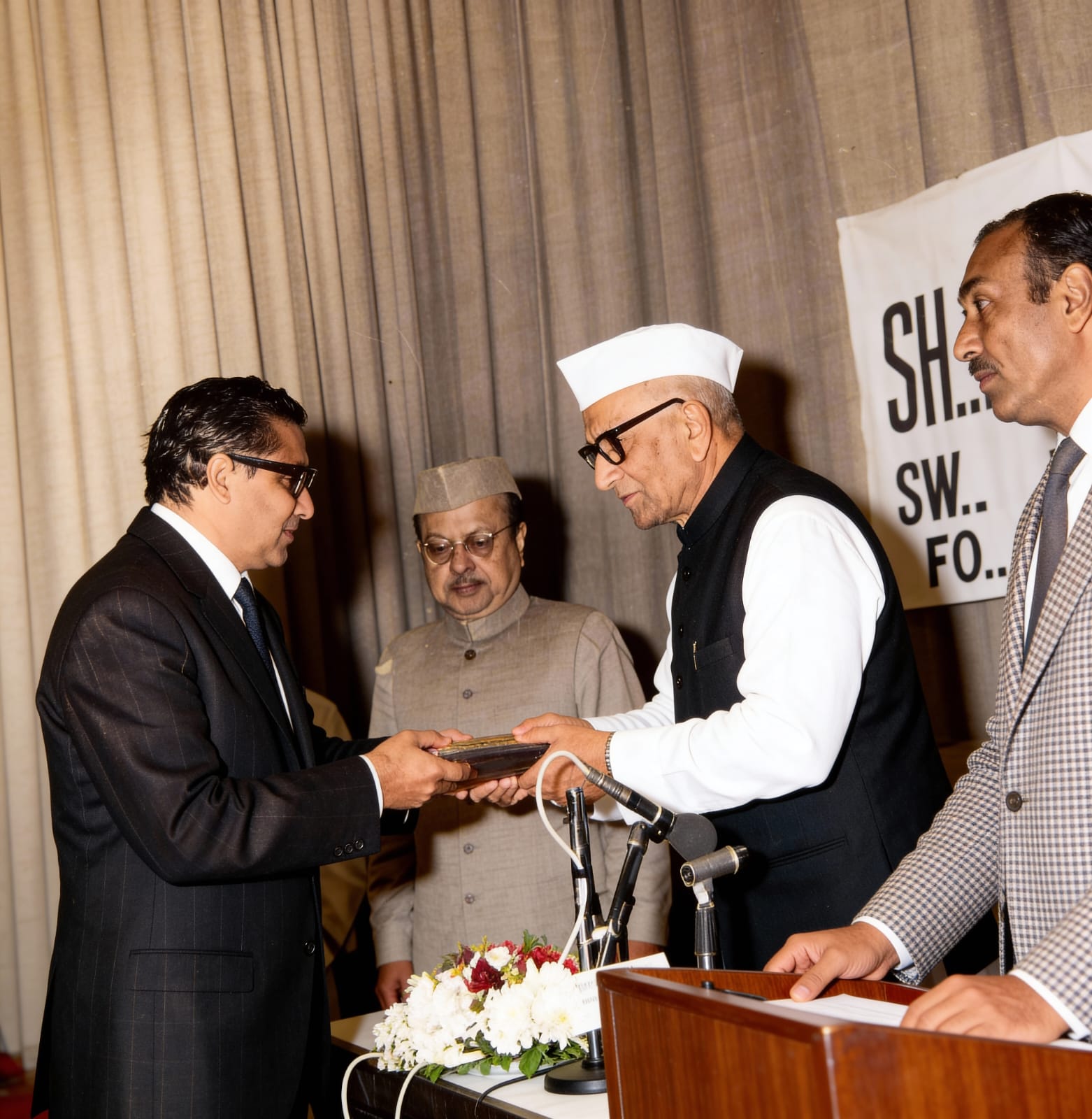
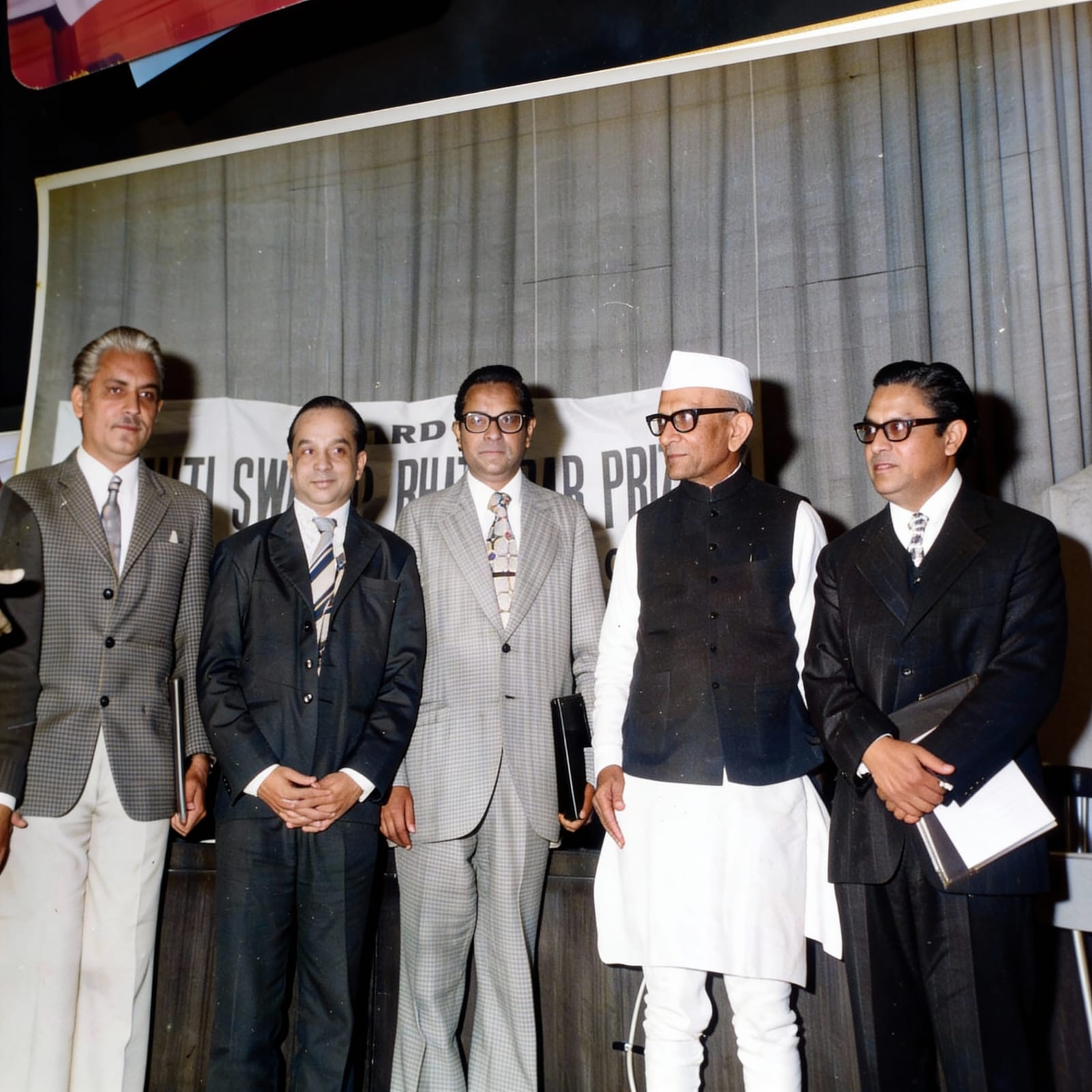
Receiving the Shanti Swarup Bhatnagar Prize from Prime Minister Morarji Desai (in 1977).
Pictures: the Rajaraman family collection, shared by Mrs. Dharma Rajaraman
699
Tributes from Undergraduate Students
When I think of Prof. V. Rajaraman, I don’t just remember a great mind or a towering figure in India’s scientific story. For all his achievements, what stays is the simplicity of his presence. His humility. His quiet dignity and the warmth that he offered to everyone around him.
I first met him in the seventies at IIT Kanpur. D. Murali Raju and I visited his home on Holi. He and his wife, Dharma, stood at the door, welcoming students with genuine affection. They even posed for a now-memorable photo with us and their gardener. There was never a sense of distance or grandeur, though he had already laid the foundations of what would become India’s computing revolution (picture appears on page 694). Nearly forty-five years later, we met again in Bengaluru. He was working on a book that traced the story of computing up to ChatGPT. His home was modest, but warm and welcoming, with his awards tucked away, his life a quiet testament to simple living and high achieving.
What I admired most was his deep sense of duty. At a time when he could have built a comfortable career in the U.S., he chose to return to India out of a quiet patriotism and a belief that his work belonged to the nation. He stayed above politics, dedicating himself to building institutions, nurturing talent, and imagining a future few could see. His contributions shaped India’s IT story—from establishing the first computer science program at IIT Kanpur, training the earliest teachers, designing the M.Tech, B.Tech, and MCA programs, to authoring textbooks that guided millions, to strengthening India’s supercomputing efforts.
These are the parts of him that settled into my memory. The feeling of being met with kindness. The feeling of being welcomed. The feeling of being seen. Not as a distant legend, but as a gentle light that touched so many lives. We have lost a remarkable human being. Yet his legacy lives on—in the institutions he built, the generations he taught, and every line of code written by those he inspired.
Shirish Joshi
BT, ChE, 1973-78, Distinguished Service Awardee, 2025
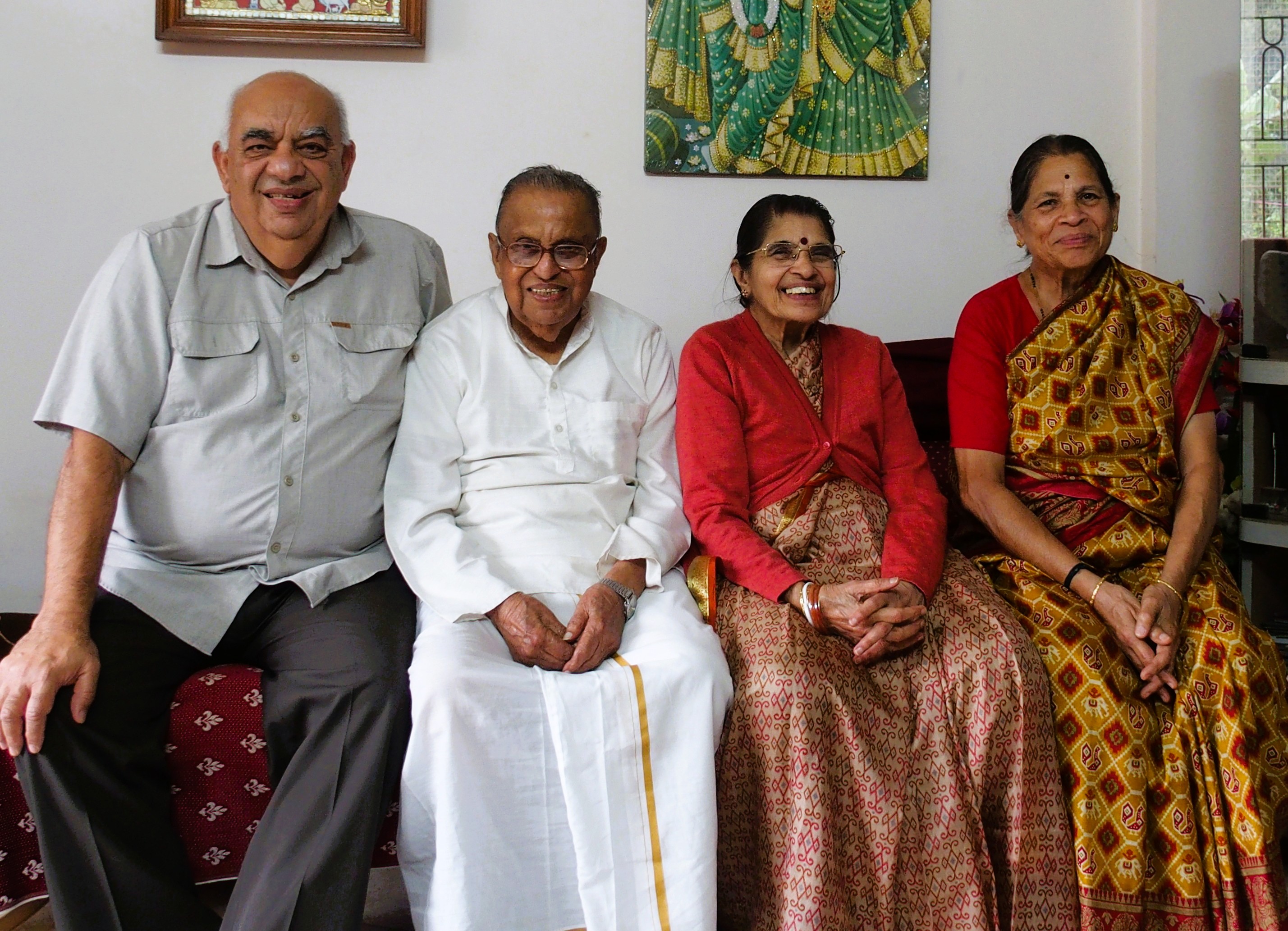
Shirish with Prof. and Mrs. Rajaraman and Mrs. Rajaraman’s sister, Vasantha. Bengaluru, Dec 2023
700
Prof. V. Rajaraman was my guide for my MTech project. He was always so inspiring, encouraging and reposing faith in you, that you could move mountains. He was prolific in disseminating well digested knowledge in classrooms and through his lucid textbooks. He gave us a balanced diet of all that is important for knowing the roots of Computer Science. We even had hands-on sessions with Analog Computers.
He remained a friend, guide and philosopher even later. When I was in Bangalore, I used to visit his house near IISc. His wife Dharma was ever so sweet and welcoming. She was his great companion in his success and made the nice sketches and diagrams which adorn his books. Even when I shifted to Mumbai, I couldn't resist calling him up now and then and was always greeted by his enthusiastic voice. It often turned out that both he and Mrs Rajaraman were working on some new book based on the latest developments.
He was always so modest that you would never realize that he has been awarded some of the top awards including the Padma Bhushan. He was more interested in what you were doing, what things you planned to do and took great satisfaction in the progress of his students.
I called their home after he died. I did not know whether Dharma would talk to me in this hour of grief and was overwhelmed when she not only came on the phone, but recognized me and asked me how I was doing. She was there with him holding hands during his last moments - this also is a divine grace.
Dear Prof Rajaraman, you will remain as one of the tallest leaders, giving direction and inspiring others to reach new heights. IITians, India and the world have lost a benign soul, who instinctively understood the essence of computing and had the flair of explaining it so lucidly that it would sink in like a fascinating story. He will remain alive in our minds and keep reminding us about how to lead a purposeful life which benefits others. I hope the central Govt, not just IITK, will name a building or an award after him, so that his memory remains "Amar" in the mind of future Science and Technology professionals in our country.
Mohan Tambe
BT, EE, 1975-80; MT, CS, 1982; Distinguished Alumnus, 2003
I graduated from IITK in 1981 with a B.Tech. in EE. Back at home a month later, I received a letter of admission to Stanford for an MS in CS, but no offer of financial aid, and that made Stanford impossible. Dr. Rajaraman – from whom I had never taken a class – somehow heard about my situation and unbeknownst to me, he wrote to Dr. Gio Wiederhold at Stanford. Dr. Wiederhold had been part of the original group of US faculty that came to set up IITK in the 1960s.
Within ten days – at a time when snail mail was the only option and letters typically took two weeks to cross the seas – I had an offer of financial aid in hand. And, Dr. Rajaraman never took a scrap of credit, either directly or indirectly, seemingly he never mentioned it to anyone. That October of ‘81, when I was roaming the corridors of Margaret Jacks Hall at Stanford in bewilderment, I stopped by Dr. Wiederhold’s paper-clogged office. After an energetic search through many piles, he produced the aerogramme letter that Dr. Rajaraman had written on my behalf with the demeanor of a magician. I wish I had thought to make a copy of the blue sheet of paper that changed my life. That’s my little story of a great educator, a true ‘guru’, and a wonderful human being.
Ratna Gupta Sarkar
BT, EE, 1976-81
Vice Provost for Institutional Research and Analytics, Johns Hopkins University
701
I first met Prof. Rajaraman in the summer of 1978 at IIT Kanpur, as I was choosing among more than sixty programs of study offered at the five IITs. Though IIT Delhi was geographically closer to my home, I ultimately chose Kanpur for one reason: Prof. Rajaraman convinced my father that the future of India depended on computer science, and he was right. So much of what we see in Digital India—IT outsourcing, Cashless Payment, Aadhaar—are possible because of the foundation he helped lay.
Prof. Rajaraman’s visionary work in computer science began in 1965 at the Indian Institute of Technology, Kanpur, where he gathered a remarkable group of scholars to build the CS program—not only at IITK but across the IITs, IISc, TIFR, and beyond. His dedication to excellence established a tradition that has profoundly influenced India and the world.
As a pioneer in CS education, he taught Programming Languages to many of us, authored the textbooks we studied, and shaped our early academic journeys. My BTech cohort of 1978 included just 18 students, many of whom would go on to graduate study in the US and UK—some, like Rajeev Motwani at Stanford and Google, became renowned in their fields. Hundreds have directly benefited from Prof. Rajaraman’s vision.
I was fortunate to learn from him at IIT Kanpur and later reconnect in 1986 at the University of Illinois Urbana-Champaign, where he fostered international collaborations for India’s supercomputing initiative (PARAM)—a catalyst for progress across government and industry.
Prof. Rajaraman deserves to be remembered as one of India’s great scientific pioneers, in the company of Vikram Sarabhai (space), Homi Bhabha (nuclear), and A.P.J. Abdul Kalam (rocketry). His legacy continues in every student and every innovation his work made possible.
Sanjeev Maddila
BT, CSE, 1978-83
WW Head of Supply Chain Solutions, Amazon Web Services
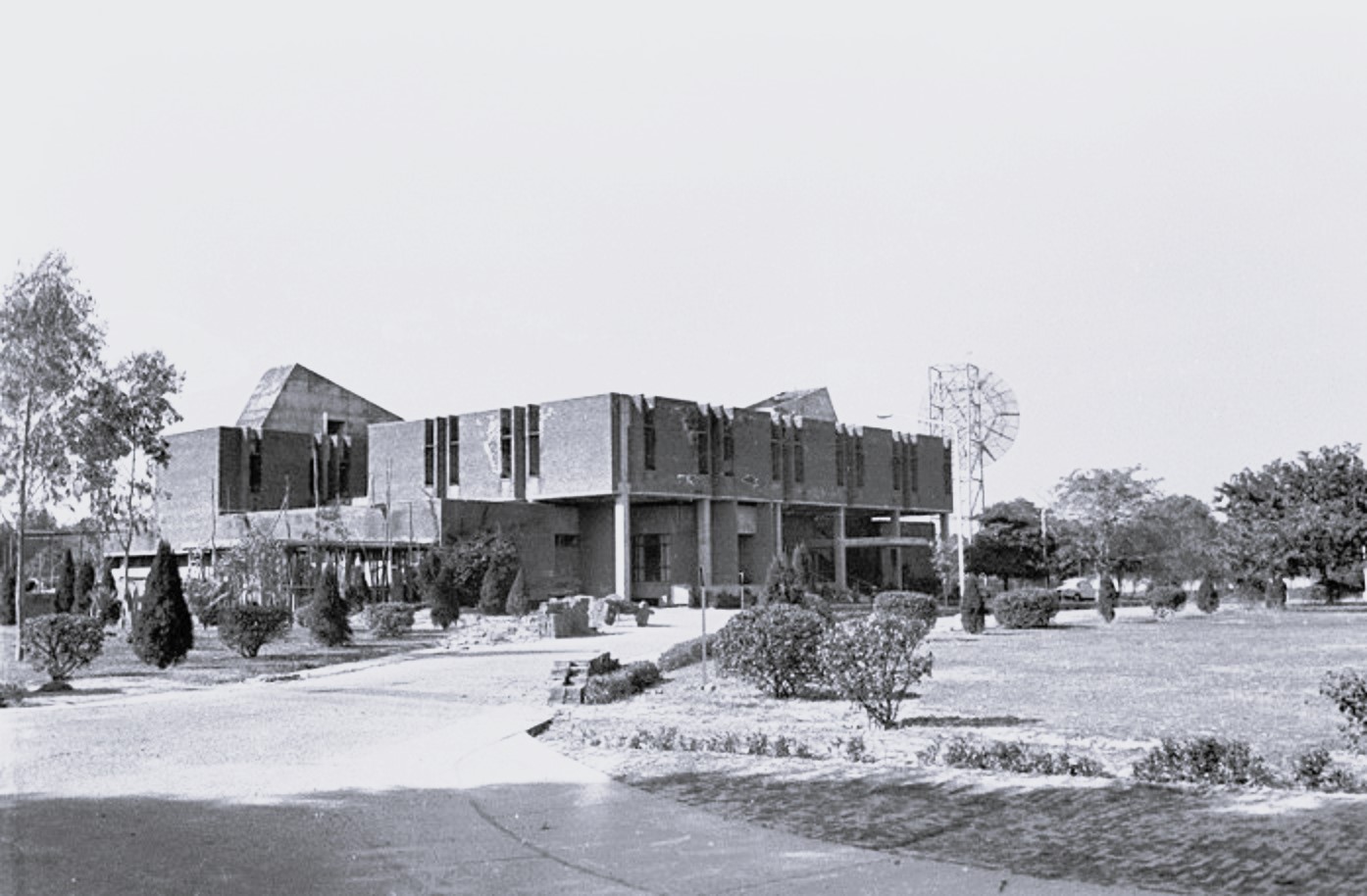
The IIT Kanpur Computer Centre, c.1977. Picture: Shirish Joshi
702
How Prof. Rajaraman shaped careers – a personal perspective
At a time and in an environment where parents often guided career choices, Computer Science was not my initial choice. Yet, as fate would have it, I joined IIT Kanpur as an undergrad in 1978 – the year we started the B.Tech. program in Computer Science. I met Prof. Rajaraman during counselling. My father, who worked at RDSO, Lucknow, knew him from an earlier visit to IITK. Prof. Rajaraman advised that I join CS, since it was the field of the future, but my father was not convinced, and I joined Mechanical Engineering. However, the vision Prof. Rajaraman had described of the future stayed with me.
Right from my first semester, I sensed incredible enthusiasm about this new field on the campus. It was the excitement of something new dawning, with everyone eagerly awaiting it. Our teachers and TAs, many of whom were Prof. Rajaraman’s students and mentees, were the force behind this; Prof. Rajaraman was the guiding light.
For my entire first year I kept questioning my decision not to join CS, with an ever-increasing sense that I had let go of a unique opportunity. I felt compelled to go over to have a conversation with Prof. Rajaraman. The first thing he did after listening to my anxious explanation of the situation was smile at me – a smile which all who have seen it know how calming it could be. He asked me about my grades and suggested that I apply for a branch change to computer science. He also said that no matter what field I studied, if I worked hard, I could have a positive impact on the future.
Then came the 3rd semester lottery where you could apply for a branch change, and if things worked out you could move to a branch of your choice. Things did work out for me, and I switched from Mechanical Engineering to Computer Science.
Being close to Prof. Rajaraman also brought me in touch with Mrs. Dharma Rajaraman. Her cheerful and helpful nature made all students feel at home. But what stuck with me was her work with the IITK Counselling Service. Although I had experienced the work of the Counselling Service as a fresher, she explained the larger purpose of the Service as ensuring the well-being of students. That opened my eyes to a new dimension of student life, and Counseling Service became my extra-curricular activity of choice. I started as a student guide, then became an Asst Coordinator, and in my final year, the Student Coordinator. Apart from being the best extra-curricular activity I could imagine, it also prepared me to become a better advisor to students when I became a professor, which has benefited my academic career.
I can certainly claim to be a double-CS major from IITK – in computer science and in counseling service. And for both it is the Rajaraman family that was the guiding light. The right guidance, the right questions asked, the right advice given – these can shape lives; and both Prof. Rajaraman and Mrs. Rajaraman helped shape mine!
Jaideep Srivastava
BT, CSE, 1978-83
Professor, Computer Science, University of Minnesota
Distinguished Visiting Professor, GSMST, IIT Kanpur
703
Memories of My Uncle, Professor V. Rajaraman
Rishiyur S. Nikhil (BT, EE, 1971-76)
CTO, Bluespec, Inc.
I knew Rajaram Uncle well, even though he was not an immediate uncle. His father, Shri Vaideswaran, was a cousin of one of my grandparents. In the early 1960s, the Vaideswaran family and my family were very close—part of the small but tightly knit and socially active Tamilian diaspora in Delhi, many of whom worked in various roles in the Government. The Vaideswarans’ daughter Usha and her family (“Mukkai Mama” and their three sons) also lived in Delhi, as did their other daughter, Radha, who I believe was a student there at the time. I was less than ten years old, but I remember them all with great fondness.
At that time, Rajaram Uncle himself was not in Delhi; he was in the United States completing his studies—an M.S. at MIT and a Ph.D. at the University of Wisconsin. I heard a great deal about him from his family. When he finished his Ph.D. and returned to Delhi, I met him for the first time. I have a hazy recollection of my father accompanying him to Kanpur, possibly to help him settle into the IIT Kanpur campus.
Shortly thereafter, I also have a memory of attending the wedding of Rajaram Uncle and Dharma Aunty in Chennai. In 1963 or 1964, my mother, my brother, and I went on a short vacation to Kanpur to stay with them on the IITK campus. They lived in quarters on the left side of the main road leading into IITK.
Vaideswaran Chittapa and Rajaram Uncle were both wonderful adults for us children—always good-humored, fun-loving, positive, and engaging. They had an old car (a Hindustan 14 or a Morris Minor) which we would take to Rawatpur, to refuel at a GT Road–side petrol bunk where the pump had to be hand-cranked.
IITK’s airstrip already existed at that time (1963–64), but there were no buildings or infrastructure around it—no control tower, hangars, or offices. Its sole use then was for an American professor (from KIAP, the Kanpur Indo-American Program) who would fly in on his personal Cessna or Piper from Delhi. Beside the airstrip was a small, roofless brick-walled enclosure where he parked his plane during visits.
Most of the time, the airstrip lay desolate and dusty. Vaideswaran Chittapa and Rajaram Uncle would take my brother and me there to “drag-race” up and down the runway—as much as one can drag-race in a Morris Minor!
IITK’s Central Library had not yet been built. The library collections were housed on slotted-iron shelves in one of the workshop buildings. Rajaram Uncle introduced my brother and me to the library staff so we could freely go in and out and browse magazines that appealed to scruffy-looking boys of our age: aero-modelling, aviation, railways, and so on.
My family moved to Bangalore in 1965, so I did not meet Rajaram Uncle and Dharma Aunty very often until 1971, when I graduated from high school. For several years I had been building simple electronic circuits—audio amplifiers, medium-wave radios, radio-control units for aero-models—and I had set my sights on studying Electronics at IITK, which had the best reputation for the subject. Fortunately, my JEE rank allowed me to squeak into the program.
704
I traveled to IITK with my brilliant high school classmate A. Uday Shankar (later a long-time Professor at the University of Maryland). The journey was not easy: Bangalore–Chennai, Chennai–Delhi, and Delhi–Kanpur by train. Exhausted upon arrival in Kanpur, we made a beeline for Rajaram Uncle and Dharma Aunty’s home for hot baths, a delicious meal, and much-needed rest. By then they had moved to quarters on the right side of the main road entering IITK. Later that day, Rajaram Uncle dropped us off at the entrance of Hall II so we could check into our rooms.
During my five years at IITK, I visited Rajaram Uncle and Dharma Aunty frequently for a very welcome home-cooked meal and warm conversation.
In my final year, Prof. Rajaraman was the undergraduate project guide for my brilliant project partner, Niraj Kumar Jain (long a distinguished engineer in Silicon Valley), and me. Under his guidance, we built an early networking device: a communication link between the IITK Computer Center’s IBM 1800 and the DEC PDP-1. I might still have a copy of that project report in the attic! Since Niraj and I had the run of the Computer Center, we were fortunate to type our report on the CC’s IBM Selectric—one of the few electric typewriters on campus.
In the 1980s, Rajaram Uncle moved to the Indian Institute of Science in Bangalore, where he remained for the rest of his career. In 1987, I was an Assistant Professor at MIT, working with my brilliant and beloved colleague Professor Arvind (also an IITK graduate, Class of 1969). We taught a one-week summer course at MIT on Dataflow Architectures and Functional Programming, and Prof. Rajaraman invited us to teach the course at IISc. We did so in 1987, staying in the IISc Guest House. Prof. Rajaraman also sat in on the course. He took us on a tour of the IISc Computer Center—back when all computers lived in glass-enclosed ‘Computer Centers’—and I remember all of us removing our shoes in the foyer as a dust-mitigation measure.
In subsequent years, several IISc students of Prof. Rajaraman spent time with us in our MIT research group in Cambridge, Massachusetts.
My most recent recollections of Rajaram Uncle and Dharma Aunty are from visiting them a couple of times in their home in the 2000s. My parents were again living in Bangalore, and I was making frequent work-related trips there. We would visit them during those trips, and naturally, each visit included a wonderful meal prepared by Dharma Aunty.
Rajaram Uncle and Dharma Aunty always created a joyful, positive atmosphere around them. In my grandmother’s house in Chennai (through whom I am related to Rajaram Uncle), the glass lintel window above the entrance door bore a Sanskrit slogan: Prasannavadanamadhyayeth, which loosely translates to “Keep Smiling.” Rajaram Uncle and Dharma Aunty were always embodiments of that wonderful ethos.
About the author:
Rishiyur Nikhil received his B. Tech in Electrical Engineering from IITK in 1976, went on to get a PhD in Computer and Information Science from the University of Pennsylvania in 1984, and then taught at MIT for several years. Currently based in Boston, MA, he is the Chief Technology Officer for Bluespec, Inc, a semiconductor tool design company that he co-founded with Professor Arvind (also of MIT and IITK fame). During his years on the campus, Nikhil was an active member of the TVC and the Western Music Clubs. He served as Editor of the Spark in 1975-76.
705
The Golden Jubilee Celebration, 2010
In August 2009, the Golden Jubilee celebration of IITK was inaugurated by alumnus N. R. Narayana Murthy, founder of Infosys. IITK organised several academic, cultural, and sports events throughout the year. The CSE Department celebrated with a special event in 2010 that included professors who founded and grew the department in its early years. The event was marked by pleasant memories, nostalgia, a renewed sense of attachment, pride in the achievements of the past, and hopes for an ever- brighter future for the department and the institute.
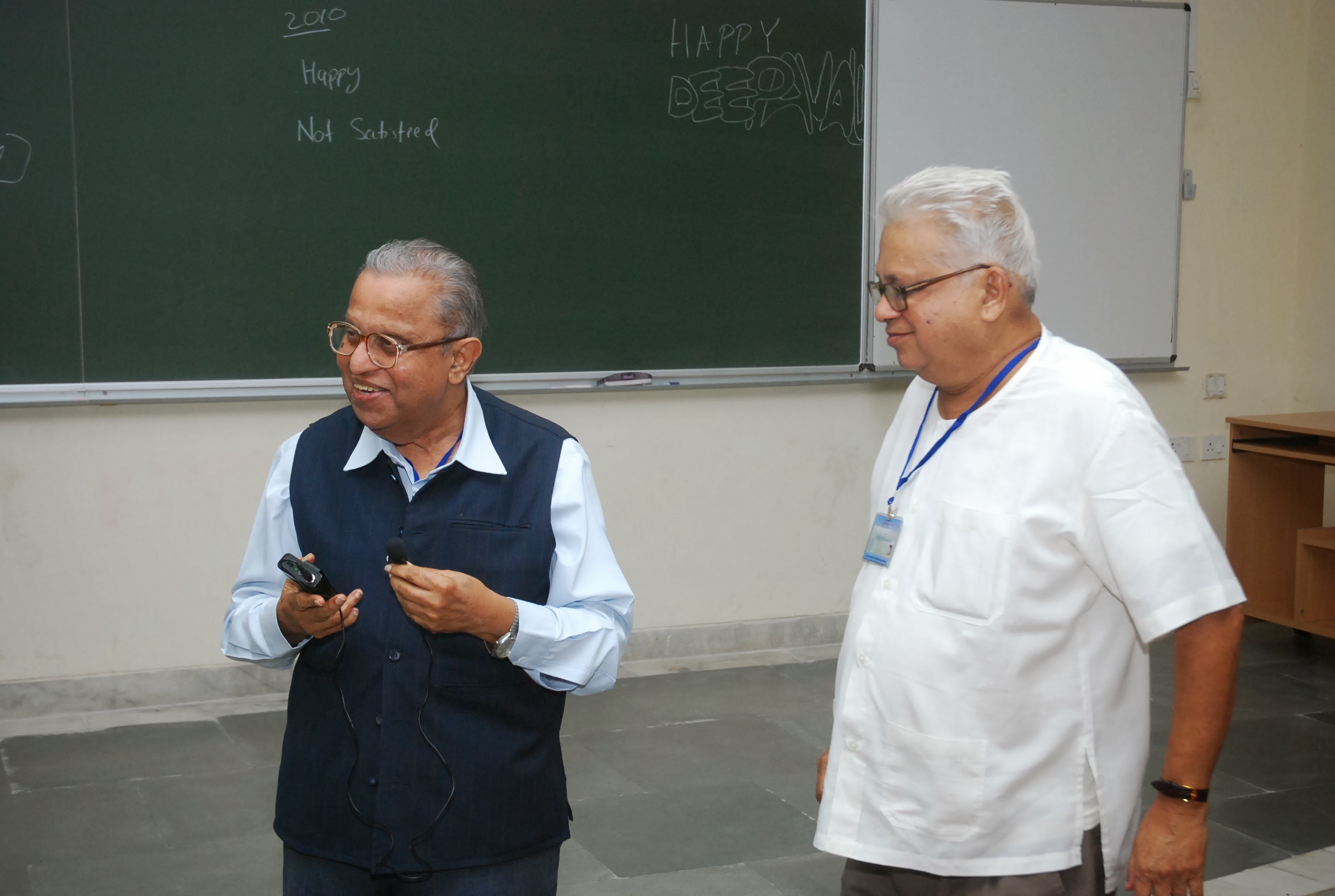
Professors Rajaraman and Mahabala, back again at IITK
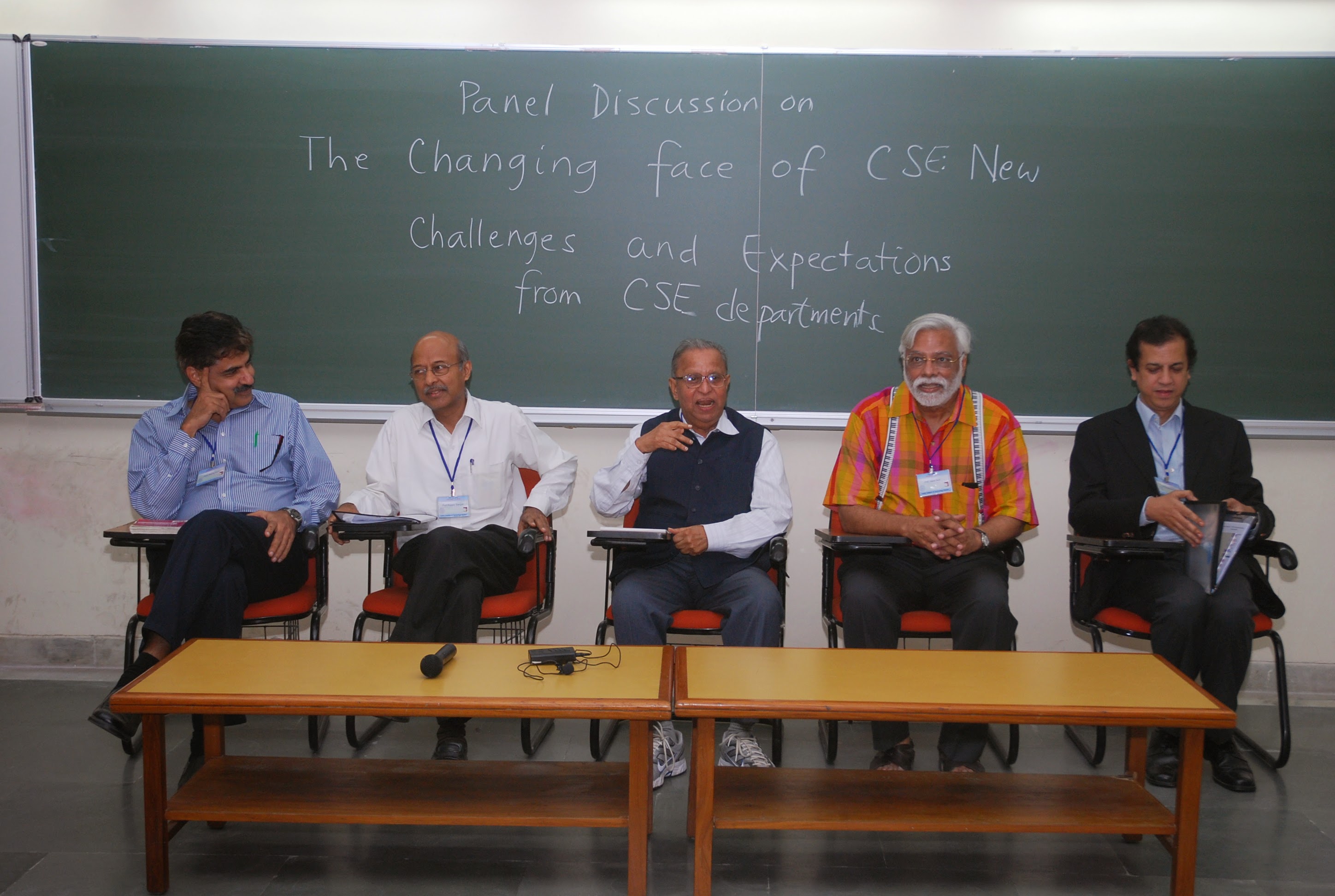
A panel discussion on the changing face of Computer Science. Visible are former IITK Professors (L to R): Pankaj Jalote (later Director IIIT, Delhi), Rajiv Sangal (later Director of IIIT, Hyderabad), V. Rajaraman, Kesav Nori (later Head R&D, TCS), and Gautam Barua (later Director IIT Guwahati). Pictures: IITK CSE archives
706
The IISc Bangalore Years
1982-1994
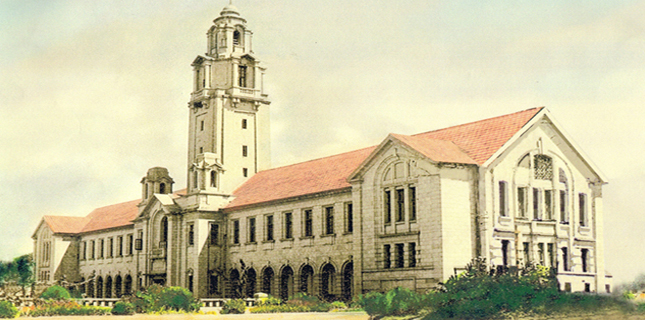
In 1982, Prof. Rajaraman moved to Indian Institute of Science, Bangalore, where he developed low-cost parallel computers and established a supercomputing facility of which he served as chairman until 1994.
He was a council member of the Indian National Science Academy (INSA) from 1986 to 1988 and also served as a consultant to Bharat Electronics (BEL), TCS, Electronics Corporation of India Limited (ECIL), Steel Authority of India Limited (SAIL) and Kerala Venture Capital. He chaired a committee set up by the Science Advisory Council to the Prime Minister in 1987 that recommended establishing the Centre for the Development of Advanced Computing (CDAC) to design and develop supercomputers in India using parallel computing technology. He was a member of CDAC's governing council in its formative years. He was TataChem professor at IISc from 1991 to 1994 and the IBM Professor of Information Technology at Jawaharlal Nehru Centre for Advanced Scientific Research (JNCAR) from 1994 to 2001. (Wikipedia)
This section of this issue includes tributes from some of his students and colleagues from these years.
707
Prof. V. Rajaraman: In Memoriam
Jayant Haritsa
Professor, Computer Science, IISc Bangalore (1990-present)
I first met Prof. Rajaraman in the early 1990s when I was contemplating my return from the US to India, as a freshly minted PhD in Computer Science. I was hoping to land a job in a premier academic institution, so with a begging bowl in one hand and a resume in the other, I had done the circuit of the IITs, and my last stop was at IISc. Despite Bangalore being my hometown, I had known little about IISc, with the only connection being that my father had been a student there in the mid-1950s. However, to my pleasant surprise, my father told me that he knew Prof. Rajaraman well since they had been classmates at IISc. Of course, I had also known of him thanks to his famous Fortran textbook, from which we first learnt computer programming during my undergraduate days at IIT Madras, but I had never seen him in person.
What struck me in my first (interview) meeting with Prof. Rajaraman was his utter simplicity – despite his legendary status of which I was in awe, he was extremely affable to me, a young neophyte in the field. I initially thought it might be due to my father’s presence, but then later came to realize that it was a fundamental character trait, where he was uniformly courteous to one and all, irrespective of station or age. When I expressed my desire to return soon to India, he was understandably sceptical since this was rather uncommon in those days. But after I told him that I took inspiration from his own return in the early 60s, and the fact that we shared a common PhD alma mater – the University of Wisconsin-Madison, he took me more seriously. I had been warned that Indian academic institutions took several months to make decisions, but to my amazement, Prof. Rajaraman sent me an offer letter within two weeks of my interview – apparently all he had to do was call up Prof CNR Rao, the then IISc director who completely trusted Prof. Rajaraman’s judgement, and the decision was made!
I joined SERC (Supercomputer Education & Research Center) in 1992 on a day that coincided with Ayudha Pooja, so he invited me to walk along with him and visit all the ancillary units related to SERC, including the power station and the backup facilities. I saw that he greeted all the staff members with the same warmth and affection that he showed his faculty. When we finally entered the SERC building, he signed in the entry register at the security desk – I was taken aback, given that he had founded the center and was still its Chairman. I could not help expressing my wonder to which he responded that the rules applied to everybody and he was no exception!
708
Many people have written and spoken about how they had never seen him angry, and this is largely true. But I experienced one such occasion where he was rather cross with me! The situation was that I had requested him to give a keynote talk in a local symposium and he had graciously agreed – I then told him that I would send a car to bring him to the venue. He was annoyed and said “What, you think I can’t drive myself? I don’t need any car to pick me up.” Subsequently, when he came to the venue, having not yet learned from my earlier mistake, I offered to connect his laptop to the AV system. He took a stern look at me and said – “A computer scientist who cannot connect his own equipment does not deserve to be called a computer scientist” and promptly went ahead and set it up himself. Moreover, as was his wont, he had come fifteen minutes early, so he went to the front row, seated himself, and then said “Jayant, I am ready to present whenever you give me the green signal”. This incident showcases how he never expected, or even liked, special VIP treatment – he was simply a professional to the core, quietly going about his business, sans fuss or frills.
It is, of course, common knowledge that Prof. Rajaraman was the author of two dozen pedagogical books covering the gamut of Computer Science, including computer organization, programming languages, information systems, parallel computing, supercomputing, and the history of computing. But what is not so well-known is that he used to ask subject experts to review his chapters in the draft version. I myself did so for a couple of the books where database systems made an appearance. The first time he asked me to review, I was hesitant, given his Olympian position, to point out a few technical issues. But in the end, I went ahead and did so, trying to couch my concerns diplomatically, but fully expecting that I may get an earful in return. To my very pleasant surprise, almost immediately I got a response from Prof. Rajaraman thanking me for the comments and saying that he would incorporate the corrections in the final version – in fact, he explicitly encouraged me not to be shy but state my mind fearlessly since he had recognized my misgivings from the tenor of the review. It was this complete lack of ego, perhaps an outcome of his Gandhian training during his formative years, that put him in a class apart from many other great scientists.
Finally, I had the honor of being associated with what turned out to be his last public speech in June 2025. I happened to be giving a lecture on relational database systems to a school audience at NCERT in Delhi, and the organizers requested Prof. Rajaraman to provide the introduction. I thought he might say a few perfunctory lines about the subject and me. But to my amazement, even at the age of 92, he had done his homework and gave a singularly apt ten-minute introduction to the field – in fact, I got worried that the audience would find me an anti-climax after such a cogent presentation! This was yet another hallmark of Prof. Rajaraman’s persona – the attention to detail, the insistence on preparation, doing nothing casually or on the fly but only after due diligence had been exercised.
The Indian computing fraternity in general, and IISc in particular, owes an incalculable debt of gratitude to Prof. V Rajaraman, an inspirational educator and venerated scientist who embodied the motto of "simple living, high thinking" – the best way for us to honor his memory is to imbibe and follow those same ideals.
About the author:
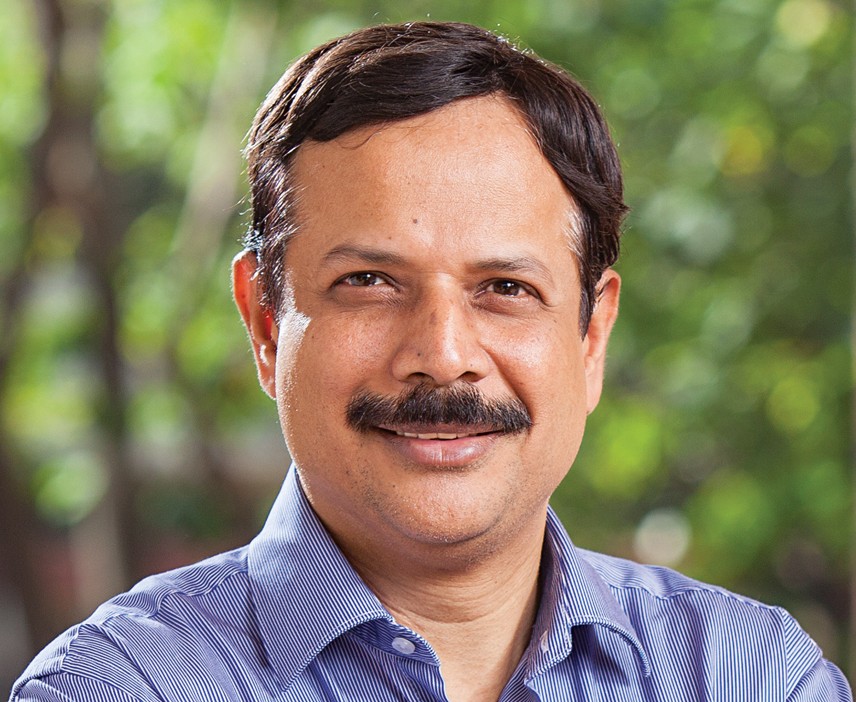
Jayant R. Haritsa is a professor on the faculty of the CDS and CSA departments at the Indian Institute of Science, Bangalore. He works on the design and analysis of Database Systems. In 2009 he received the Shanti Swarup Bhatnagar Prize sponsored by CSIR, India, and in 2014 he received the Infosys Prize for Engineering.
709
My Memories of Prof. Rajaraman
H Krishnamurthy
Chief Research Scientist (Retired), IISc, Bangalore
After completing my ME in Aerospace Engineering from IISc I worked in DRDL Hyderabad and taught at REC Warangal until 1983, and then returned to IISc, working as a Scientist in the “Reliability and Fault Diagnosis of Large Complex Systems” Project until March 1987. Prof VR was then the Chair of the Computer Centre in IISc and was establishing the Supercomputer Education and Research Centre (SERC). My first meeting with him was memorable; I did not have a CS background, but he said, “I have taken the responsibility of setting up the High-Performance Computing Facility and want you to work on this challenging initiative full time, and you will directly report to me.” He articulated his vision and the road map for the next five years; I gladly accepted the assignment and worked as his trusted lieutenant during his tenure as the Chair of SERC. He had more trust and confidence in my capabilities than I did myself!
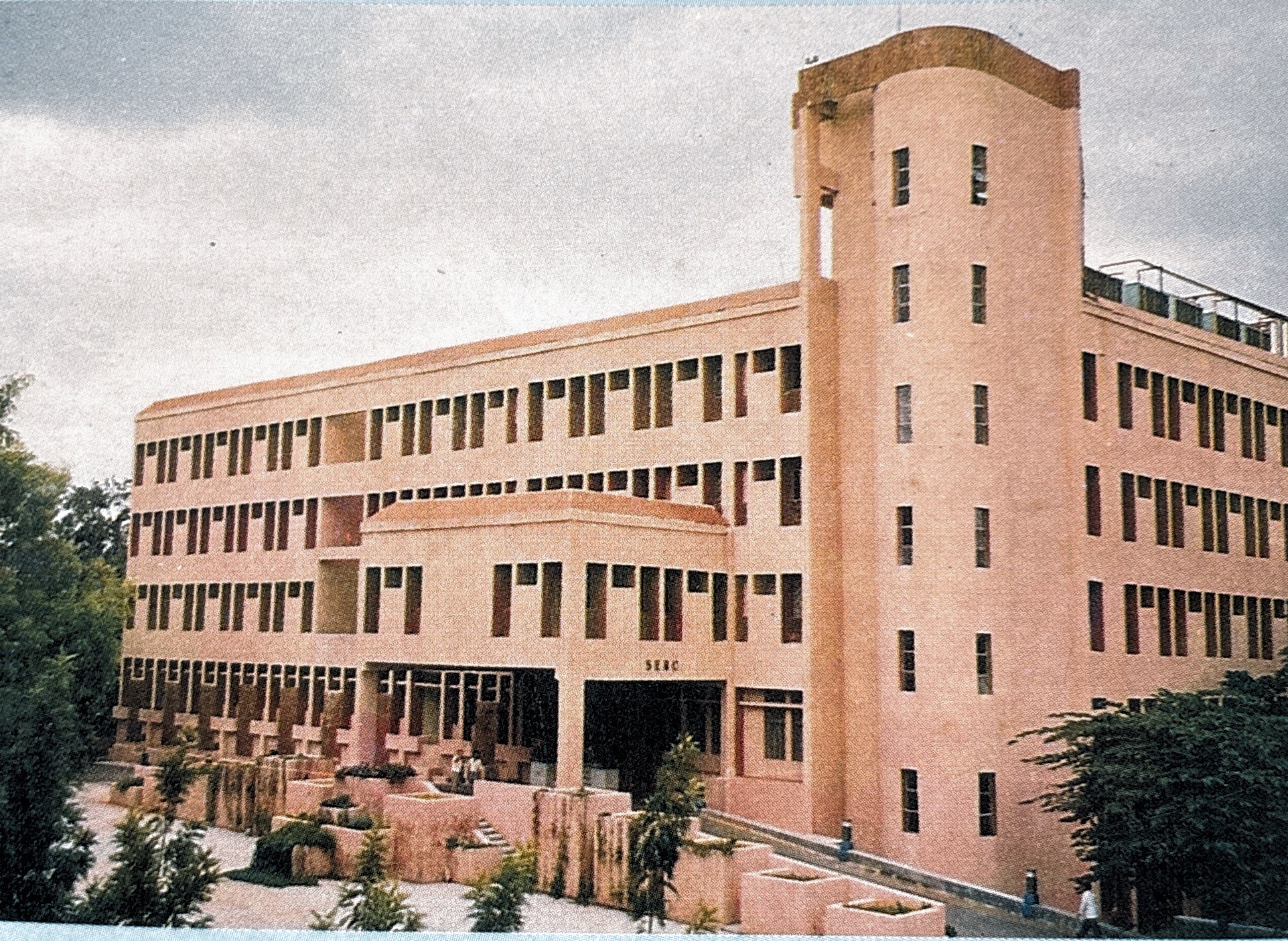
The SERC Facility at IISC Bangalore
We faced several challenges while building the infrastructure to host the High-Performance Computing Systems, with enormous delays. But he remained cool, calm and composed; it was a great learning experience to work with him during that period. He led many national initiatives, managing each one admirably. From him, I have learnt technology project management and developed a passion for nation building initiatives on a large scale, gaining enormous confidence. SERC was governed by a National Committee headed by Prof CNR Rao with Prof VR as the member secretary. For one of the meetings scheduled in SERC I wanted to excuse myself and I applied for leave on that day. But I cancelled my leave plans when he said “HK, I have not taken any decision in this project without discussing with you. Please attend the meeting, if possible.” Prof Rao was a member of the Planning Commission and wanted us to meet the Ministry Officials and explain the justification for the funding for one of the front-end computing systems. Prof VR mentioned to Prof Rao that I was best suited to handle that discussion as I was fully aware of all the details and therefore should go instead of him. I attended the meeting in MHRD and provided the inputs and the justification, and necessary funding was made available to the Institute.
710
Prof VR was a patient listener, and made you feel comfortable in all the discussions so that you could express your point of view very openly. It was a great privilege for me to be closely associated with him, and this learning experience has significantly helped me in the rest of my professional career.
Subsequent to our establishing the facility for HPC Systems (in the current context Data Centre) Prof VR encouraged me to support other such Government initiatives, and I became involved with NAL, CMMACS, IICT, National Supercomputing Mission, etc., in an advisory capacity.
The next major initiative of SERC was to build a state-of-the-art campus network environment. As I did not have the background and necessary expertise, Prof VR was not convinced initially that I could handle this initiative. But with the support of Prof Anurag Kumar, a student of Prof VR in IITK, and colleagues from ECE, I was able to handle this project and more importantly convince Prof VR that I can pull it through. Looking back, this opportunity gave me a very good insight into designing and implementing large complex networks.
Prof VR retired from IISc in 1994 and was very active for the next 30 years. I remained in touch with him, and every meeting was a learning experience. His words of wisdom and his appreciation of good work, as well as the enthusiasm to learn emerging technologies and explain the same in a simple and lucid manner through his books has benefitted millions of students across the country. We all miss him and his wise counsel dearly.
Prof VR and Madam Dharma Rajaraman attended my felicitation at SERC (as a Chief Research Scientist) on my retirement day (31st July 2017) and he mentioned that I had been his right hand in SERC, IISc. This was the greatest compliment I have received in my professional life. I am at a loss for words to thank him for all that he has done for me. I pray the Almighty give strength to Madam to bear this loss. Madam has devoted her life to be of great support to Prof VR and he could not have achieved all the glory and recognition without her unstinted support.
About the author:
Prof. H. Krishnamurthy served the Indian Institute of Science for more than three decades and Retired as a Chief Research Scientist in 2017. His focus areas are Networks and Security in particular and Banking Technologies in General. He serves as Chairman/Member of several technology initiatives of RBI, SEBI, IRDAI and PFRDA. He is on the Boards of Insurance Information Bureau (IIB) and Institute of Insurance and Risk Management (IIRM). He has served on the Boards of Indian Institute of Banking and Finance (IIBF), IDRBT and Canara Bank in the past.
711
A Tribute to Prof. Rajaraman
Ramaswamy Govindarajan
Professor, Electrical, Electronics and Computer Sciences, IISc, Bangalore
Prof. Rajaraman was a true national icon of Computer Science and was affectionately regarded as the Pitamah (founding father) of the field. I was an undergraduate student when he joined IISc. I benefited from his Pascal programming course in my second year and continued to use it for another 5+ years, till I finished my Ph.D. Many of his books, including the one on Computer Fundamentals, ensured my transition from an electronics background to computer science was smooth. I was fortunate to attend his research course on “Fifth Generation Computer Systems”. Through his projects and professional networks, he brought eminent researchers from the USA and Europe to give lectures and tutorials in our department. We, the graduate students, benefited immensely from these lectures and were greatly inspired by them.
I was the last faculty member appointed at the Supercomputer Education and Research Centre (SERC) during his tenure as Chair. Ten years later, I had the privilege of succeeding him as the Chair of SERC. It was then that I truly recognized and appreciated his contributions to SERC.
Rolling back to 1982, on the invitation of Prof. Ramaseshan, Prof. Rajaraman joined IISc as a professor and Chair of the then Computer Centre. The Computer Centre acted as a facility providing computing resources for researchers across key fundamental science and engineering departments. Prof. Rajaraman spearheaded a committee with the mission to establish a supercomputing centre at IISc, eventually funded by the Ministry of Human Research Development, Government of India. His visionary planning in setting up the infrastructure for the Supercomputer Centre (including Electrical and Air Conditioning facilities), the introduction of 1-year trainee programs to produce human resources to operate the Centre, and the development of a home-grown online reservation systems to enhance smooth access to facilities quickly transformed the centre as the nucleus of cross-disciplinary research. He was instrumental in coming up with the blueprint of a modern supercomputing centre consisting of distributed supercomputing systems. The facilities established and the trainee programs started by him continued to serve and meet the requirements of the centre for more than two decades – a testament to his visionary planning!
In addition to the Computer Centre’s role as a facility centre (till ~1989), Prof. Rajaraman initiated various research activities and transformed it into an education and research centre. He was instrumental in starting two major projects (and associated centres): (i) Computer Aided Design Centre funded by Department of Electronics (DoE), Government of India and United Nations Development Programme (UNDP) in 1984 to carry out research and development in the area of Very Large Scale Integration (VLSI); and (ii) Knowledge-Based Computing System (KBCS), funded by UNDP and DoE, in 1986. Both these programs created a pool of scientists and researchers who have served in various capacities. In addition, Prof. Rajaraman started research programs (M.Sc [Engg] and PhD) in 1988 and inducted academic faculty in SERC. Through these efforts, he elevated the facility centre to an academic department, culminating in the Computer Centre being renamed as Supercomputer Education and Research Centre (SERC) in 1990.
712
In all my interactions with him, what struck me most about Prof. Rajaraman, was his simplicity. Despite his tremendous accomplishments, he never projected an imposing aura; he always made those around him feel comfortable and valued. Equally admirable were his remarkable discipline and deep commitment—qualities he continued to embody even at the age of 90. These are truly qualities from which we all have much to learn. I was fortunate to witness this firsthand when he sought my inputs on his books “Breakthroughs in Information and Communication Technologies” and “Anecdotes from the History of Modern Computing”. It is remarkable to note that he continued to actively write and revise his books until 2024, with the same level of enthusiasm and discipline as he did in the prime of his career.
Prof. Rajaraman will remain a role model for generations of computer scientists to come, who will continue to benefit from his many influential books. I consider myself extremely fortunate to have known and interacted with him for over four decades.
About the author:
Ramaswamy Govindarajan received his B.Sc. degree in Mathematics from Madras University, and B.E. and Ph.D. (Computer Science) degrees from the Indian Institute of Science, Bangalore. He has held postdoctoral research positions and visiting faculty positions at Universities in USA and Canada. Since 1995, he has been with the Supercomputer Education and Research Centre and the Department of Computer Science and Automation, IISc, Bangalore.
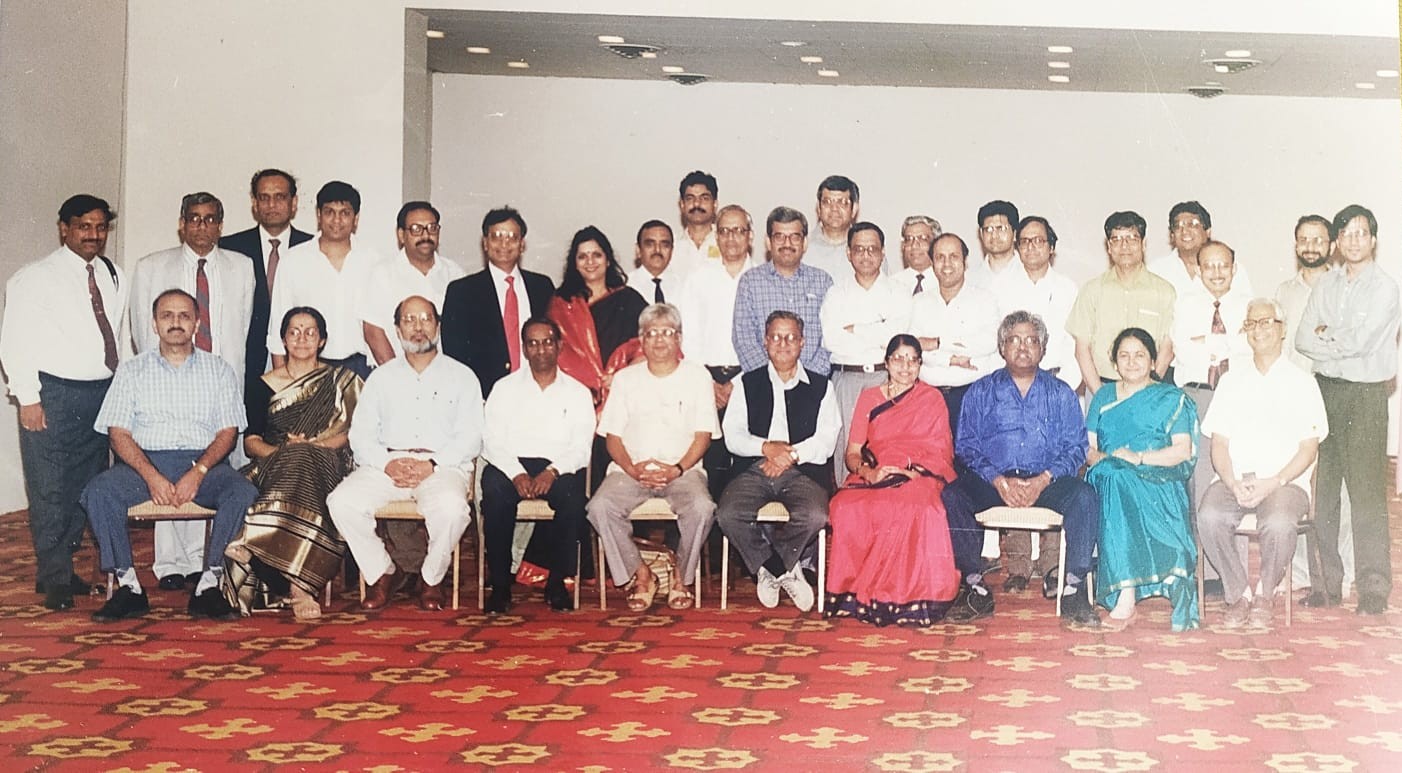
A symposium organized by the Supercomputer Users Research Centre at IISc, 1994, and attended by the who’s-who of India’s IT community. Seated in the front row are: Profs. Sartaj Sahni, Mrs. Gita Mithal, Arvind, T Radhakrishnan, Mahabala, Rajaraman, Mrs. Rajaraman, TR Viswanathan, TL Viswanathan and HV Sahasrabuddhe
713
I am deeply saddened by the sudden passing of my PhD supervisor, Professor V. Rajaraman. I remain eternally grateful for his continuous guidance and encouragement—not only during my doctoral studies (1984–1988), but throughout the three and a half decades of my academic career at IIT Madras. He was truly a father-like figure to me.
He inspired and guided me in writing high-quality computer science textbooks. For many years, I taught the Parallel Computing course to students at IIT Madras and, more recently, at IIT Hyderabad, using the textbook Parallel Computers: Architecture and Programming (Editions 1 and 2), which we co-authored. Working closely with him on this project taught me that writing a textbook requires not only deep expertise but also tremendous dedication.
As a teaching assistant for his Computer Organization course, I attended all his classes for one semester. He was an exceptional classroom teacher—clear, patient, and inspiring. Over his long and distinguished career, he supported and uplifted hundreds of students and colleagues. He was a devoted supervisor and a valued mentor to all who had the privilege of learning from him.
Prof. Rajaraman will be remembered for his vast knowledge across all areas of computing, his pioneering contributions to computer science education in India, and his remarkable humility. His passing is a profound loss to the computer science community.
C. Siva Ram Murthy
Honorary Professor of Computer Science, IIT Hyderabad
Professor Rajaraman’s associations extended well beyond IITK and IISc. He had a significant association with the Computer Society of India, being one of its earliest members, an elected Fellow and received the Lifetime Achievement Award for his fundamental work in Indian computer science education, policy making and supercomputing. (CSI was originally called the ‘All India Computer User's Group’, and started at IITK in 1964).
Swarnalatha Rao
Former Professor and Head, CSE, MVJ College of Engineering; Fellow, Computer Society of India
Prof. Rajaraman was the examiner for my Ph.D. thesis, titled "Language-Based Problem Solving," which I completed in 1969. His critical evaluation and insight into that work left a deep impression on me. Over the years, our association deepened through the Knowledge-Based Computer Systems project and his generous support at key moments in my professional journey. He was a referee for several of the awards I have been fortunate to receive, and he served on the Board of Advisors when I played a key role in starting up HP Labs India.
His books and writings have educated and inspired me over several decades. His example as a scholar and mentor has left a lasting impression on me, and I continue to be guided by his work and the values he embodied.
Srinivasan Ramani
Founding Director, National Centre for Software Technology
Inductee, Internet Hall of Fame, 2014
714
Padma Bhushan, 1998
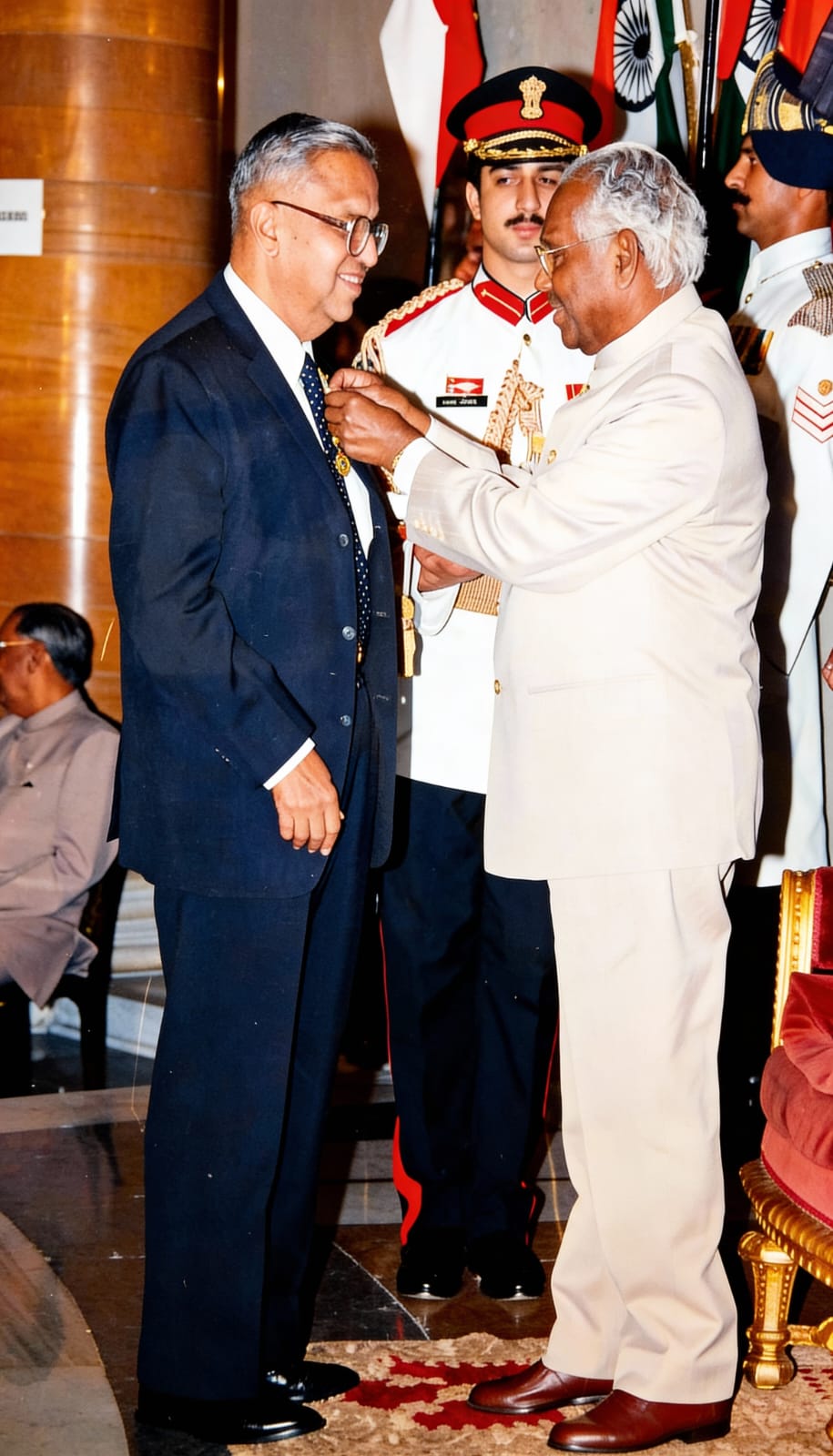
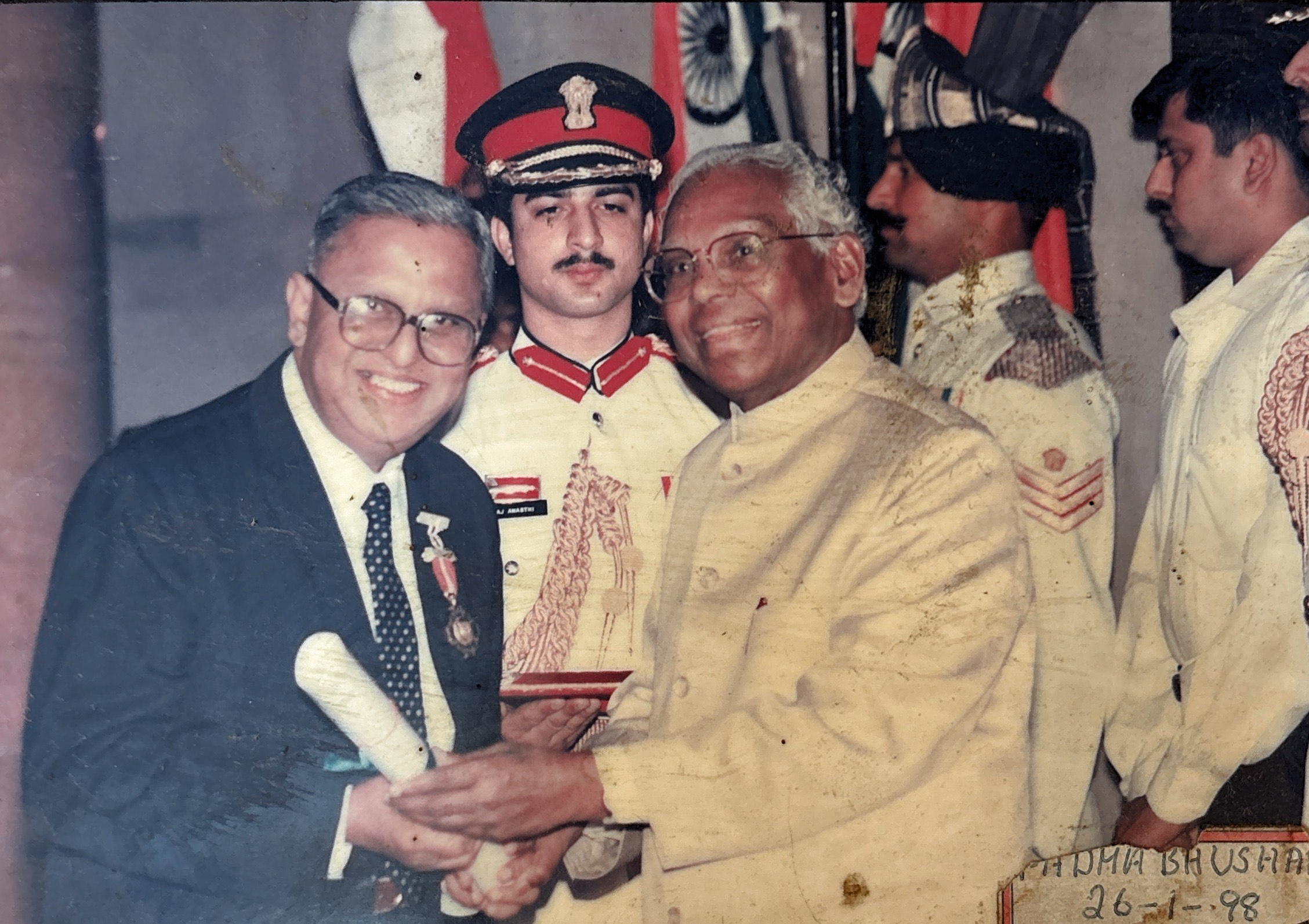
The Government of India awarded Prof Rajaraman the third highest civilian honour of the Padma Bhushan, in 1998, for his contributions to science. The images show President KR Narayanan presenting the award in 1998
715
A Prolific Author
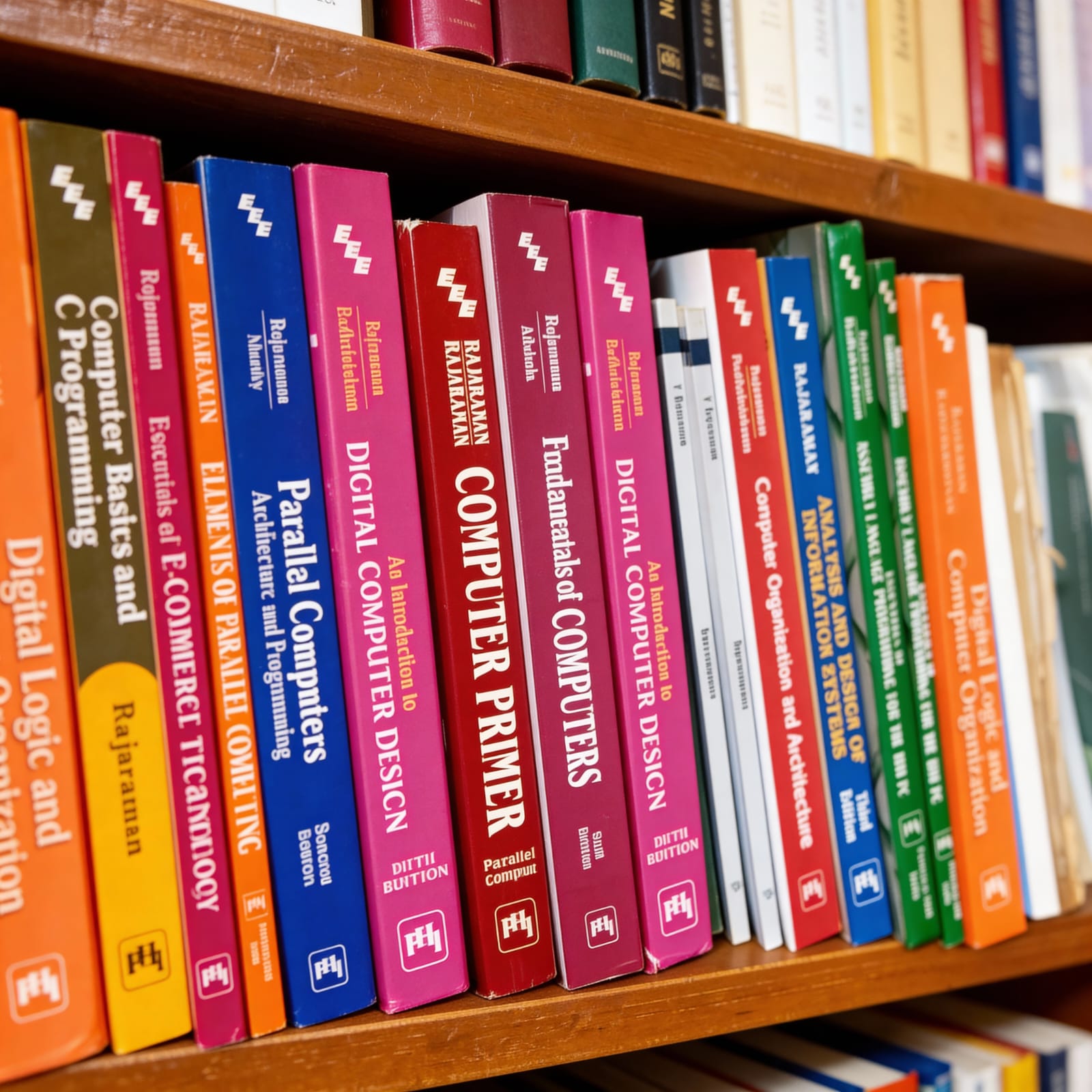
Professor V. Rajaraman was a prolific author who wrote numerous, highly successful textbooks and foundational books on computers, programming, and information technology. These books have been used by generations of students and have pioneered the computer science curriculum in India.
He continued to write up to his very last days with Anecdotes from the History of Modern Computing being released in June 2024. All his books were published by PHI Learning (Prentice Hall) as Eastern Economy Editions, making them affordable for young students.
716
Remembering Our Best-Selling Author, Prof. V. Rajaraman
PHI Learning
We at PHI Learning are deeply saddened by the passing of Professor V. Rajaraman, one of India’s most distinguished pioneers of computer science education and a cherished long-time author with our publishing house. His association with PHI Learning spans five decades, during which his textbooks became foundational learning resources for countless students and educators across the country. He was not only an author for us but a precious member of the PHI Family.
Professor Rajaraman’s remarkable clarity of expression, his passion for teaching, and his dedication to strengthening computer science education in India have left an indelible mark on generations of learners. His meticulously crafted books, published by PHI Learning, not only set benchmarks in technical writing but also served as guiding lights for those entering the world of computing. Most of today’s IT professionals grew up reading and learning from his books. Hence, the author-publisher duo sparked interest in computing in India in the early days, when there was no literature available to our youth in this area. They worked together to keep the book priced as low as possible so that it would not become a barrier to disseminating computer science knowledge, which was essential at the time. The books, authored by Professor Rajaraman, continue to inspire and influence academic thought, reflecting his exceptional scholarship and commitment.
At IIT Kanpur Prof. Rajaraman conducted short-term courses in FORTRAN, the first successful and widely used, commercially available high-level programming language developed by a team at IBM and released in 1957. The notes prepared by him during the course or teaching students in regular classes were printed as a booklet and were later published and marketed by PHI only at ₹15, to make it economical and affordable for the students and academia in the country. This book not only proved successful but also played a crucial role in founding computer education in India and making our students confident in the course. Inspired by this success, Prof. Rajaraman later wrote several books on numerical techniques, programming, digital logic, parallel computing, and other subjects. All the books became bestsellers, making Prof. Rajaraman a household name in the programming community.
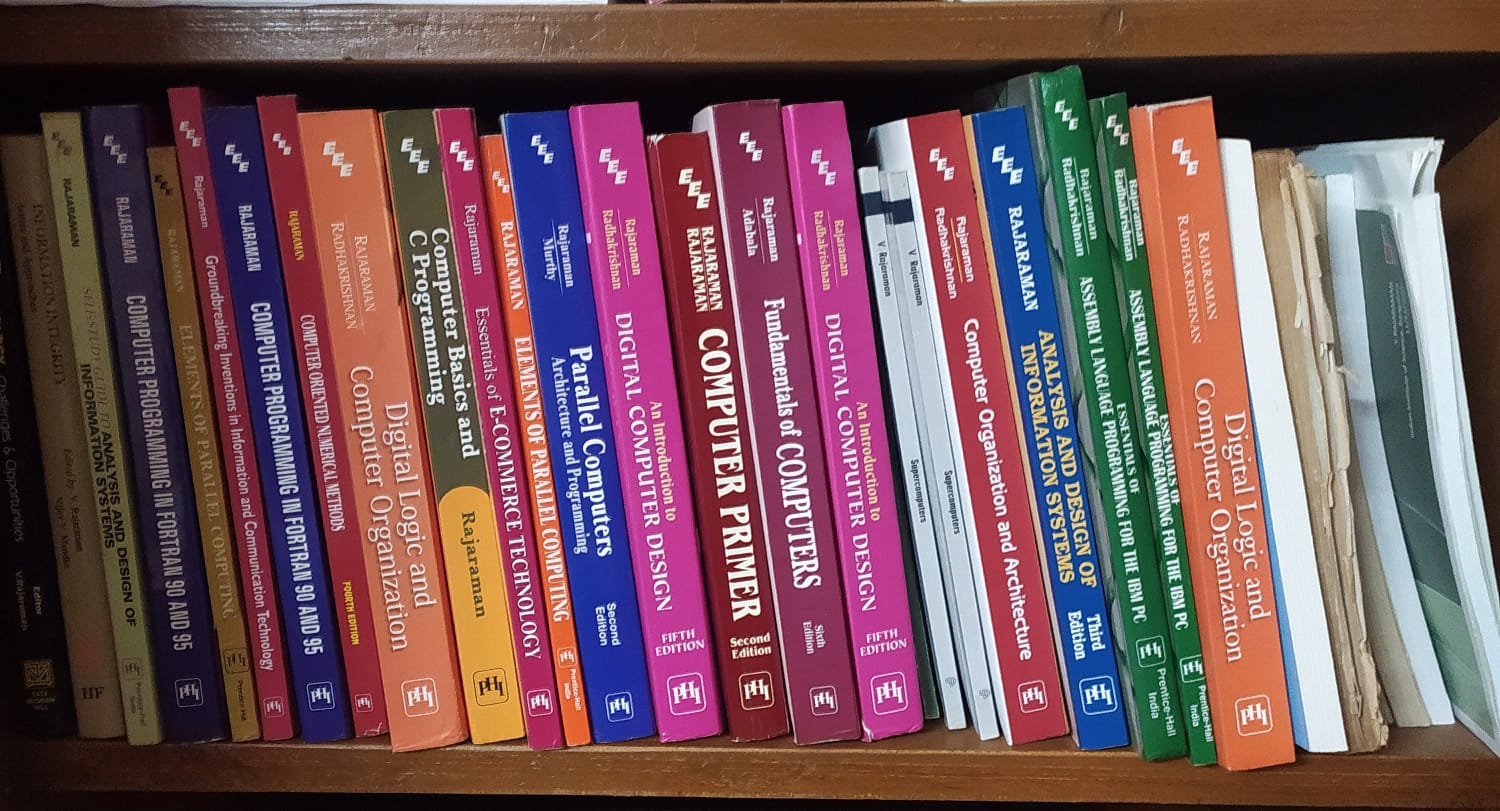
717
All his subsequent publications were well-received with open hands, especially another iconic text Fundamentals of Computers, whose latest edition (the eighth edition) has been recently released in 2025. This book has successfully guided generations of learners, becoming essential texts in universities and institutions across the country. The enduring popularity of his works made him one of PHI Learning’s bestselling authors, but more importantly, these publications strengthened his legacy as a teacher whose clarity, precision, and wisdom transformed how students encountered the world of computing.
Beyond his academic brilliance, Professor Rajaraman was deeply respected for his humility, generosity, and unwavering dedication to advancing knowledge. His long and meaningful association with PHI Learning stands as a testament to his genuine academic interest and his lifelong pursuit of excellence.
We extend our heartfelt condolences to his family, the IISc community, his colleagues and students at IIT Kanpur, and the many educators and readers who are touched by his work.
His legacy will live on through his writings, his teachings, and the profound impact he has made on the growth of computer science in India.
With deep respect and solemn remembrance.
The PHI Learning Team
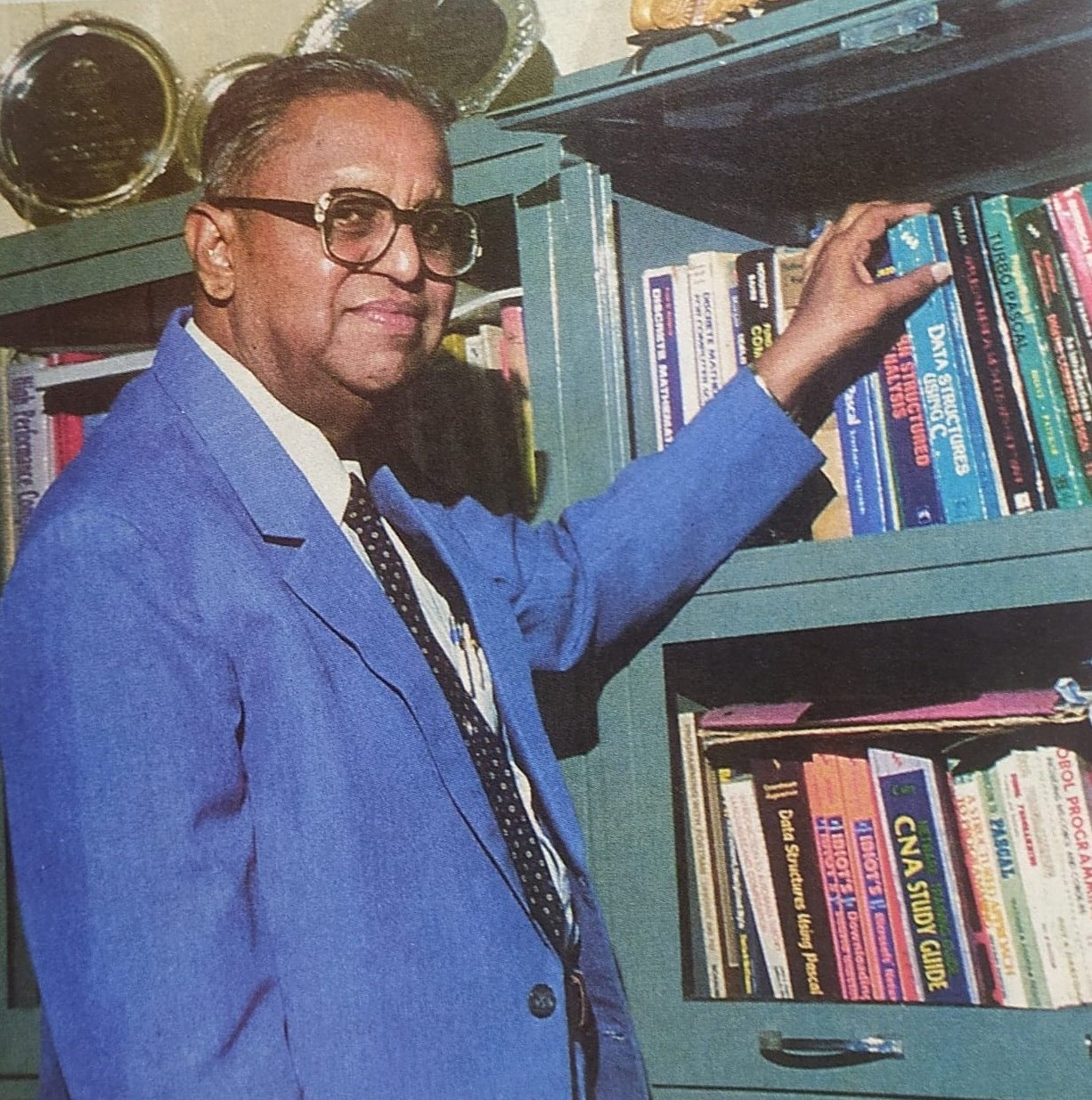
“I came back because I wanted to be in my own country. Mahatma Gandhi influenced me (as a child)… somehow, that ethos stayed.”
718
Professor V. Rajaraman’s Writing Journey with PHI Learning Shaped Computer Education in India
PHI Learning
Long before coding became a trend and computer science turned into one of India’s most sought-after disciplines among youth, a young engineer-turned-academic named Prof. V. Rajaraman was already laying the foundation for how India would learn, teach, and understand computing. He is one of the most influential figures in Indian computer science education—a visionary who established the first academic CS program and the computer lab at IIT Kanpur and led the design of computing curricula. He was honoured with Padma Bhushan by the President of India in 1998, recognizing his seminal contributions.
Behind every extraordinary journey stands a silent but steady partnership. In his case it has been with PHI Learning (formerly Prentice-Hall of India), one of India’s most respected academic publishers. His six decades of association with PHI pioneered and shaped computing education in India, producing a structured, accessible, and distinctly Indian learning experience.
Born in 1933, Prof. Rajaraman excelled in mathematics and science from an early age. After studying Physics at St Stephen’s College Delhi and Electrical Communications at the Indian Institute of Science (IISc) Bangalore, he travelled to the U.S. for his PhD in Control Systems at the University of Wisconsin.
When he returned to India with a Ph.D. in the 1960s, he found a country hungry for scientific growth but lacking the academic frameworks needed to cultivate computer science education. While working at IIT Kanpur and IISc Bangalore, he became a pioneering force, helping build what would eventually become one of India’s earliest and finest computer science environments. But research alone wasn’t enough. India needed reliable textbooks written in clear and accessible style for Indian students.
That’s when PHI Learning entered the picture. Their shared philosophy—clarity, reliability, and academic honesty—turned the association into one of the most productive author–publisher partnerships in Indian education. His early titles such as Analysis and Design of Information Systems, Introduction to Digital Computer Design, and Computer Programming in FORTRAN 77 quickly became standards in classrooms.
When Principles of Computer Programming was first published, it filled a critical gap. There was simply nothing like it in the Indian market—clear explanations, logical structure, abundant illustrations, and examples that made sense to Indian students. It’s the book that became a generation’s first computer teacher. The book was printed under the imprint “Eastern Economy Edition” and was priced at Rs. 15 to make it affordable to all students in India. For over three decades, it became the first computer science book for all. Teachers taught from it. Students revised from it. Working professionals learned fundamentals and applied them in their projects. PHI achieved wide reach through world-class marketing and affordability through excellent pricing, while Prof. Rajaraman ensured academic depth and simplicity. This synergy made the book a classic, one of the best textbooks adopted in university syllabi for decades.
719
Along with Prof. Rajaraman, his books also served as a mentor to generations. These books helped in shaping curriculum, and contributed to national technology initiatives, as Prof. Rajaraman served on government committees, influenced early IT policies, and encouraged the growth of computing research in India when the field was in its infancy. Despite his stature, his writing remained grounded—a deliberate choice to ensure that every learner, regardless of background, could understand computer science.
The enduring partnership between Prof. V. Rajaraman and PHI Learning has been a testament to what can happen when scholarly excellence meets publishing integrity. It’s a legacy preserved in print.
 Edited and cleaned up v2.jpg)
The Founding Chairman of PHI Learning, Mr Asoke K. Ghosh felicitating Prof. V. Rajaraman to celebrate his Padma Bhushan award
Prof. Rajaraman’s publications with PHI Learning
- Introduction to Information Technology
- Fundamentals of Computers
- Analysis and Design of Information Systems
- Computer-Oriented Numerical Methods
- Computer Organization and Architecture
- Computer Programming in C
- Computer Programming in Fortran 77
- Computer Programming in Fortran 90 and 95
- Digital Logic and Computer Organization (with T. Radhakrishnan)
- An Introduction to Digital Computer Design
- Computer Basics and C Programming
- Parallel Computers: Architecture and Programming
- Analog Computations and Simulation
- Essentials of E-Commerce Technology
- Groundbreaking Inventions in Information and Communication Technology
- Anecdotes from the History of Modern Computing
720
Highlights of Prof. Rajaraman’s Books published by PHI
- They were among the first Indian textbooks in computer science.
- Used simple language without losing academic rigour.
- Included examples relevant to Indian learners.
- Updated frequently to keep pace with changing technology.
- Adopted widely across universities, engineering colleges, and polytechnics.
- Millions of Indian students introduced to computing through his texts.
- Influenced the design of early computer science syllabi nationwide.
- Laid the groundwork for new directions in computer science research.
PHI preserved the availability of his books for decades, ensuring each new batch of students had access to updated editions. For the publisher, his contributions strengthened its identity as a leader in technical education publishing. For the country, this partnership helped build an ecosystem in which computer science could flourish.
Today, as digital transformation reshapes India’s economy and education, the contribution of pioneers like Prof. Rajaraman becomes even more profound. His books continue to guide learners, his academic vision lives on in institutions, and his clarity of thought remains a benchmark for authors and teachers alike. Above all, his partnership with PHI Learning stands as a model of what sustained collaboration can achieve—transforming not just an academic field, but the future of an entire nation.
Prof. Rajaraman’s books, in association with PHI Learning, stand tall as the everlasting teachers. They will continue offering timeless guidance and knowledge to shape lives from generation to generation.
“Prof. Rajaraman’s books proved that clarity is not the opposite of intelligence—it is its highest form.”
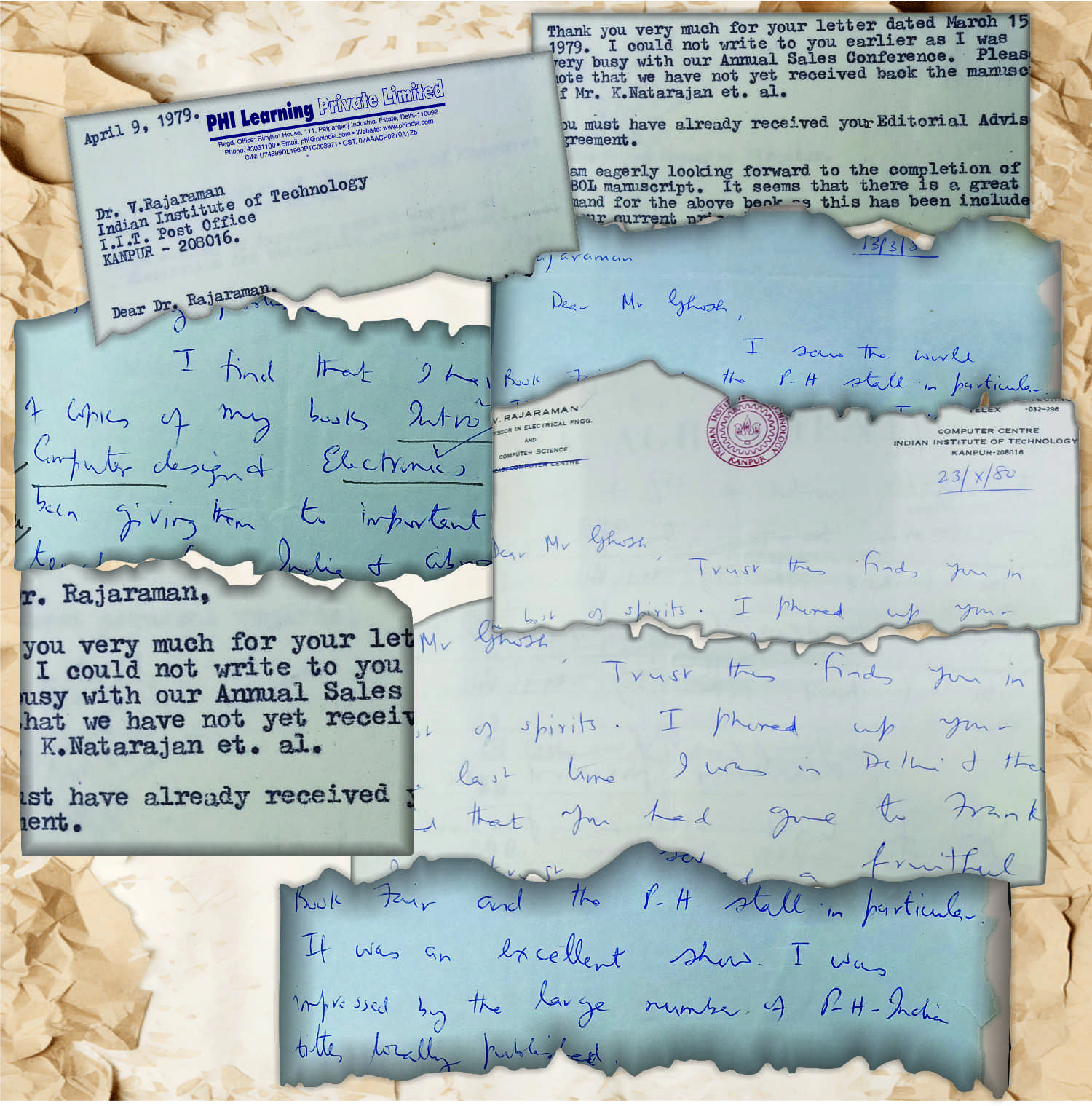
Collage created by Babita Misra, Publishing Editor, PHI Learning
721
The Family Album
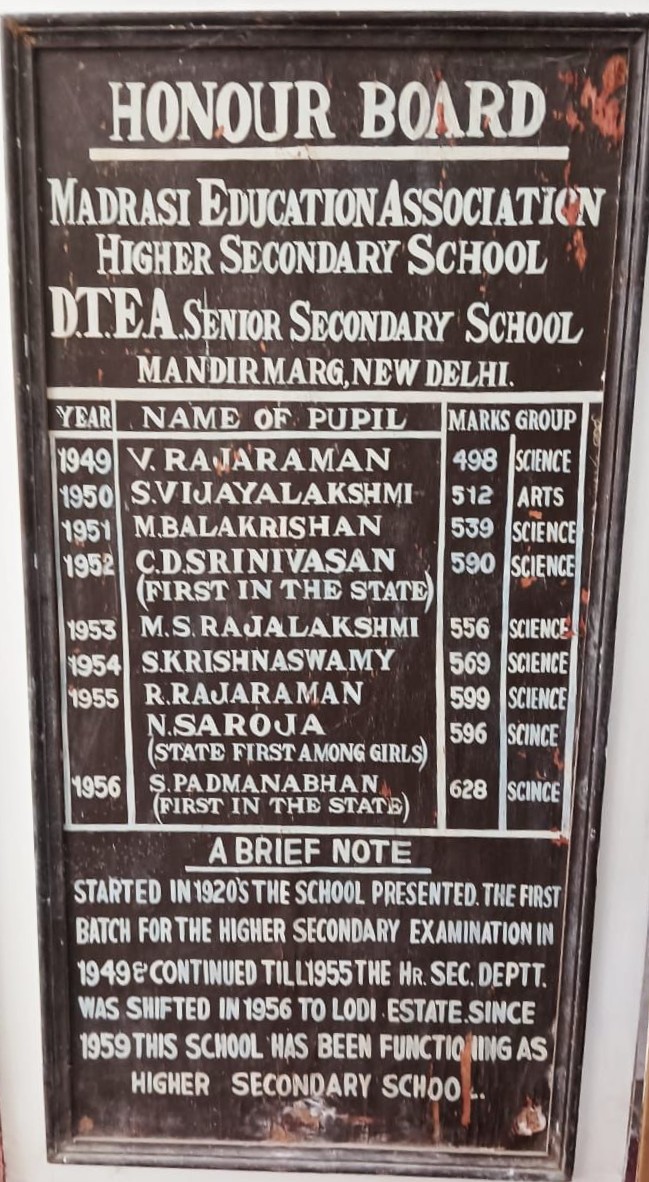
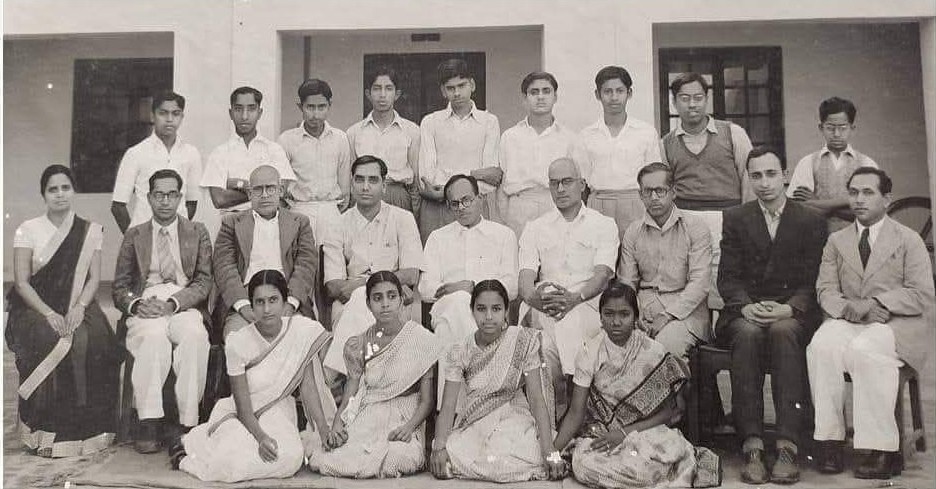
The first batch of the MEA Higher Secondary School, Reading Road, Delhi, 1949
V. Rajaraman is standing on the extreme left
722
A Memorial Tribute to My Brother, Rajaram
Radha Balakrishnan
As I place my fingers on the keyboard to write about my dear brother Rajaram, memories rise in waves, filling my heart with both love and longing. He was the eldest of our three siblings. Our sister Usha, just a couple of years younger than him, passed away in 2015. I am Radha, the youngest, born when he was eleven. One of my earliest treasures is a photograph of the three of us, taken by our father with his Agfa box camera around 1946.
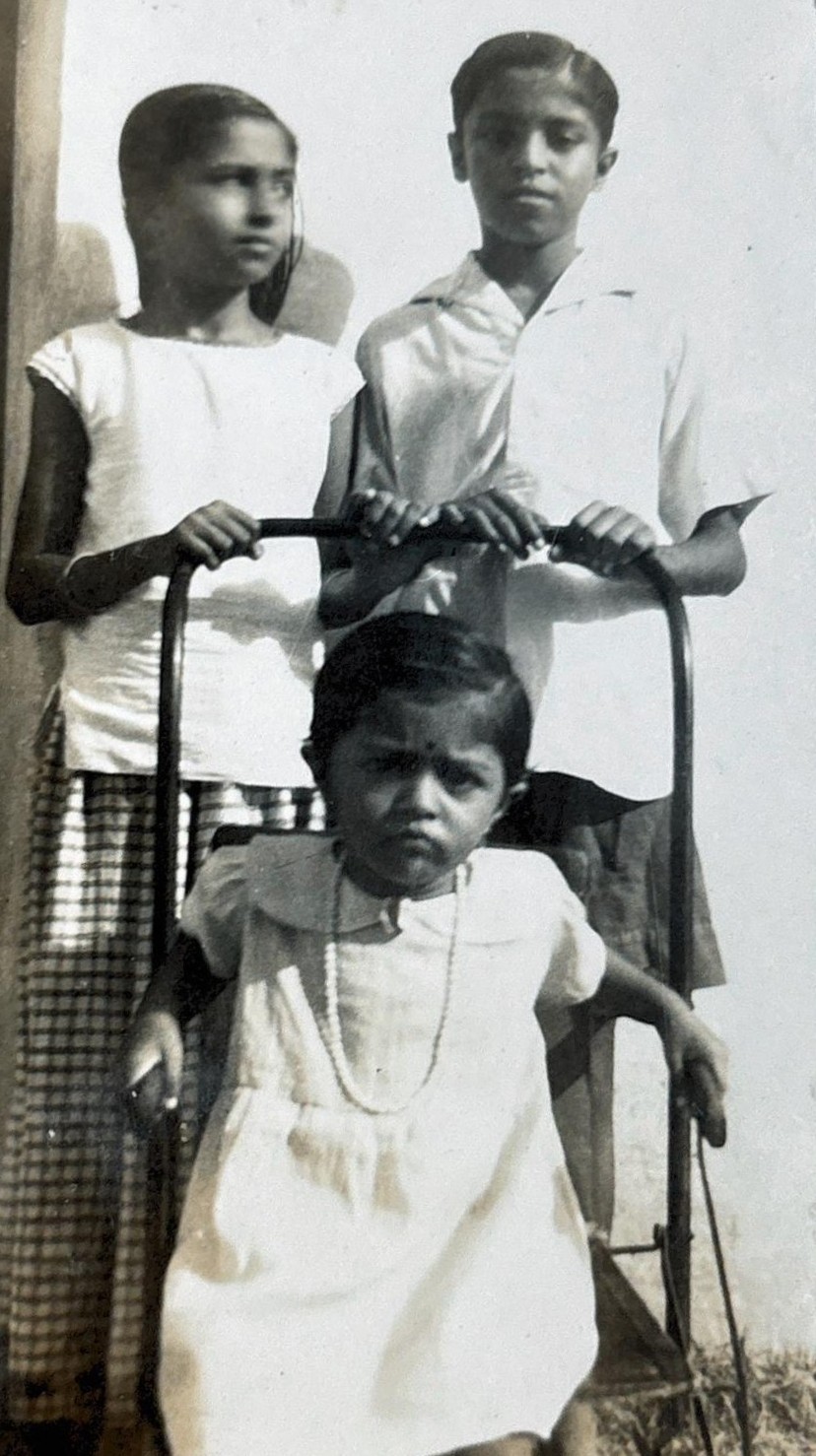
We grew up in Delhi, in a modest, middle-class home. Our father, Ramaswamy Vaidyeswaran, worked for the Central Government, and all three of us studied at the Madrasi Education Association Higher Secondary School, where we learned Tamil, Hindi, and English. Our mother, Sarada, filled our home with Carnatic music. She would tune the radio to Madras or Trichy stations, undeterred by the static. Rajaram, who loved music deeply, often hummed or sang his favorite krithis and Hindi film songs. When I cried as a little girl, he would sing Chali Radhe Rani, ankhiyon me pani, and my tears would turn into laughter.
Rajaram’s interests were wide and lively. He loved cricket and followed matches with great enthusiasm, listening intently to radio commentary. He was also a voracious reader from a young age, devouring Tamil and English books—fiction, nonfiction, anything that fed his curiosity. During the summer holidays of the early 1950s, he and Usha would carefully extract the Ponniyin Selvan chapters from weekly issues of Kalki magazine and bind them into volumes. I watched them as a five-year-old, not knowing that those very volumes would become beloved companions for me in later years.
723
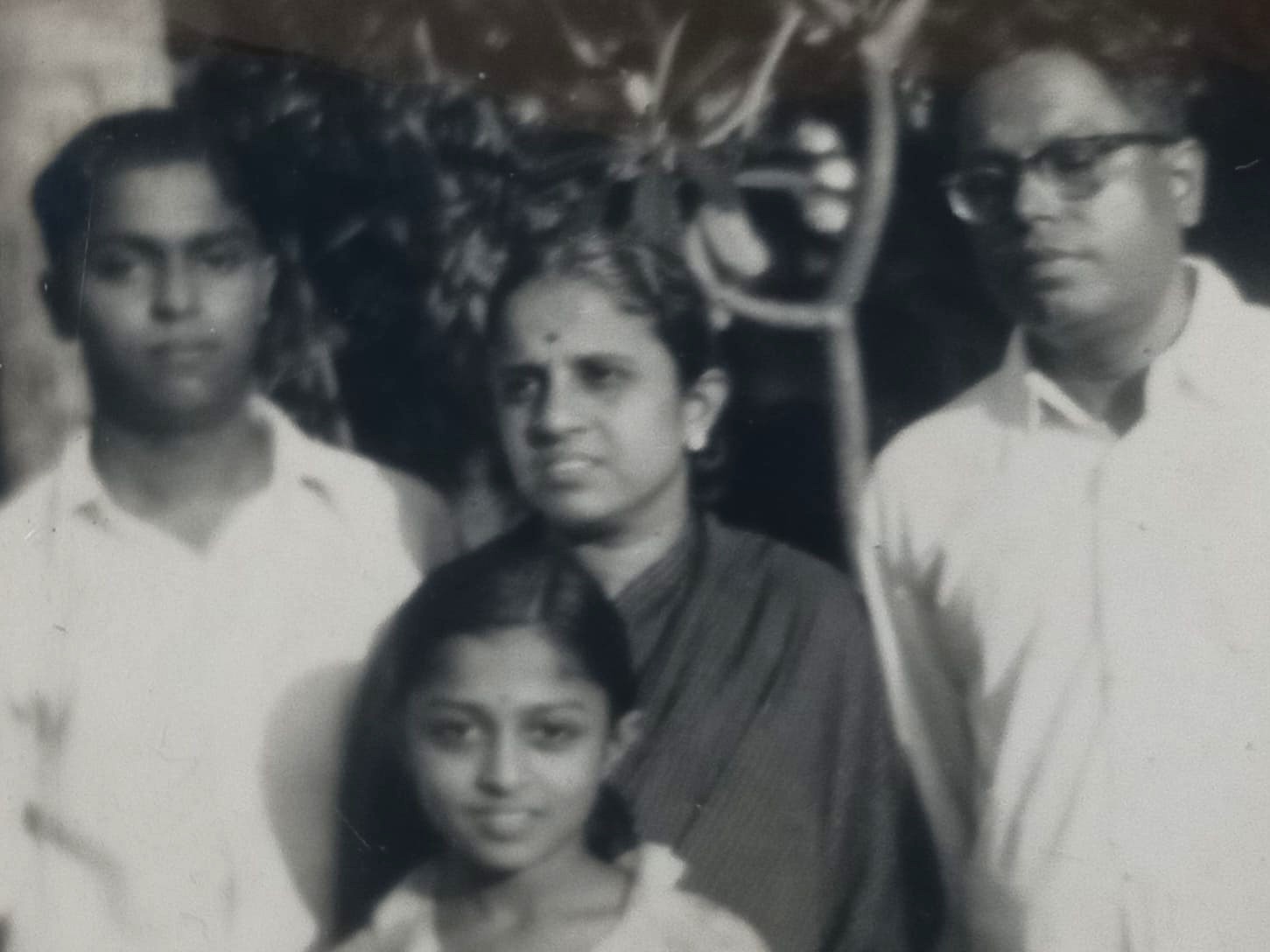
A photograph of Rajaram with our parents and me, taken around 1951
In 1952, Rajaram left for IISc Bangalore. Each summer, he returned home with stacks of paperbacks— P. G. Wodehouse, Perry Mason, The Saint, Alfred Hitchcock collections, and many bestsellers. He left them for our mother, who loved to read, and they filled our bookshelf for years. I eventually read every one of them. His love for books never faded; throughout his life, he continued to read widely, both in his field and beyond.
In 1957, he embarked on a journey that would shape the rest of his life: he left India for the United States to pursue higher studies at MIT. I remember him at home in Delhi, preparing to leave, often singing Que sera sera—“whatever will be, will be.” Perhaps he sensed the uncertainty ahead. He was giving up a secure engineering job in the Indian Government to follow his passion for research, a bold and unconventional choice in those days. He traveled to the U.S. by ship and sent me a postcard from London along the way.
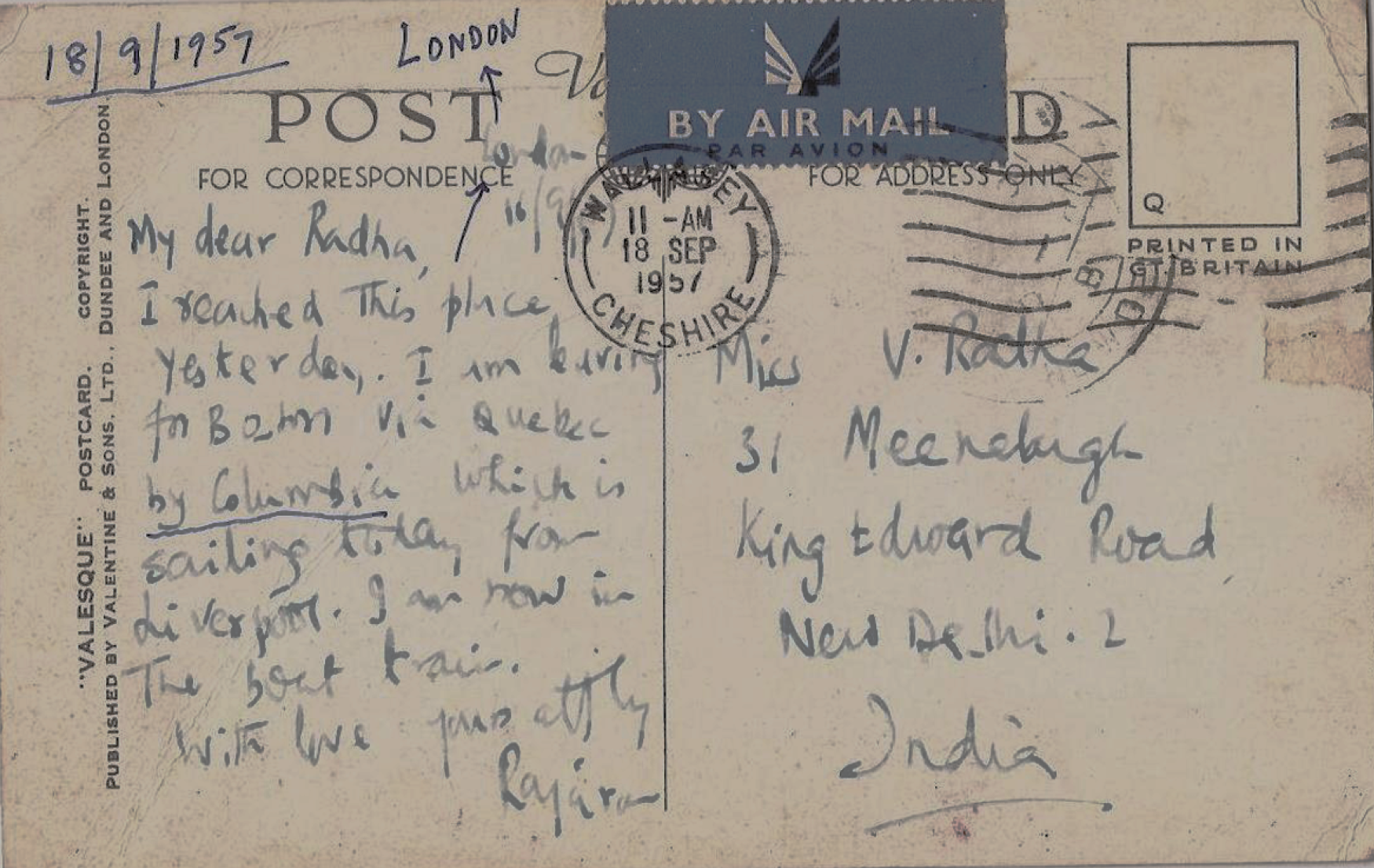
At that time, an airmail letter from the U.S. took two weeks to arrive, and international phone calls had to be booked in advance. Yet Rajaram wrote regularly to our parents, and we eagerly awaited each letter.
724
In 1960, after finishing my schooling, I applied for admission to the B.Sc. (Hons) program in Physics at Delhi University—just as Rajaram had done eleven years earlier. He wrote to my father advising him to gently warn me that it was a demanding course, and that as a girl entering a male-dominated field, I should be prepared for additional challenges. Keeping his words in mind, I completed the degree, went on to earn my M.Sc. there, and later pursued my Ph.D. in Theoretical Physics in the United States.
One memory from that period remains especially vivid. When Rajaram returned to Delhi from the U.S. in 1962, I was in my final year of the B.Sc. (Hons) program and living in the women’s hostel at Miranda House. Although we knew he would arrive sometime in November, he did not share his exact travel plans—he wanted to surprise us, and he did not want our father to make the long trip to the airport. We had not seen him for five years.
One afternoon, as I stepped out of the Physics lecture hall—the very hall where he had attended classes eleven years earlier—I saw him waiting for me. We sat on the university lawns under the gentle Delhi winter sun and talked. I had heard that corporate jobs were the best-paying positions for engineers in India, so I naïvely asked if he planned to take one. His reply has stayed with me ever since: “After all the research in engineering that I have done, do you want me to take a corporate job? I want to teach engineering to the younger generation in India.”
Later, he explained that it was not that he considered corporate jobs less important, but simply that he was not suited for them. He always had a strong patriotic streak and wanted to serve India in the way he felt most meaningful.
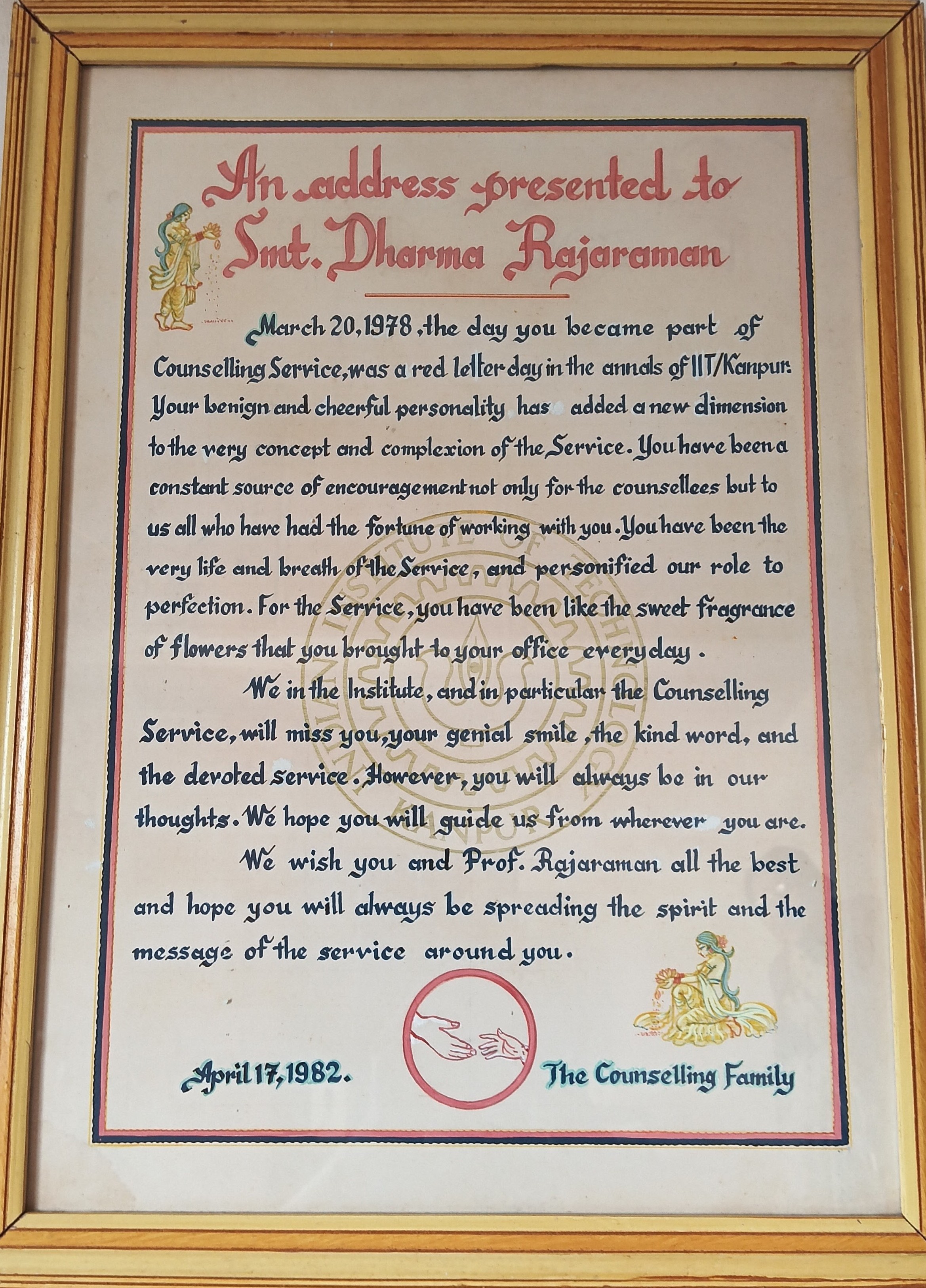
On 28 May 1964, Rajaram married Dharma, and I gained an elder sister. They were truly made for each other. Over the years, Dharma has been a pillar of strength for him, personally and professionally. It was she who first encouraged him to write books on computer programming during his early years at IIT Kanpur. She also served, informally, as a compassionate counselor to many students there. I asked her for a copy of the note of appreciation presented to her when she and Rajaram left IIT Kanpur; since Spark is an IITK magazine, I felt it fitting to include it here.
Dharma is a well-trained Carnatic musician and teacher. Rajaram, with his lifelong love for Carnatic music, attended every Thyagaraja Aradhana she led during their four decades in Bangalore after he joined IISc. One of the Guruvandana photographs taken in Bangalore, where both were honored as teachers, is attached.
Rajaram lived through historic times in Delhi. In recent years, we often spoke about the events surrounding India’s independence. Beginning in 1946, he attended Mahatma Gandhi’s evening prayer meetings, carried there by our maternal uncle, Murthy Mama, with me in his arms as a two-year-old. Gandhiji spoke informally in Hindi, often emphasizing unity and respect among religions. Those values shaped Rajaram deeply—and they shaped me as well. He learned to spin the charkha we kept at home and collected autographs of leaders such as Sardar Patel and Rajendra Prasad as they left the prayer meetings. He remembered vividly the terrible communal riots in Delhi. I told him that even I, at three years old, sensed the tension at home during that time.
725
Rajaram was an eternal optimist. When I was seriously ill in 2011, he would call me from Bangalore and encourage me to stay positive. I have carried that lesson with me.
 sj edit feb 3.JPG)
 sj edits feb 3.png)
(L) At our home in Chennai, (R) at his home in Bangalore
He was health-conscious and disciplined, never missing his morning walks, rain or shine, and keeping up with regular health check-ups. He had an impeccable eye for silk sarees; he and Dharma gifted me so many that I rarely needed to buy any myself.
His memory for people and events was extraordinary. He stayed in touch with all our relatives. A beautiful extended-family book titled Our Memories, featuring tributes from cousins, nephews, and nieces, was lovingly compiled by Anu Shivkumar and Renu Ramkumar and presented to him on his 90th birthday. He was deeply affectionate toward all our relatives.
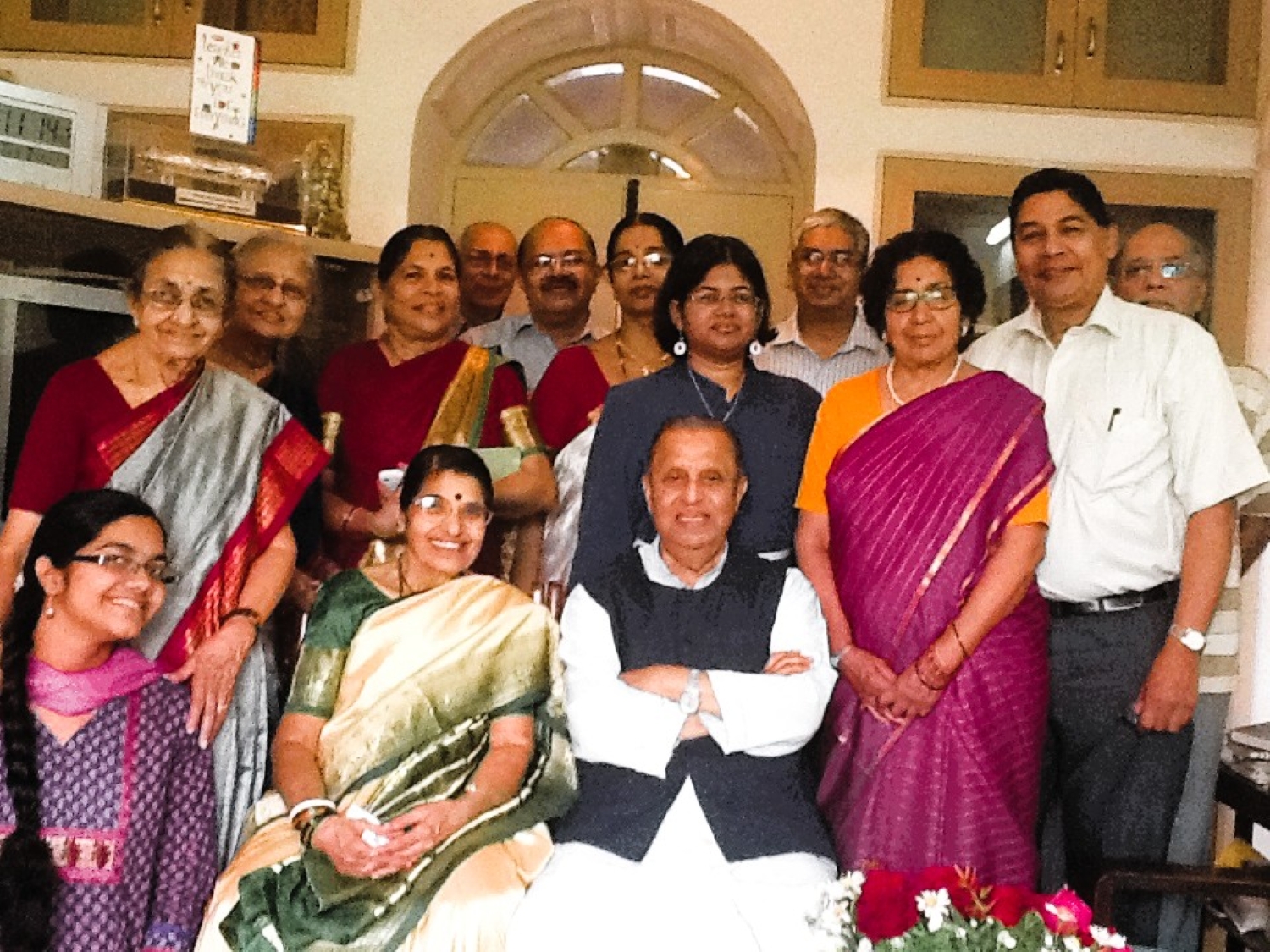
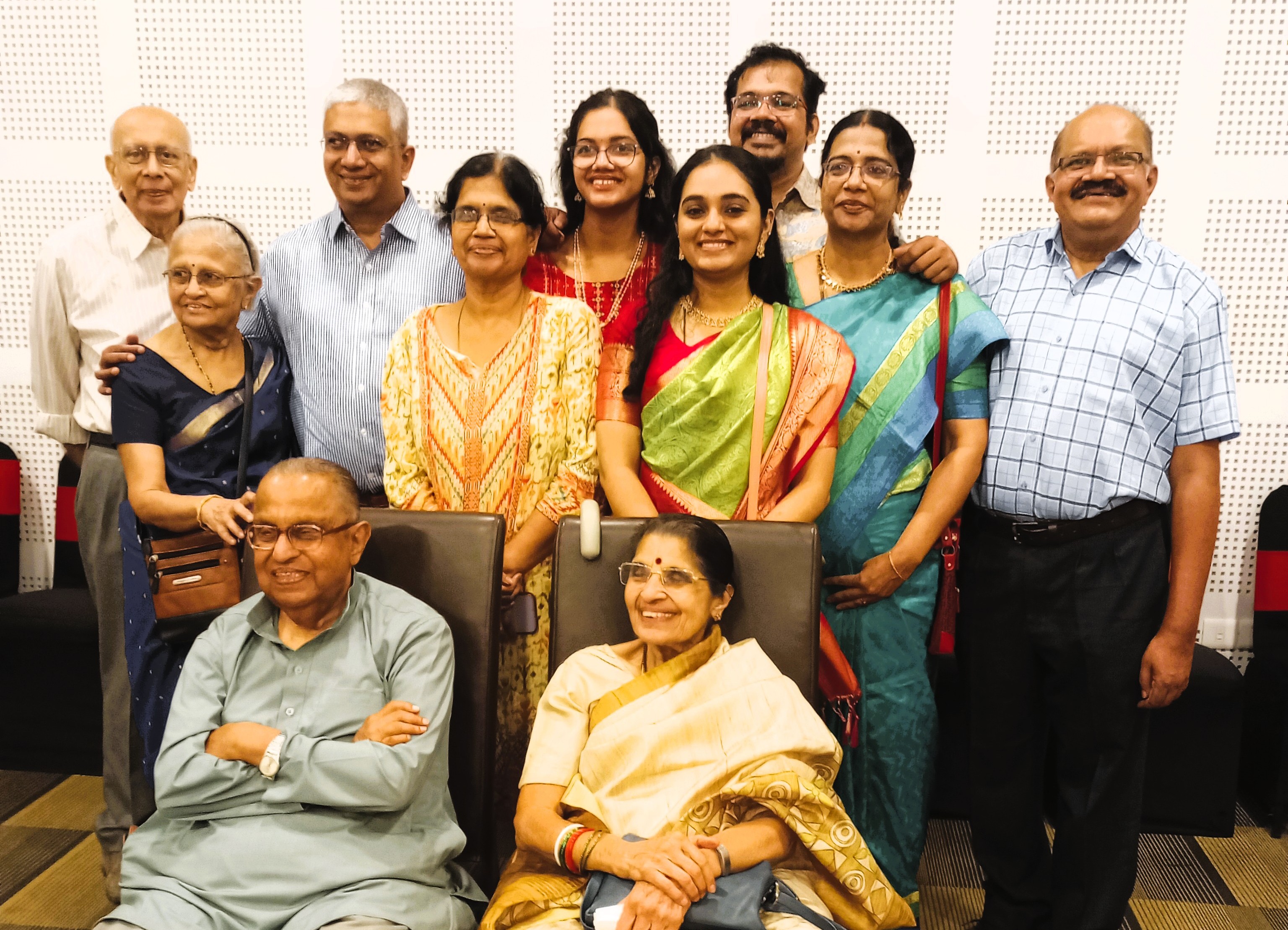
Birthday Celebrations: (L) 80th and (R) 90th with the extended family
Over the years, he sent me a copy of every book he published. More recently, he would share manuscripts of his articles for educational journals and books, asking for my comments. When I noticed that he had acknowledged me, I told him, “I am your sister—I don’t expect any credit!” He replied, “You are an academic in your own right, and it is only fair.”
He was pleased that I remained active in research and continued publishing with my collaborators. He often said that academics are fortunate—we can write, teach, and pursue creative work even after retirement, a privilege few professions offer.
726
For the past decade or so, we spoke almost every Sunday between 11:00 and 11:30 a.m. Often, before I could call him, the phone would ring and it would be Rajaram. He would update me on family news, and my husband Bala would join in as we chatted about world events and academic matters.
Our last long conversation was on Deepavali day, 20 October 2025. He was delighted to hear that my recent collaborative paper in Physical Review had been accepted with strong referee reports. He reminded me, as always, of the importance of staying active both physically and mentally as we grow older. He mentioned that he had pulled a leg muscle, that a physiotherapist was visiting daily, and that he hoped to recover soon.
These memories—tender, vivid, and enduring—are the legacy he leaves with me. They remind me of a brother who was gentle, thoughtful, curious, and courageous; a man who followed his calling with grace; and someone who enriched our lives simply by being himself.
Radha Balakrishnan
Retired Professor, Institute of Mathematical Sciences, Chennai
My brother-in-law, Professor V. Rajaraman, was blessed not only with remarkable intellectual gifts but also with a modest, generous, and deeply caring nature. These qualities endeared him to an unusually wide circle of relatives, colleagues, and friends.
My wife Radha has shared her personal memories of her elder brother, Rajaram. I would like to add a brief reflection of my own. Among his many distinguished accomplishments, the one that has always struck me as truly extraordinary is his body of work in computer science education. His textbooks opened an entirely new field to generations of students and teachers, shaping the discipline in India in a way few individuals ever do.
The sustained effort behind such an achievement is difficult to describe. It calls to mind a remark by the great astrophysicist S. Chandrasekhar, who said that one makes progress by doing “a little bit today, a little bit tomorrow, and a little bit more the day after”—and over decades, meaningful work accumulates. Rajaram’s contributions reflect that same long-term dedication.
Most people never write a book; even in science and technology, only a few do. Rajaram wrote twenty-five technical books, in addition to revising their many editions. If research papers are like sprints and review articles like middle-distance races, then writing a book is a marathon—demanding planning, stamina, and unwavering perseverance. Rajaram completed not just one such marathon, but many.
No great endeavor is undertaken alone. Dharma, his partner and steadfast support for more than six decades, played an essential role in his journey. Their life together, like his work, was marked by harmony, purpose, and quiet strength.
V. Balakrishnan
Retired Professor, Dept. of Physics, IIT Madras
727
Remembering Raju Mama
Prof. V. Rajaraman is my mother’s older brother—my Raju Mama. During my childhood, we made many trips to visit Mama and my aunt, Dharma Mami. These were among the most relaxing moments of my youth, not only because of the beautiful campus, but even more because of the calm, predictable, and perfectly ordered way in which they lived their lives. One could set a clock by the time of their walks, their meals, and the moment Mama would retire to his study after dinner to continue his work.
Mama accomplished many things in his professional career and received numerous accolades, but what has always impressed me most is the metronomic consistency with which he worked toward his achievements. His life is a testament to how steady, disciplined progress can lead to exceptional outcomes—such as his remarkable twenty-five published books in computer science.
For most of my childhood, I had only a vague awareness of Mama’s pioneering role in shaping computer science in India. He was the first PhD in my family (there have been several more since), so I knew he was a trailblazer for us. It was part of our family lore that he traveled from Bombay to MIT by ship in 1957—on the SS Stratheden. The journey took nearly three weeks, passing through Aden, Malta, Gibraltar, and Southampton, followed by a train to London, a return train to Southampton, another ship to Quebec, and finally a train to Boston.
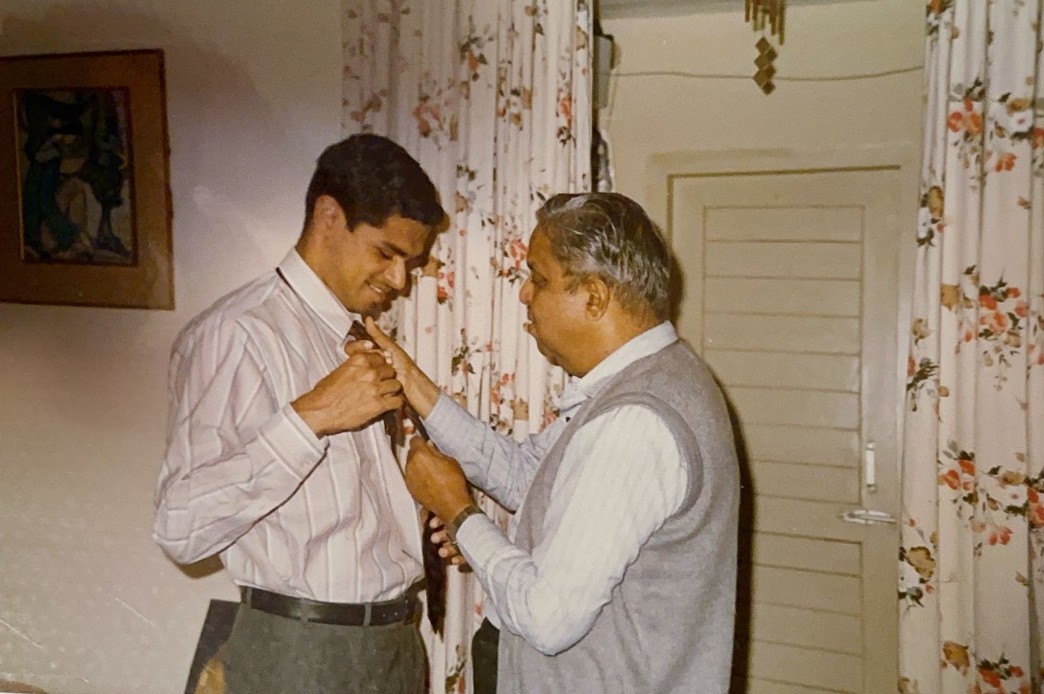
Leaving for Grad School at Berkeley, 1993. Prof. Rajaraman teaching Hari how to knot a tie.
728
Like many students in India, my first exposure to computer programming came through Mama’s books. From them, I learned how computers worked, how to specify flowcharts and algorithms, and how to write programs. By helping create the first computer science program in India at IIT Kanpur, he laid the foundation for generations of students. Indians today are a major force in computer science around the world, and Mama rightly deserves significant credit for setting the stage for the success of countless graduates from Indian institutions.
Raju Mama and Dharma Mami have been positive, supportive presences throughout my life and career—never failing to send kind notes and always remembering every accomplishment, however small. Their unconditional kindness and affection are deeply cherished, not only by all of us in their extended family, but also by the thousands upon thousands of students and colleagues they have inspired and encouraged over many decades.
A small tribute in verse:
Rajaraman, a young boy from Erode,
From St. Stephen’s to MIT via ship he rode,
After Wisconsin, with Dharma by his side,
Berkeley, Kanpur, and Bangalore—they journeyed wide,
Writing book after book, teaching millions to code.
Hari Balakrishnan
BT, CSE, IITM, 1989-93
Fujitsu Professor of Computer Science and Artificial Intelligence, Dept of EE and CS, MIT
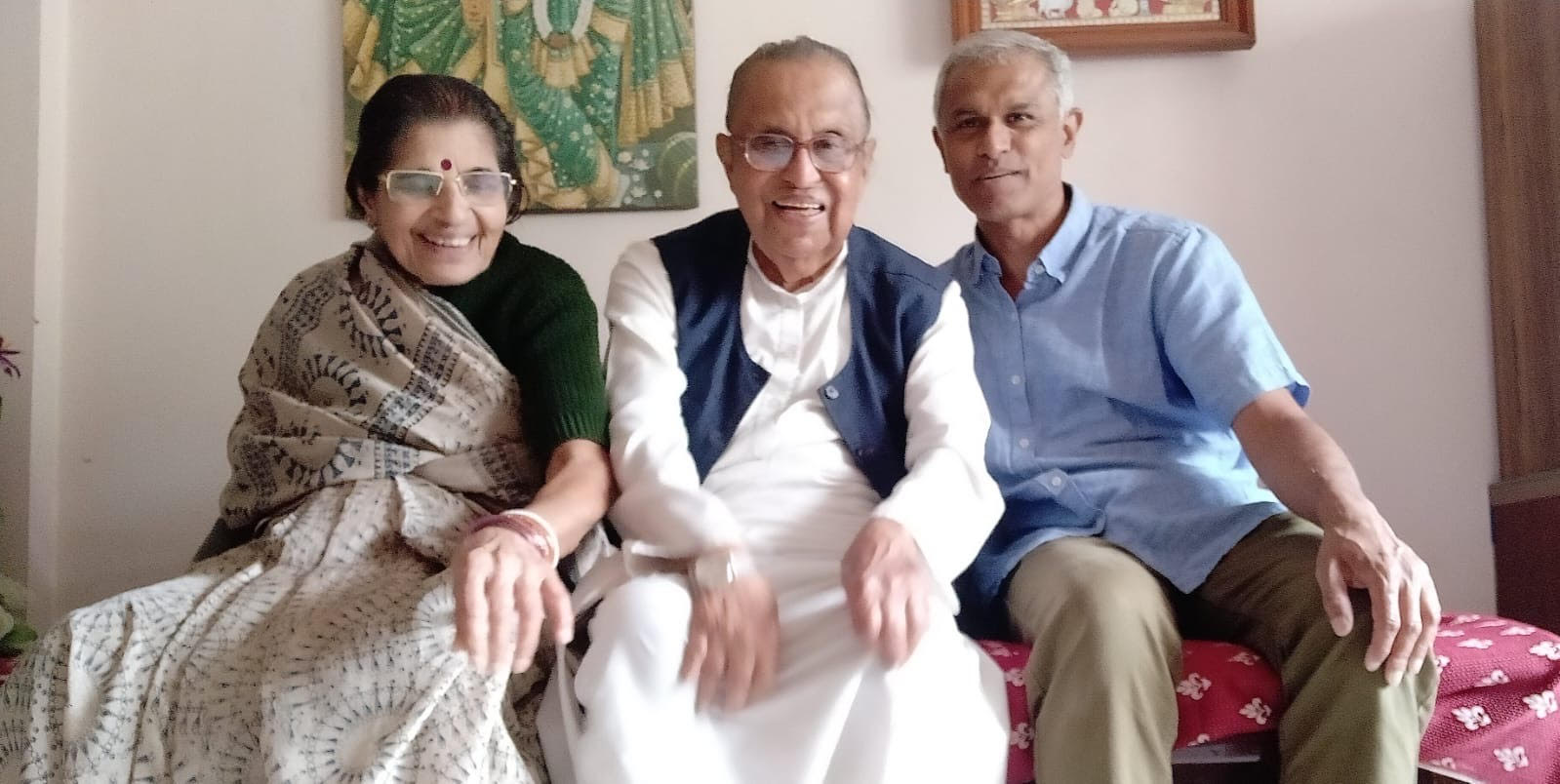
Hari with Prof. and Mrs. Rajaraman at their home in Jan 2024
729
Growing up, summer vacation for me was synonymous with going to see Raju Mama (as I referred to Prof. Rajaraman, my mother’s brother) and Dharma Mami in Bangalore. For the longest time, I even assumed that Bangalore was our “native place”! I still have wonderful memories of summers in their home on IISc Campus, where the Bangalore weather was a pleasant escape from the heat of Chennai. It was here that I heard stories of Mama’s journey to the US for graduate school (how the ship that he traveled on had its lower decks flooded, ‘turning the sambar powder in his luggage into sambar,’ as he liked to say), and of Mama and Mami’s many adventures together, from their drive across Australia to their recollections of Berkeley, CA. Many years later, when I lived in Berkeley myself, it was fun to compare notes on how the city had changed.
Looking back, I did not fully appreciate then what a giant Raju Mama was in his professional life and his contributions to Computer Science education in India. But even as a child, I learned the importance of being passionate about one’s work and having a strong work-ethic by watching him, qualities that I aspire to emulate. More than a decade later, when I started working on control systems in graduate school, I learned that he too had begun his research career working on control theory!
V. Rajaraman, "Theory of a two-parameter adaptive control system," in IRE Transactions on Automatic Control, vol. 7, no. 4, pp. 20-26, July 1962, doi: 10.1109/TAC.1962.1105481. I was (and still am!) in awe of someone publishing a first author paper in TAC when they were just finishing their PhD!
I looked forward to my nearly annual visits to Bangalore: Conversations with him were always marked by his genuine interest in what I was up to, and his steady love, support and encouragement whenever I felt worried or insecure. As we now remember the ‘Pitamah’ of CS education in India, I remember and miss, most of all, my uncle–Raju Mama.
Hamsa Balakrishnan
BT, 1996-2000, IITM
Professor and Associate Department Head, Aeronautics and Astronautics, MIT, Cambridge, MA
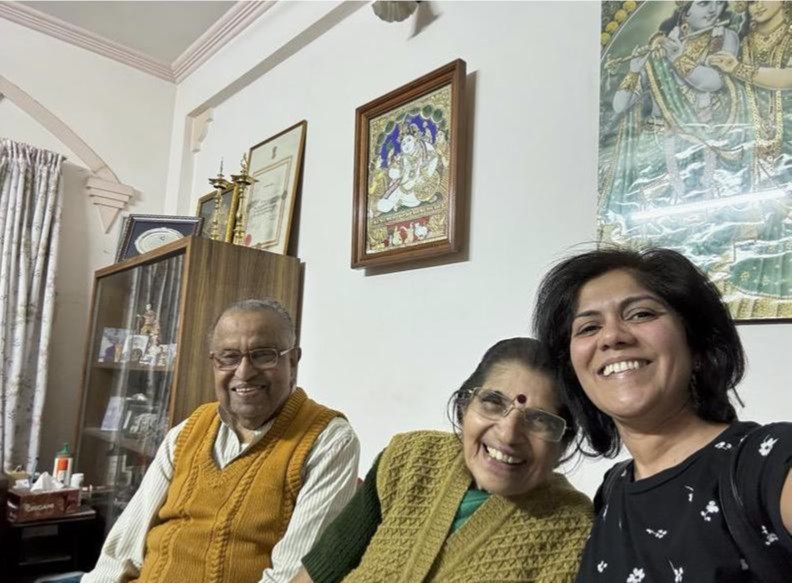
Hamsa with her Mama and Mami in January 2025
730
My Affectionate Athimbare (Brother-In-Law)
My association with Professor Rajaraman whom I affectionately called ‘Athimbare’ started with his marriage to my sister way back in 1964. I was a schoolgirl and being many years younger to him used to be a little afraid of him as he was a big professor in Kanpur. My first visit to my sister’s place in 1969 brought him very close and I realized that he was very simple and kindhearted, telling us funny anecdotes about his childhood, the freedom movement, and about his daily attendance to Gandhiji’s prayer meetings in Delhi. He had no airs about all his great awards but was down to earth and never made us feel that he was a distinguished Professor in the Computer Science department.
He was always there to guide and advise our family. He and my sister were responsible for my continuing my MSc in 1971 when my father suddenly suffered a severe stroke and continuation of my degree was a big question. He encouraged me to continue buying all books etc. This paved the way for completing my PhD later at Pune, at NCL.
We used to meet often, and he was the first to visit and hold my sons when they were born in Delhi and Pune. He was always there to give us the best advice about the choice of courses my sons should take in the Engineering college. In fact, both of them became my support after I lost both my parents and my husband a few years back.
I was blessed to be with him in the last few months before he passed away. I never felt our age difference but used to speak to him frankly. I loved the time we used to watch news and then films at night. He always used to give in to my choice of films. He was very regular in his habits of morning walks, eating at the right time, and very particular about eating small meals. He used to spend most of his time writing, reviewing and reading new books and keeping abreast of the latest in his subject. He used to encourage my sister and I to practice music. He never complained that our loud practice disturbed him. This has kept our music interest alive even today. Even though he was very peaceful in his last moments I will miss him a lot and I can only pray for his soul to rest in peace.
Vasantha Sivaramakrishnan, sister-in-law
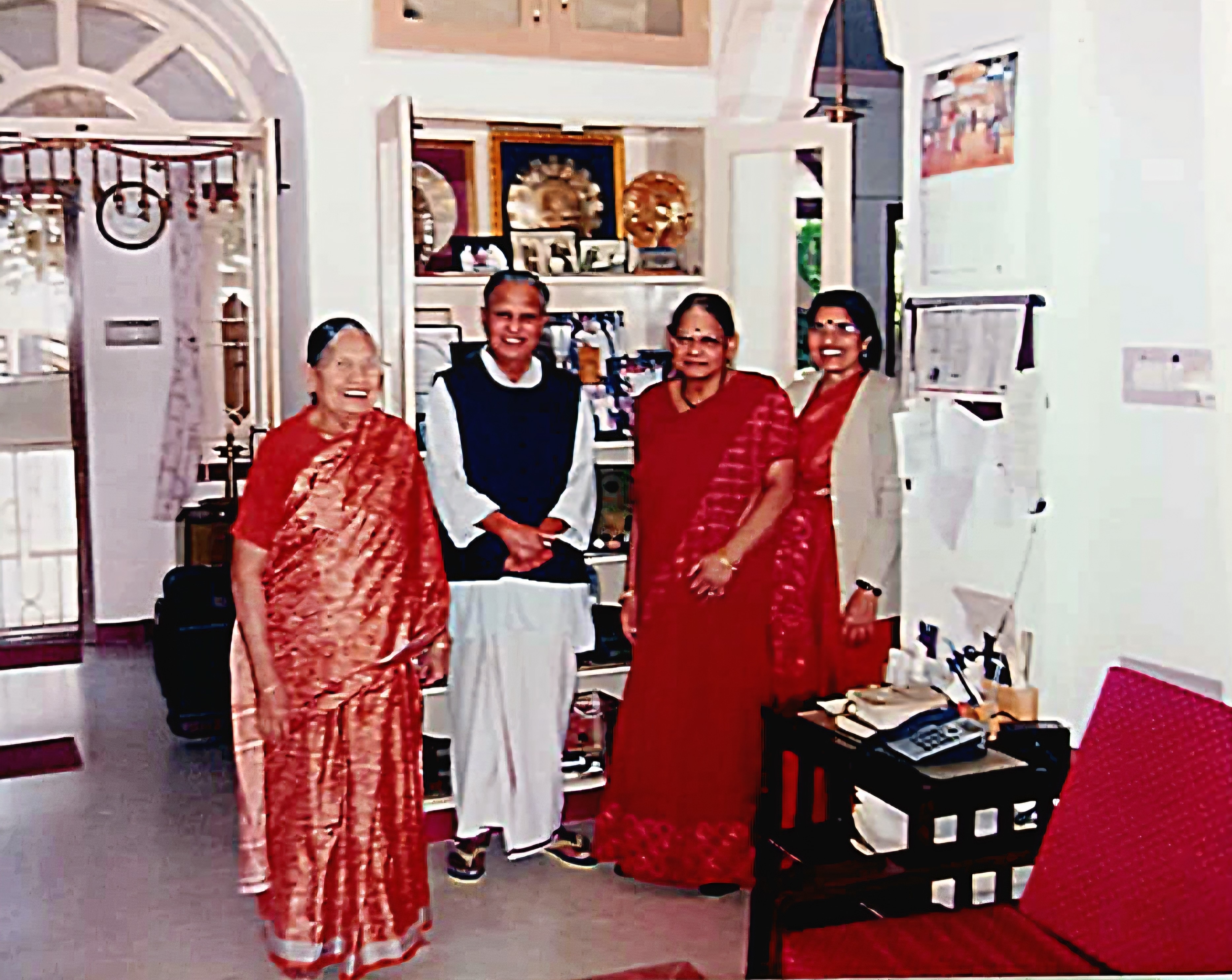
A family picture at the Rajaraman home. From right to left: Mrs. Dharma Rajaraman, her aunt Janaki, Prof. Rajaraman and Mrs. Rajaraman’s mother, Rajyalakshmi
731
Professor V. Rajaraman: The Human Side of a Leader
I first met Professor V. Rajaraman — “Raju” to our family— in 1964 when he married into our family and instantly became an elder brother. I had just completed my B.Sc. in Physics and wanted to become an engineer. Raju advised me to study instrumentation, convinced that automation would define the future—a remarkably prescient view shaped by his own work in adaptive control systems.
After completing my postgraduate studies at the Madras Institute of Technology, I began working as an instrument engineer and later as a project manager. During those years, I often visited Raju and Dharma in Kanpur and later in Bengaluru. Our shared passion was cricket; many of our conversations revolved around the game we both loved. In 1999, I completed a Ph.D. in management and moved into academia. That was when I began working alongside Raju during our visits from Australia, in his home office in Bengaluru while he wrote the books that shaped generations. I would sit at a small table to his left, typing on my laptop as he played jazz for me, though his own tastes leaned toward classical music.
As a scientist, he was initially skeptical of management research, recalling how he reluctantly took on administrative roles at IIT Kanpur only out of necessity. But as he watched my academic career grow—with grants, publications, and industry recognition—he eventually conceded, “Shankar, it looks like you have become a real academic now.” It felt like receiving Vasishtar Vayal Brahma Rishi Pattam—praise from the highest authority.
Raju lived by a disciplined routine: morning tea, a brisk walk in the park, pooja, reading Deccan Herald and The Hindu, breakfast, and then writing in his study until lunch. After a short nap and afternoon coffee, he watched news in English, Hindi, Kannada, and Tamil, comparing national and regional perspectives. Evenings were for dinner, fruit, movies, or cricket—often films he had already seen but wanted us to enjoy. He loved detective fiction, preferring light reading after intense research.
Despite his strict schedule, he always made exceptions for family. I remember him staying awake until the early hours when our flight from Sydney arrived late, determined to welcome us personally.
Our last visit was in July 2025. I was en route from a conference in Europe to another in Chennai. When Raju was hospitalized, we extended our stay to support Dharma. He worried constantly about disrupting our plans. The night before we left, he insisted on returning home—gathering all his strength—so he could say goodbye from his living room, not a hospital bed. He sat with me to watch the final day of the India–England Test match, knowing how much cricket meant to us both. Even as he was being taken to the hospital earlier, he was concerned about the book he was revising. He proofread it carefully before leaving, determined to meet the deadline he had promised his publisher—and he did.
Jawaharlal Nehru’s favorite poem by Robert Frost ends with the lines: “But I have promises to keep, And miles to go before I sleep.” Raju fulfilled every promise and walked every mile with grace. He was a brilliant researcher and educator, but to me, he will always be the brother I never had.
Shankar Sankaran
Professor of Organisational Project Management, University of Technology Sydney (UTS), Australia
732
Remembering Professor V. Rajaraman
The passing of Professor V. Rajaraman brings back a flood of memories. He and Dharma were my godparents, and their presence has been a steady, formative part of my life.
I first truly interacted with him when I was seventeen, just beginning my undergraduate studies in computer science. Although I had known him socially—my mother and Dharma often performed Carnatic music together—this was the first time I spoke to him in a meaningful way. I was struggling then, unsure of my path and lacking confidence.
What struck me was the way he listened. There was no impatience, no authority imposed—only calm attention and clarity. He asked what genuinely interested me in computer science, handed me a book and a few exercises, and encouraged me to return with my thoughts.
When I met him again weeks later, nervous and expecting criticism, he instead reviewed my work with care. He asked me to explain my reasoning and gently showed me where I could think more clearly. What stayed with me was not the correction, but the respect he showed a hesitant student. It changed how I saw myself.
Over time, I realised this was central to who he was as a teacher. He valued rigour, but never at the cost of empathy. He challenged ideas without diminishing the person behind them. I had never encountered a mentor like him.
With his steady guidance, my confidence grew. I topped the university and later completed my master’s dissertation under his supervision. More importantly, I discovered what I truly enjoyed.
Our conversations continued over the years. During a visit to India, he encouraged me to consider entrepreneurship. In his understated way, he simply said, “Stretch yourself, Prashant.” I took his advice to heart and eventually co-founded an AI technology venture. I deeply regret that I could not share our recent progress with him.
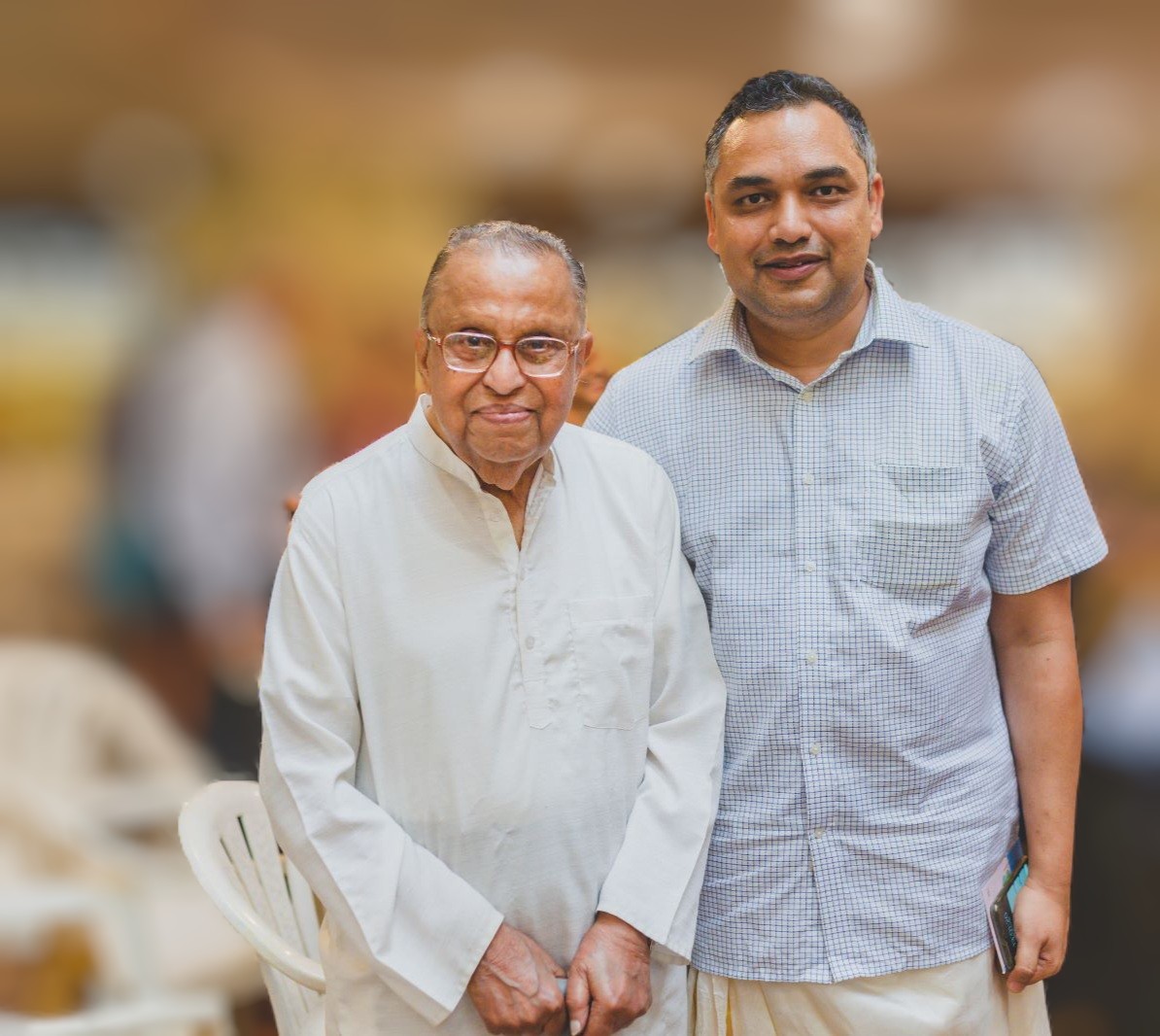
When I think of him now, it is not first his stature or achievements—remarkable though they were—that come to mind. I remember the teacher who listened without judgment, who made space for curiosity, and who believed in a young student before he believed in himself.
To me, that is the true measure of a great teacher, a generous human being, and a life lived with purpose.
Prashant Bharadwaj
CEO, Alvence Ltd, London, UK
733
Recollections and a Tribute to Prof. V. Rajaraman
Prof. V. Rajaraman, the Doyen of Computer Science education in India, is credited with pioneering several computer education programs that put India on the global map in Computer Science. One of these programs was the Master of Computer Applications (MCA) program. In 1979, he was appointed the chairman of a committee to project demand for manpower and suggest appropriate educational programs to meet the requirements. A true visionary, Prof. Rajaraman understood that while there were engineering programs that focused on computer architecture and hardware, there was a need to build a formal education program to create a talent pool of application programmers who had knowledge of both computers as well as business practices. To address this gap and to create meaningful career opportunities for B.Sc/B.Com graduates, he proposed the MCA program. The program was launched in 1982–83, initially across ten institutions.
I am privileged to be a graduate of one of the early batches of the MCA program at PSG College of Technology, Coimbatore, and even more privileged to be related to Prof. Rajaraman and Mrs. Dharma Rajaraman. Dharma and I are first cousins - her mother Rajyalakshmi was the eldest sister of my mother Janaki, and we are part of a very close-knit family.
When they moved from IIT Kanpur to the Indian Institute of Science (IISc) Bengaluru in 1982, they lived in the campus residence which was some distance away from the main campus. Prof. Rajaraman commuted to the campus on his bicycle, a simplicity that characterized him throughout his life. Despite his demanding schedule, he always made time for family, colleagues, and students. I recall as a young adult having engaging discussions about various topics with him ranging from how computers worked, to the latest hit movie! When I graduated with a B.com degree, the MCA program he had pioneered was at its infancy. My parents were worried about career prospects for a new degree, and Prof. Rajaraman and Dharma re-assured them. Little did we know then that this program would one day help position India as a major global hub for IT talent — just as he had so wisely envisioned!
The MCA curriculum was demanding, yet we were fortunate to have his textbooks such as Principles of Computer Programming, Computer Programming in FORTRAN IV, and Computer Programming in C, to name a few, which greatly helped us grasp even the most difficult subjects. After graduation, my classmates and I got well-paying jobs very quickly and went on to build fulfilling careers across the globe.
Until just a few months before his passing, he remained very active - giving speeches, writing books and articles and revising his older books to keep up with advancements in technology. He had a unique style of writing that made the most complex subjects more understandable. At their residence in Bengaluru, there is a well-designed study with two chairs, one for him and one for Dharma who was his editor and greatest champion. One of my fondest memories is watching them work side by side, deeply focused, with music playing softly in the background. He was exceptionally disciplined, and had a strict routine he followed well into his later years.
Music was a shared passion for both of them, with Dharma being an accomplished Carnatic music singer. They frequently hosted many musical get-togethers and events at their home. As I recall, Prof. Rajaraman’s two favorite genres were Carnatic and Western classical music. On one of my visits, he proudly showed me a new radio that could play a wide range of stations, and he was excited and delighted by the many music channels it offered!
734
Daily walks were also an integral part of their lives. On one such walk in 2018, he suffered a fall while trying to avoid a speeding bus and injured his leg quite badly. He never once complained. With grit and determination and support from family, he put himself through a rigorous six-month period of physical therapy and exercise. His resilience was remarkable, and before long he was back to his walks, undeterred, though now on the roof terrace out of caution!
He greatly appreciated good food, and Dharma, an excellent cook, lovingly made various dishes he enjoyed, but always with moderation. He had a great sense of humor, and an infectious laugh that was so endearing. Family was very important to him. He was especially close to Dharma’s mother Rajyalakshmi, who was tech savvy even into her eighties. It was often the case that both of them would pore over the user manual of a newly acquired gadget — with her reading out the instructions and him assembling it!
During our phone conversations, he would always speak with great enthusiasm about the latest writing project or research he was working on. My last conversation with him was on September 8th — his birthday. As always, I asked him what he was currently writing. This time, his response was very different. He said, “Nothing at the moment — it is time for me to fully focus on reading other authors.”
Prof. Rajaraman will be remembered as a brilliant visionary and educator, to whom countless individuals in India owe their careers. Amidst an extraordinary lifetime of achievements and honors, what stood out above all was his passion for learning and teaching, his simplicity and humility, his openness and approachability to everyone, and his unwavering discipline throughout his life and work. I am deeply grateful for the conversations we shared and for the profound impact he has had on my life and on the lives of so many others.
Padma Narayanaswamy
Software Project Manager, Citibank USA
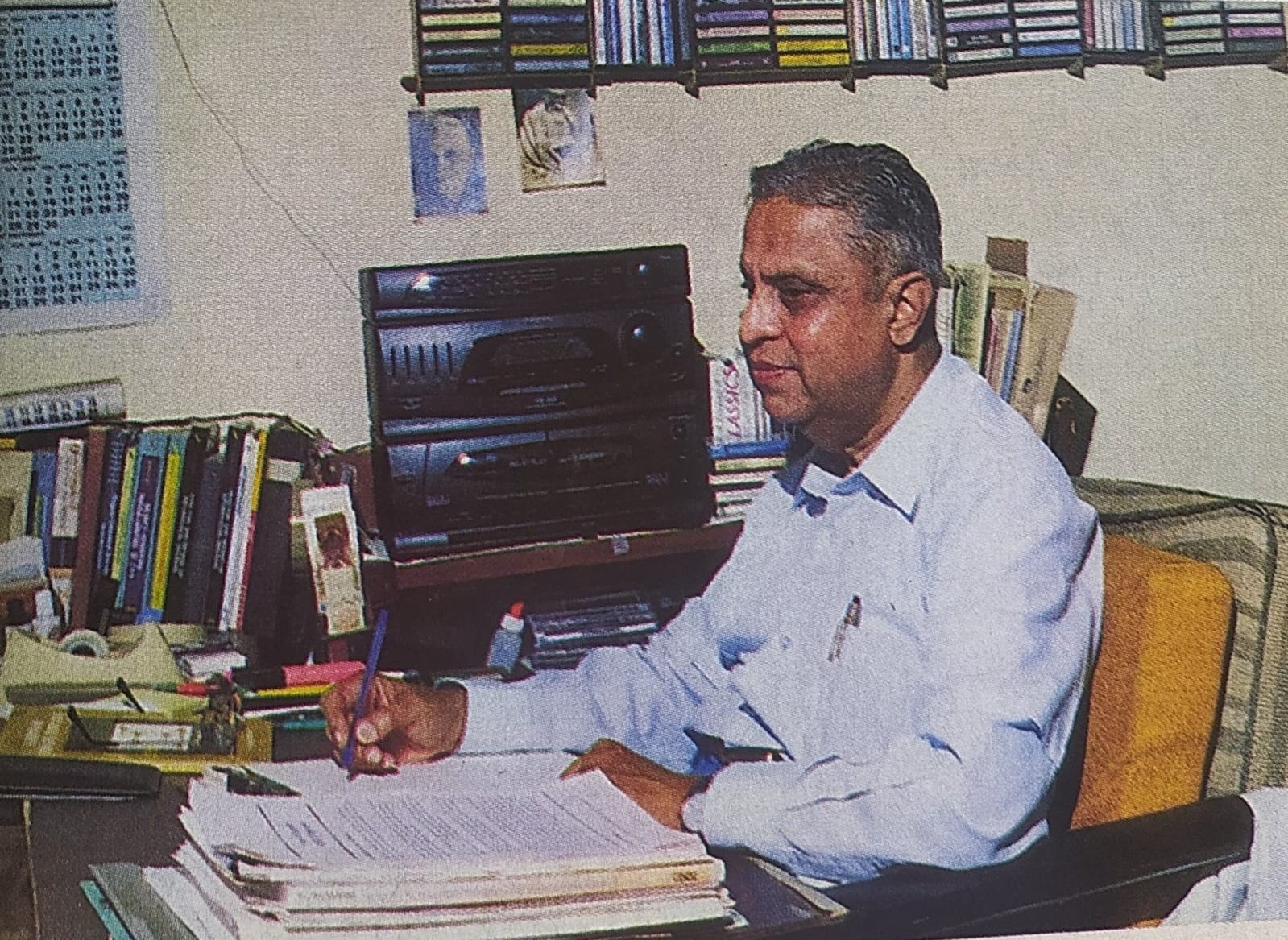
At work, IISc, Bangalore
735
Humble reflections on Sri. V. Rajaraman – affectionately, my Rajaram Periappa
In 1982, “Rajaram Periappa" (my uncle Dr. Rajaraman) and Dharma Periamma moved to the duplex quarters at IISc, where I would visit them during the long lazy Indian summer vacations, and my earliest childhood memories are of looking up to them. I have fond memories of his clockwork routine, riding his black bicycle to the CAD center/SERC every morning, and afternoons spent carefully editing manuscripts with Periamma by his side. His enormous collection of materials to assist editing his numerous textbooks captivated my curiosity. Love for both Carnatic and western classical music permeated the home of these karma-yogis dedicated to “Vidya-Vikas”, inspiring and motivating all who had the privilege to meet them.
Periappa was a voracious reader of numerous magazines gifted by former students and a keen follower of the news. He had insightful perspectives on world events, whether in the arena of science, politics or world events. He would occasionally share nostalgic memories of years in the US, and in more recent years, I was able to relate this to my own life experiences abroad and how they contrasted with life in India. I am eternally grateful for the time spent at Vidya-Vikas during my Stanford postdoctoral years (2007-09), when I lived with them while commuting to the NCBS campus nearby for research. Our daily conversations revolved around emerging scientific events, and I strikingly remember Periappa predicting the rise of artificial intelligence, with the exponential rise in computing power that he continued observing from his unique perspective. He was at the vanguard of bringing new technologies to India and was able to explain their inner workings in terms that a lay scientific audience could grasp and appreciate. Later during my annual visits as a Visiting Faculty member at the Institute for Stem Cell Science and Regenerative Medicine (inStem), Periappa would reflect on his childhood and early adult memories –keen recollections of a bygone era as though the incidents happened just yesterday!
My wife Ramya and I visited Periappa and Periamma’s home right after our wedding, when they warmly welcomed us into the family. Over the years, we visited Vidya-Vikas every summer with our two young children, and both kids have loving memories of Periappa’s great sense of humor. Periamma and Periappa were particularly pleased by both kids’ love for papaya, a morning staple at the Vidya Vikas breakfast, and as a family we continue to remember them fondly whenever we find perfectly ripe ones!
Periappa exemplified the life of a quintessential dedicated academic and lifelong Gandhian, in his simplicity and profound outlook on life. He shared with me his childhood reflections on visiting Mahatma Gandhi in-person in New Delhi, and the lasting influence of the post independence period in shaping his life and purpose to serve India. I recall with reverence his quiet study, while he worked calmly besides the photo of Bhagavan Ramana Maharshi, an inspiration to how he lived his life. Their homes (first DQ20, then Vigyanapura, and finally Vidya-Vikas) were distinguished by simplicity and sanctity. Amidst in the stratospheric opulence of the IT-era, Periamma and Periappa’s simplicity of living centered on needs rather than wants, reflected in dedicated focus on what mattered to them – service through education and research, devotion through music, and providing inspiration, support and guidance to all.
Periappa’s beacon of inspiration continues to shine – our son is fondly named ‘Rajaraman’ after him – and will live on in the numerous individuals both Periamma and Periappa have uplifted throughout their dharmic lives.
Sivaraj (Shiv) Sivaramakrishnan
Dept. Head and Professor, Dept. of Genetics, Cell Biology and Development, Univ. of Minnesota
736
The Architect of Indian Computing
To the world, Dr. V. Rajaraman was the “Pitamah” of Computer Science in India—a titan who helped shape the nation’s digital destiny. To me, he was simply my uncle, a man whose humility often masked the magnitude of his contributions. Between 1982 and 1995, I had the privilege of seeing the person behind the legend: visiting him often, staying in his home, spending long days in his company, and watching him work. While the public knew him through his Padma Bhushan and his pioneering roles at IIT Kanpur and IISc, I knew him through quiet, personal moments that revealed a greatness that never sought attention. His life showed that true impact does not shout; it builds, nurtures, and teaches.
An Inspiration for National Ambition
His ambition was never for personal acclaim but for India’s technological self-reliance. Though he studied at MIT and Wisconsin–Madison, he often said his heart belonged to IIT Kanpur, where he created India’s first academic program in computer science at a time when the field was virtually unknown. He embodied Einstein’s wisdom: “Strive not to be a success, but rather to be of value.” My uncle did not just build machines—he built a nation’s confidence. At every talk and award ceremony I attended, his humility and national focus were unmistakable.
A Father Figure and Caring Soul
Beyond his achievements, he had a gentle, nurturing presence that touched everyone he met. During the many days I spent with him and Dharma Mami, and on our walks along the tree-lined roads of IISc, I saw how deeply he cared for the well-being of others. He treated my questions with the same seriousness he gave his research. His approach echoed Ramana Maharishi’s words: “Your own Self-Realization is the greatest service you can render the world.” He uplifted others simply by helping them grow. His legacy lives not only in the institutions he built but in the warmth and safety he created for those around him. He and Dharma Mami were always present at family milestones—my Upanayanam, my wedding, and countless celebrations.
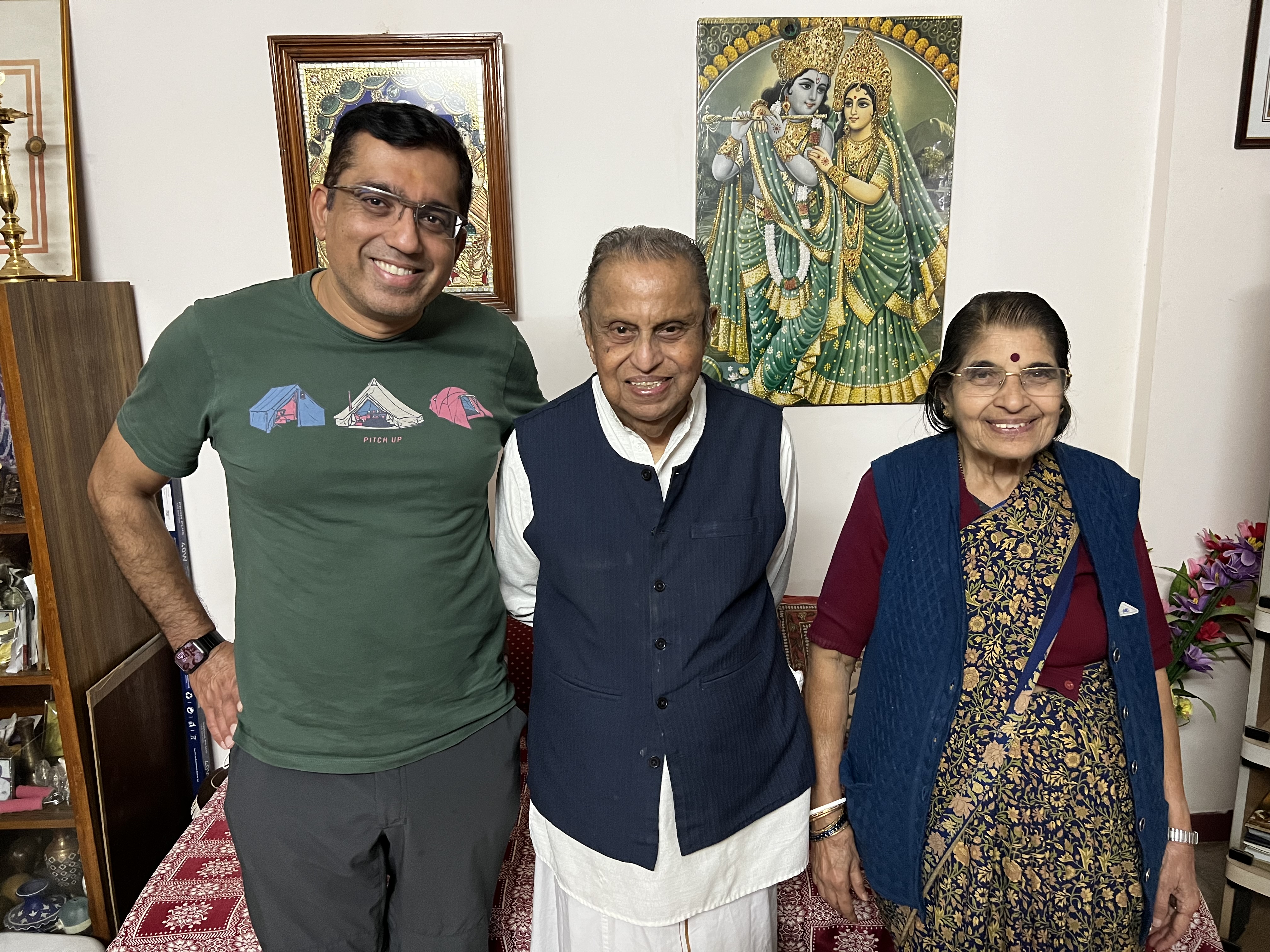
Sesh with Prof. and Mrs. Rajaraman at their home in Bengaluru, October 2022
737
The Amazing Thinker and Teacher
As a teacher, he had the rare ability to make complexity simple. I still remember him explaining how compact discs worked—turning a small piece of plastic into a lesson on physics and encoding—and clarifying the difference between expert systems and machine learning long before AI became mainstream. I treasure the signed copies of his books, reminders of his belief that knowledge must be accessible. His clarity of thought brings to mind Hemingway’s aim “to put down on paper what I see and what I feel in the best and simplest way.” Whether writing a textbook or teaching me in his living room, he always revealed the underlying logic with elegance and simplicity.
A Timeless Legacy
As we bid him farewell, we celebrate a life lived with purpose, humility, and brilliance. Together, Dharma Mami and Rajaram Athan were the roots from which the great banyan tree of Indian IT grew—offering shade, nourishment, and inspiration to generations. From my earliest visits in 1982 to our conversations in the 2020s, they remained a constant source of wisdom and affection.
Their ambition ignited an industry, their care warmed our hearts, and their teachings illuminated our minds.
I miss him deeply, but I take comfort in knowing that his influence is enduring—encoded into the DNA of every computer scientist in India and alive in the lessons he so generously shared with me.
Sesh Iyer
Managing Director & Senior Partner
Boston Consulting Group, Washington, DC
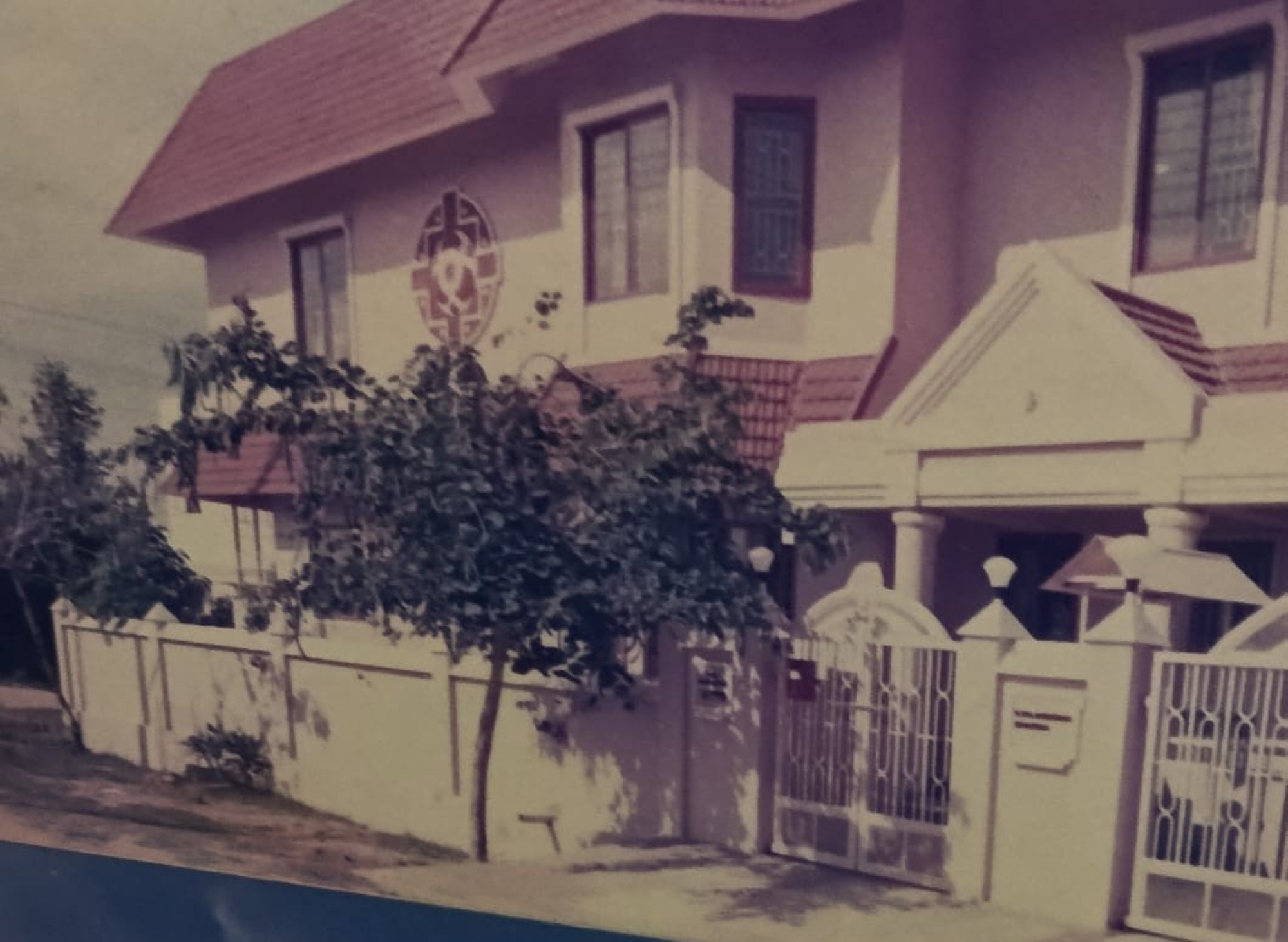
The Rajaraman home, Vidya Vikas, Tatanagar, Bengaluru
738
First Day Cover, 2019
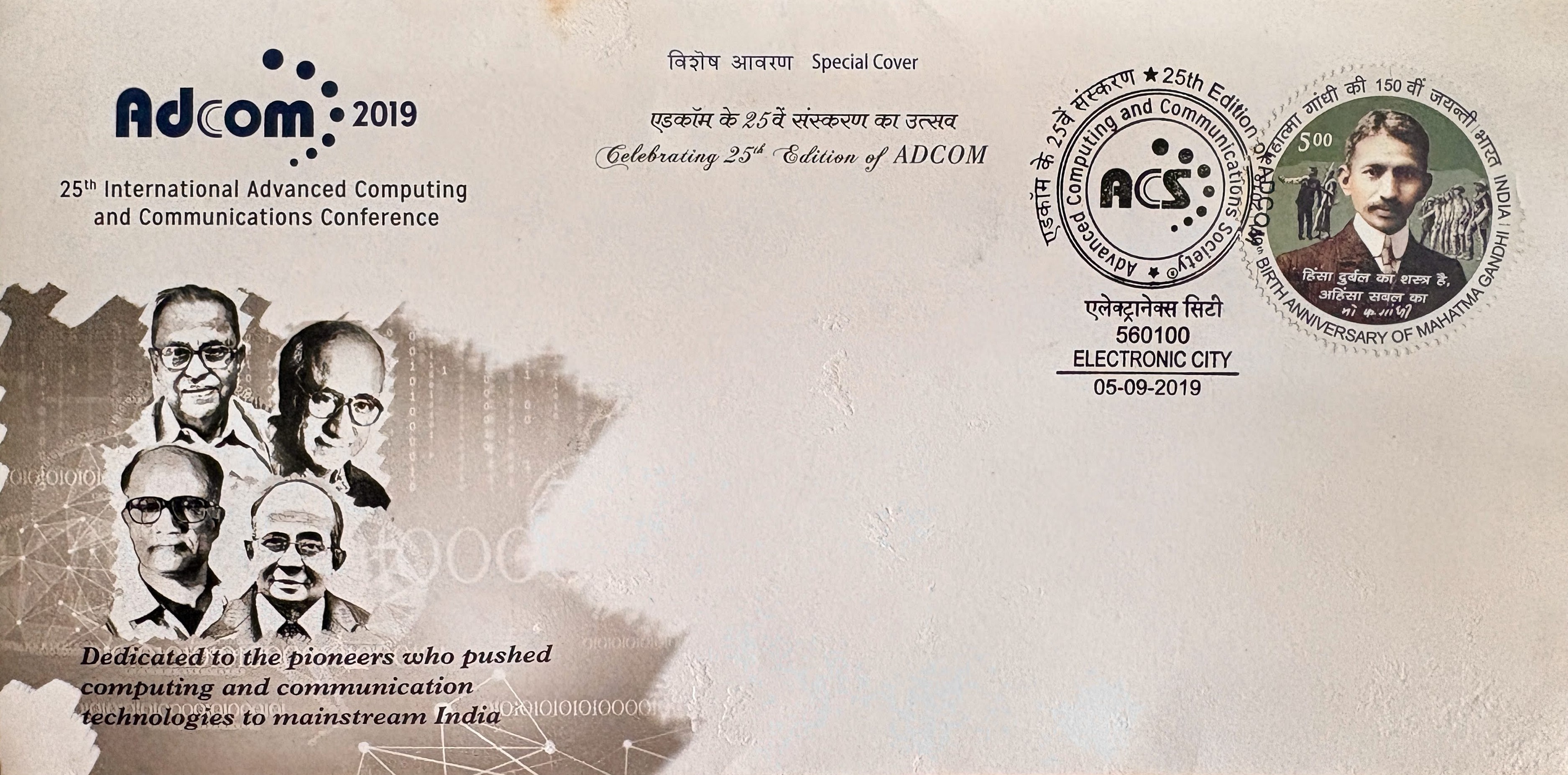
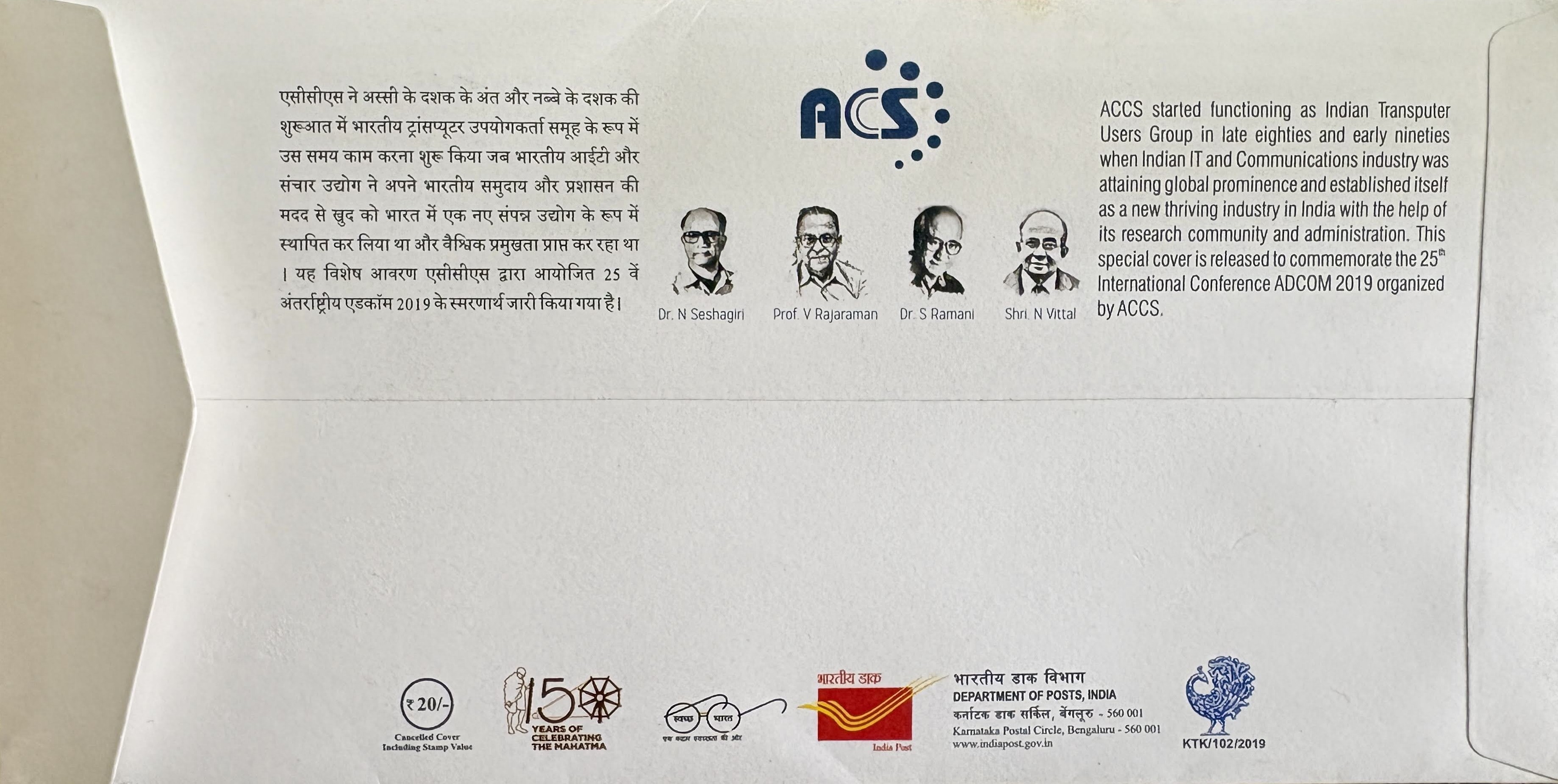
A First Day Cover released during the 25th International Advanced Computing and Communications Conference, 2019, recognizes the pioneers who pushed computing and communications technologies to mainstream India.
739
From our archives
The Spark, an IITK campus magazine published by the students from 1965 through 1989, was revived by
alumni in 2021. The new issues have been theme-based, with the intent to document the rich history of
the institute and celebrate the achievements of the present generation. The first six issues featured the
Introduction of Computer Science Education in India, starting from a barren land – literally, to the Param
series of computers.
Professor Rajarman’s enthusiastic support played a key role in establishing credibility for this project and
allowed us to reach a wide audience. He wrote nearly half a dozen articles, some of which are reprinted
here. Mrs Dharma Rajaraman also contributed to this effort, writing her recollections for the more
recent issues featuring the Counselling Service. We are thankful for their support.
All back issues of the Spark can be accessed at the IITK DORA site at:
The Spark
740
CSE at IITK – Some Recollections from those Early Days
V. Rajaraman (Professor, EE/CSE IITK, 1963-82)
The IBM 1620 was the first computer to be installed at IIT/Kanpur. It was a gift from the Kanpur Indo-American Program (KIAP) and arrived in July 1963. The corner room in the Western Labs was earmarked for its installation. When the computer came on a bullock cart and unloaded, we found that the door leading to the computer room was not broad enough to move it into the room. The wall at the far-end was broken and the computer was moved into the room which already had a false floor, false roof, air-conditioning etc. Professors Harry Huskey, Forman Acton, and Irving Rabinowitz had come earlier to help run the computer. The computer was installed by Indian IBM customer engineers who had been trained for this purpose. IBM 1620 was the first computer with a FORTRAN compiler to be installed in India. No other IIT had a computer in 1963.
I started teaching TA 306, the first course in computer programming in 1964 on the 1620. The computer had 60,000 digits of memory and did decimal arithmetic by looking up an arithmetic table stored in its memory. Then IBM 1620’s informal name was CADET and people joked that it stood for “Can’t Add; Doesn’t Even Try!” The input used decks of punched cards. The output was also a deck of punched cards that were printed off-line using an accounting machine as a printer. Programming was done using FORGO, a version of FORTRAN II.
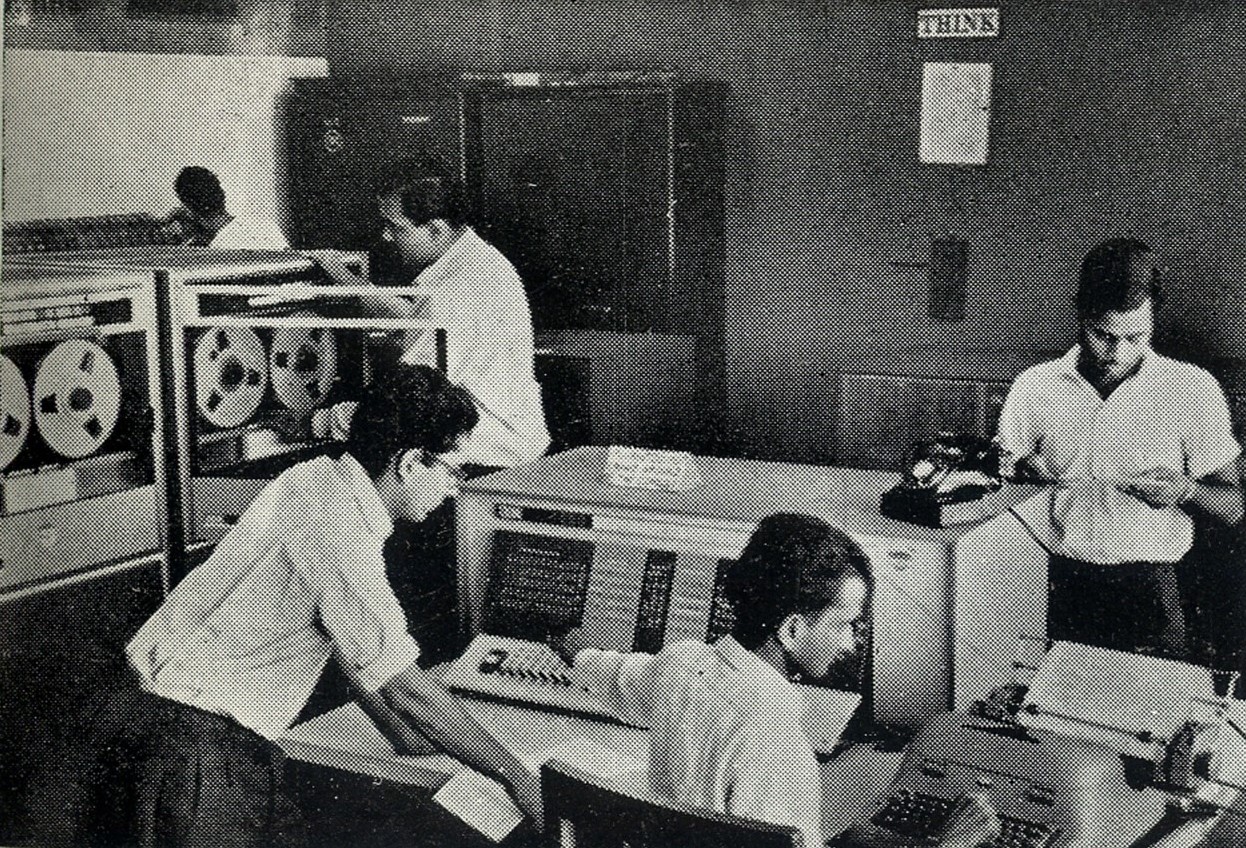
The IBM 1620 at IIT/Kanpur. R.N. Basu is mounting a tape. IBM Engineer Hinduja is standing in front of the console. M.N. Misra is operating the console typewriter. Source: IIT Kanpur 1965 Convocation Publication, IITK and CMU Archives
741
Students wrote their program, went to a card punch, punched the program, assembled the cards as a deck and submitted the deck to the operator. The operator collected all the decks from the students, made a batch of programs, and fed it to IBM 1620. The computer ran the programs and the results were punched on cards. Students collected their results and printed them, only to find that the result was an error message saying missing comma in line number 7! After correction, the deck was re-submitted. Hopefully, there were no more errors. Else, the cycle was repeated till the results came through. Finally, if there were no logical errors in the program, the answer was correct. Most students had to go through three rounds of submitting decks, debugging, re-punching, and re-submitting, before they got the correct answer, even for a simple program such as finding the largest of 10 numbers. At the end of the first laboratory class a student came to me and innocently said: Sir, you said our computer is a wonderful machine that will reduce the work I have to do to solve problems. Now I don’t know whether I am working for the computer or the computer is working for me!
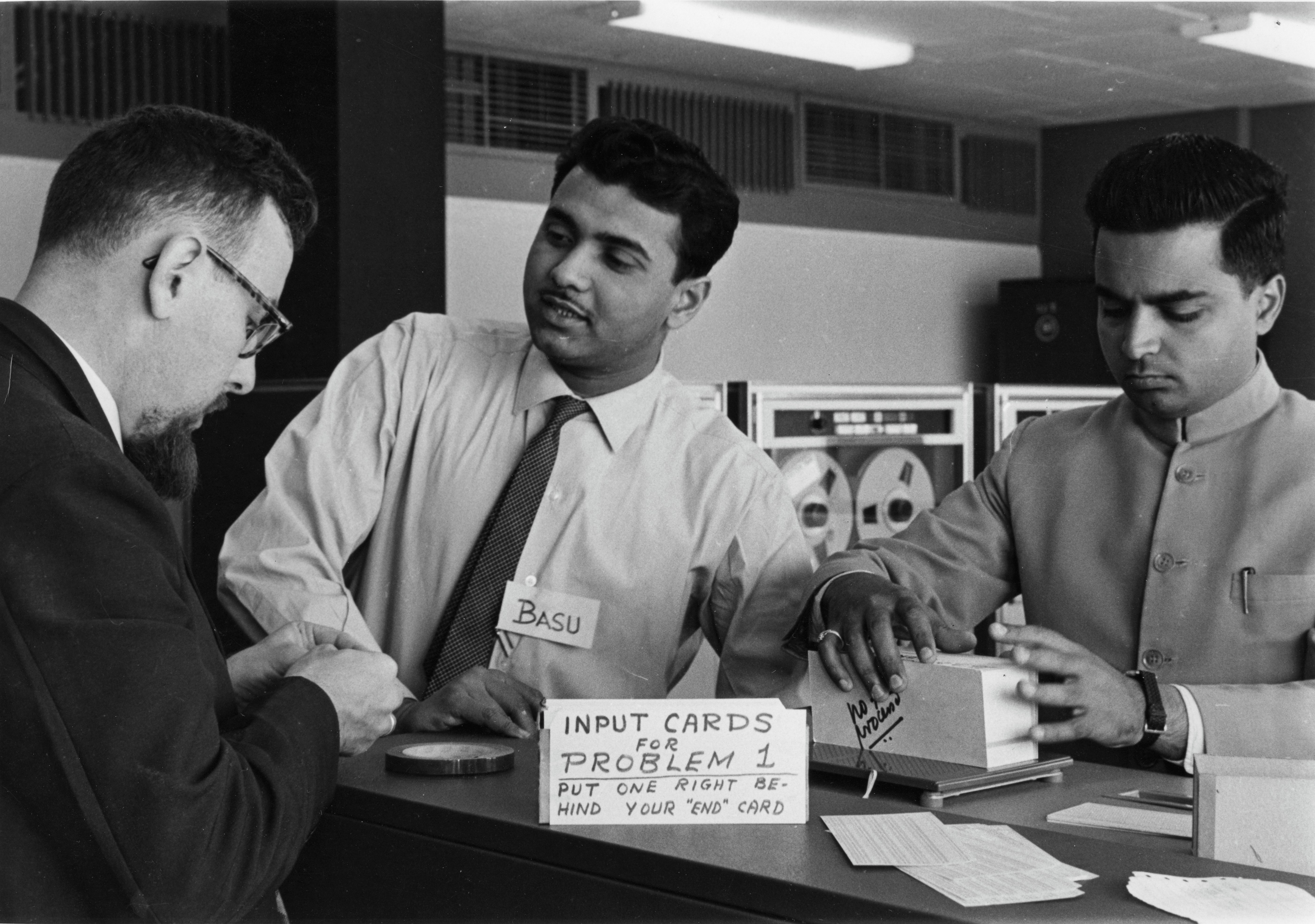
Working on a deck of computer cards. Prof Irving Rabinowitz is visible on the left, and R.N. Basu, a software engineer with the IITK Computer Centre, is visible in the middle. Picture: Prof Irving Rabinowitz, from the KIAP photo collection of Prof Gio Wiederhold
By 1965, the 1620 was running 24 hours a day, 7 days a week and was saturated. Waiting time to get results from the computer was becoming too long and IIT/Kanpur started looking for a bigger computer. KIAP did not have a budget allocation to buy a larger computer and we had to find our own resources to make this purchase. Besides this, getting foreign exchange to buy computers was difficult.
Meanwhile, the Tata Institute of Fundamental Research (TIFR) in Bombay was allocated funds by the Government of India to buy a large mainframe computer. IBM was very confident that it would get the order from TIFR and had quoted an IBM 7044. However, TIFR decided to buy a CDC 3600 from Control Data Corporation instead and IBM was left holding an unsold 7044.
742
When IBM learnt that we were planning to buy a larger computer, it approached us with a proposal to sell the IBM 7044. The 7044 was a mainframe computer with 32 Kilo words (36 bits per word) main memory, 4 tape drives, a fast CPU, and I/O units, but it was already being phased out in the US by IBM and succeeded by the IBM 360 series. Gio Wiederhold, a visiting KIAP Professor, was given the task of negotiating with IBM and getting a unit with the latest upgrades, to ensure that it lasted us for a while. The normal practice of IBM was to quote the price of imported computers in US Dollars. We told IBM our difficulty in getting foreign exchange. IBM, after consultation with their management, offered to sell the machine for Rs.60 Lakhs after giving a 60% educational discount.
IIT/Kanpur, however, did not have Rs. 60 Lakhs in its budget which was a huge amount in 1965. After further discussions, IBM agreed to receive Rs. 60 Lakhs in five installments of Rs.12 Lakhs each year. This offer was given in writing by one of the sales managers of IBM India in early 1966. This offer was satisfactory. However, the new computer centre building was not ready and there was no space to put the huge 7044 in the Western Laboratory. IIT/ Kanpur allocated Rs.12 lakhs to be paid in the financial year 1966-67. The 7044 was to be delivered in the later part of 1966.
We then received a shock. The Rupee was devalued on 6 June 1966 from Rs. 4.76 to a dollar to Rs.7.50 to a dollar. IBM India reneged and told us that the deal was off. Prof. Forman Acton of Princeton University, who was a member of the first American team that supervised the installation of IBM 1620, had stayed in contact with IITK. We told him about our problem with IBM. He immediately shot off a letter, in his own inimitable style, to one of the senior Vice-Presidents of IBM in the USA (who incidentally had been Acton’s student at Princeton) that what IBM India was doing was unethical and they could not go back on a written commitment. Acton got a reply that IBM would stand by its obligations. The IBM India sales manager came back and agreed to sell IBM 7044 as per the original agreement. The 7044 was delivered in mid-July and became operational in September 1966.
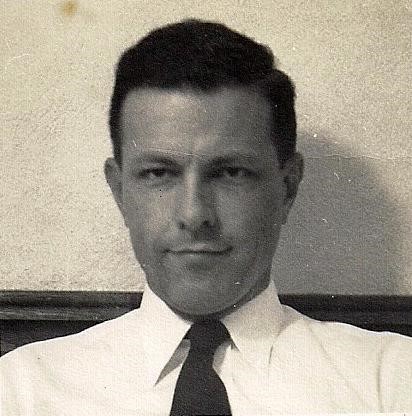
Professor Forman Acton (Princeton University) was part of the original team that installed the IBM-1620 in 1963-64. He stayed in contact with IITK and returned for another semester-long visit in August 1967. Picture: IITK archives.
743
Use of IBM 7044 as a stand-alone computer was inefficient as Input/Output was too slow compared to its processing speed. An IBM 1401 was required as an Input/Output computer. The 1401 read punched cards input and stored the program/data on a tape. This tape was read by IBM 7044 and the computed result was written on another tape. This was read by the IBM 1401 and printed on a high-speed line printer. The 1401 was made in India by IBM and we bought it the next year. It had 4 Tape drives, 5 Disk drives (2MB/drive), a card reader, and a high-speed line printer. It cost around Rs.35 Lakhs.
The IBM 1620 was moved from the Western Lab to the New Computer Centre Building after 7044/1401 started working in 1967. Eventually, it was sold to Steel Authority of India R&D Division, Ranchi around 1970. Dr. S.C. Mehta who was on the faculty at IIT/K joined SAIL R&D and was using it in their research.
The IBM 7044 and IBM 1401 were the main computer systems at IIT/Kanpur from 1966 till the DEC-1090 arrived in 1979. IIT/Kanpur was able to sell these computers by auction, a month before the DEC-1090 arrived, for Rs. 45 Lakhs. How we did it is another story!
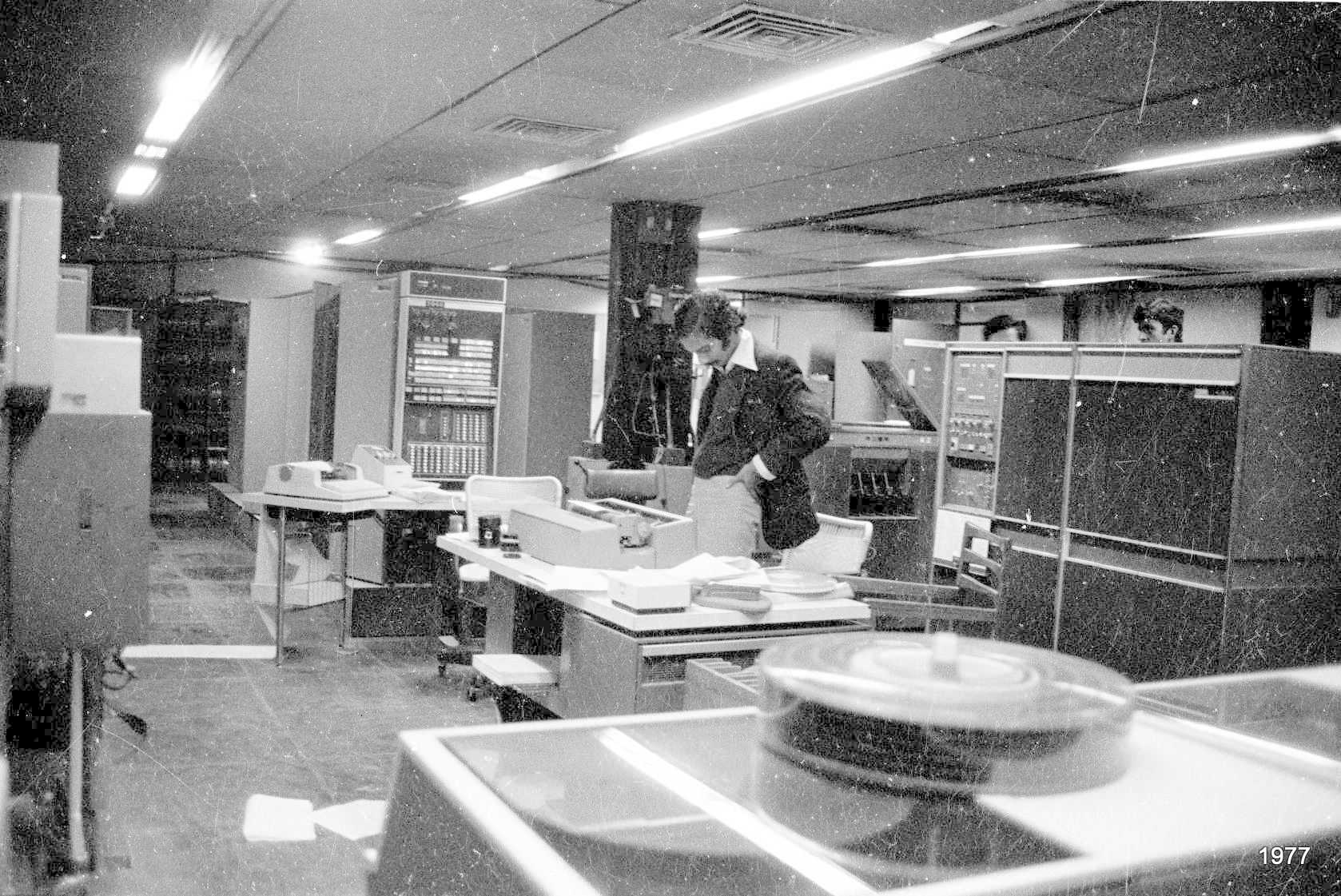
The IIT Kanpur Computer Room, c. 1977. The IBM-7044 is visible in the back, and the IBM-1401 on the right. The student in the room is Prasanna Mulgaonkar. Picture: Shirish Joshi (BT, ChE, 1973-78)
Originally published in The Spark, Issue 2, December 2021, pg. 40-44, available at: Issue 2
For additional details on the arrival of the IBM-1620 please refer to The Spark, Issue 1, October 2021, pg. 4-14, available at: Issue 1
744
Establishment of the CSE Academic Programmes at IIT/Kanpur
V. Rajaraman (Professor EE/CSE, 1963-82)
Prologue
I joined IIT/Kanpur as an Assistant Professor in the Department of EE on March 23, 1963. I was an Assistant Professor of Statistics at the University of Wisconsin, Madison before I came to Kanpur. My Ph.D. was in EE (Adaptive Control Systems). When I joined IITK there was no campus. We were in a wing of HBTI in Agricultural Gardens (called Company Bagh by locals). We officially moved to the Kalyanpur campus at the end of March 1963. The only building which was ready was the workshop. First, the library moved to the workshop. About a month later, the departments moved to the workshop. I remember the May - June heat in the workshop where all faculty of EE sat together in one enclosure. The next buildings to be ready were the Southern and Western Labs. The IBM 1620 moved to the far end of the Western Laboratory in August 1963.
The (Late) Professor H.K. Kesavan joined as Professor and Head of the EE Department in early 1964. Before joining IITK he was the Head of the EE Department at the University of Waterloo in Canada. It was fortunate that he joined IITK as he was far-sighted and an excellent academic administrator. He was my mentor in my early days at IITK and I learnt a lot from him about academic administration. There was only a BTech programme when Kesavan joined. He was convinced that with a young research-oriented faculty joining the EE department it was necessary to start a post-graduate programme as soon as possible.
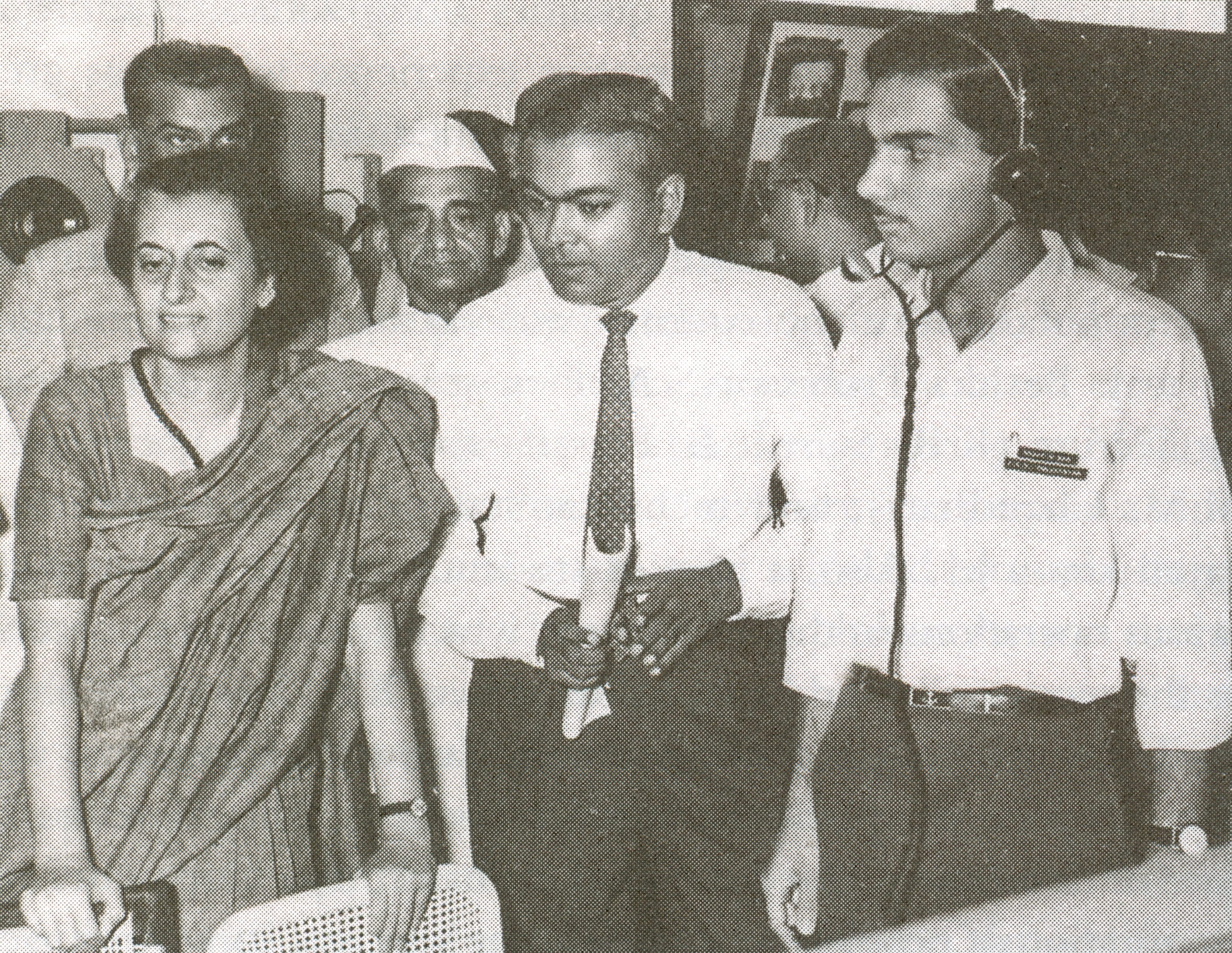
Prof. HK Kesavan giving Mrs. Indira Gandhi a tour of the IIT Kanpur Television Centre, 1966.
Source: EC Subbarao, “An Eye for Excellence: First Fifty Innovative years of IIT Kanpur
745
IITK was a new institute and it was necessary to publicise its special facilities and the young talented faculty. On Prof. Kesavan’s suggestion, I went to IIT/Madras and IISc, Bangalore in March 1964 to talk to graduating students in EE and tried to convince them to join the MTech programme being started in IITK in August 1964. The first batch of ten students joined in August 1964. Among them was H.V. Sahasrabuddhe who had earlier joined IITK as a research assistant after graduating from IIT/Bombay, S.C. Seth, C.V.S. Rao, and R.K. Ragade from IISc, Bangalore. (All three went on to get Phds.)
In early 1965 H.N. Mahabala joined the EE Department from the University of Waterloo. He had worked with a Bendix computer at the University Of Saskatchewan in Canada where he obtained a Ph.D. In August 1964, Professor Kesavan was made the Head of the Computer Centre in addition to his responsibilities as Head of EE. He requested me to join him in the Computer Centre as his deputy and I gladly accepted. I had taken courses in digital computation and programmed the IBM 704 in the USA during my student days and had extensively worked with analog computers during my doctoral research. In 1965 Mahabala and I started teaching some courses in computers and requested Kesavan to allow us to introduce an option in MTech EE with specialisation in Computer Science. He was far-sighted and saw the future growth of computing and the unique position of IITK that had a computer. It was an informal arrangement as the MTech degree was awarded in EE.
Starting an M.Tech. (Computer Science) Option in the EE Department
The Computer Science option in EE became very popular and a majority of students admitted to MTech EE opted to take courses in Computer Science and do a project in that area creating some friction among the EE Department faculty. The courses in Computer Science were limited. They were on Digital Logic Design, Software Engineering, Programming Languages, Artificial Intelligence, and Design of Information Systems. Approximately a dozen students were graduating with MTech with the Computer Science option in EE. Ph.D. students also joined EE in 1965/66. If I remember right H.V. Sahasrabuddhe started working with Professor H.K. Kesavan as a Ph.D. student in 1966 in the area of power systems that involved considerable programming using the 1620.
In 1966, P.C.P. Bhatt who was a lecturer and C.R. Muthukrishnan started working on their Ph.D. thesis with my guidance. Muthukrishnan submitted his thesis in 1969 working in the area of Decision Tables and joined the faculty of EE along with Sahasrabuddhe. Another Ph.D. student was (Late) T. Radhakrishnan who worked with me in the area of parallel information retrieval. He also joined the EE faculty. P.C.P. Bhatt also obtained a Ph.D. degree in 1969. We now had six faculty members in the Computer Science area. In 1968, Professor Kesavan left IITK and returned to the University of Waterloo where he started a new Systems Engineering Department. I took over as the head of the Computer Centre.
Starting an Interdisciplinary Post-Graduate Programme in Computer Science
In 1971 the Senate of IITK approved starting separate MTech programmes in Computer Science, Materials Science, and Nuclear Engineering. The first admissions to a new MTech Computer Science Programme were started with an admission of around a dozen students. As an interdisciplinary programme the minimum qualification for admission was BTech in any discipline or an MSc degree in Mathematics or Physics.
746
The parting of ways from the EE Department was cordial. The EE faculty was happy that Computer Science got separated as the MTech students in EE, after the split, were taking EE courses and working on their MTech and Ph.D. theses in the traditional EE subjects such as Power Engineering, Electronics, Control Systems, Electromagnetics, and Circuit Theory.
I continued to be a faculty in EE in addition to being the Convenor of the Computer Science Programme. The first MTech (Computer Science) batch graduated in 1973 and most of the graduating students were employed by TCS. The course was in great demand and we continued to get good students. Admission was by a written test and an interview. GATE had not started.
The Computer Science faculty size increased slowly and steadily with Shyam Kumar, S.V. Rangaswami, S.K. Basu, Narsingh Deo, R.M.K. Sinha, V.K. Vaishnavi, S.N. Maheshwari, Arvind (Visiting), S.C. Seth (Visiting), R. Kodandapani, K.V. Nori, and R. Sankar joining over the years. IIT/Madras installed an IBM 370/155 system in 1973 and did not have any experienced faculty to manage the computer centre. Mahabala accepted an invitation from IIT/Madras to join its faculty, manage the Computer Centre, and also start an academic programme in Computer Science. He persuaded Muthukrishnan and Radhakrishnan to join him. P.C.P. Bhatt was invited by IIT/Delhi to start its Computer Science programme.
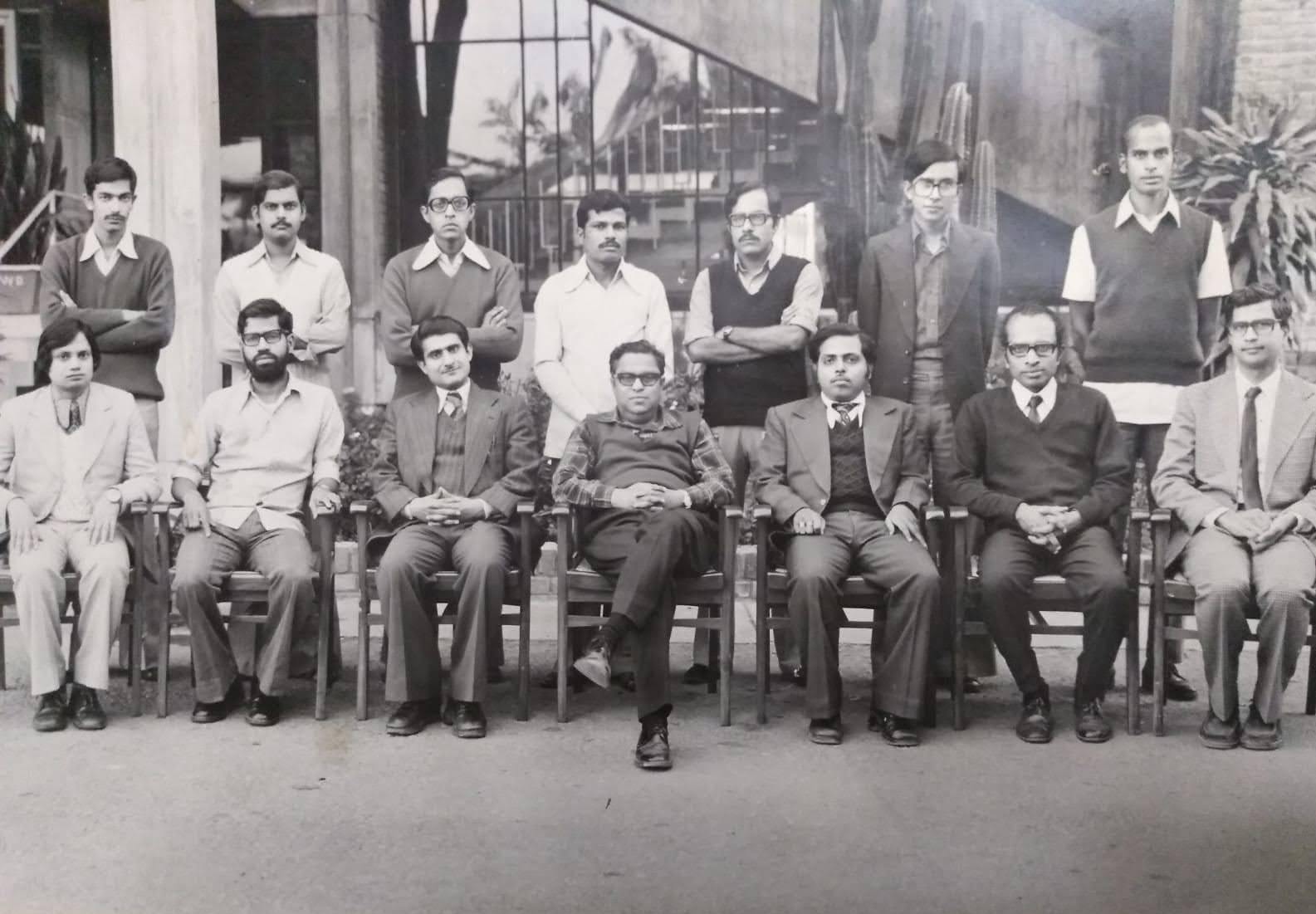
An early picture of the CSE Programme Faculty, in the early 1970s, received from Prof M.S. Krishnamoorthy. This photo was taken after a Quality Improvement Program Course - an intensive course aimed at improving the quality of faculty members in other Engineering Colleges. Seated (L to R) are a Program Attendee (QIPA), M.S. Krishnamoorthy, QIPA, V. Rajaraman, R.M.K. Sinha, QIPA, and H.V. Sahasrabuddhe. Standing in the back are additional QIP attendees along with V. M. Malhotra and V. K. Kaithal who were the Teaching Assistants for that course
747
The MTech and Ph.D. programmes thrived. IITK was graduating around a dozen MTechs every year. The Ph.D. programme was also thriving. In my memory several students including A.S. Sethi, V.K. Vaishnavi, M.S. Krishnamoorthy, R.M.K. Sinha, V.Gupta, M. Ibramsha, Om Vikas, B.K. Gairola, Asha Goel, V.M. Malhotra, R. Govindarajulu, S. Krishna, and S. Biswas obtained Ph.D. during the period 1970 – 1982. (This list is not exhaustive).
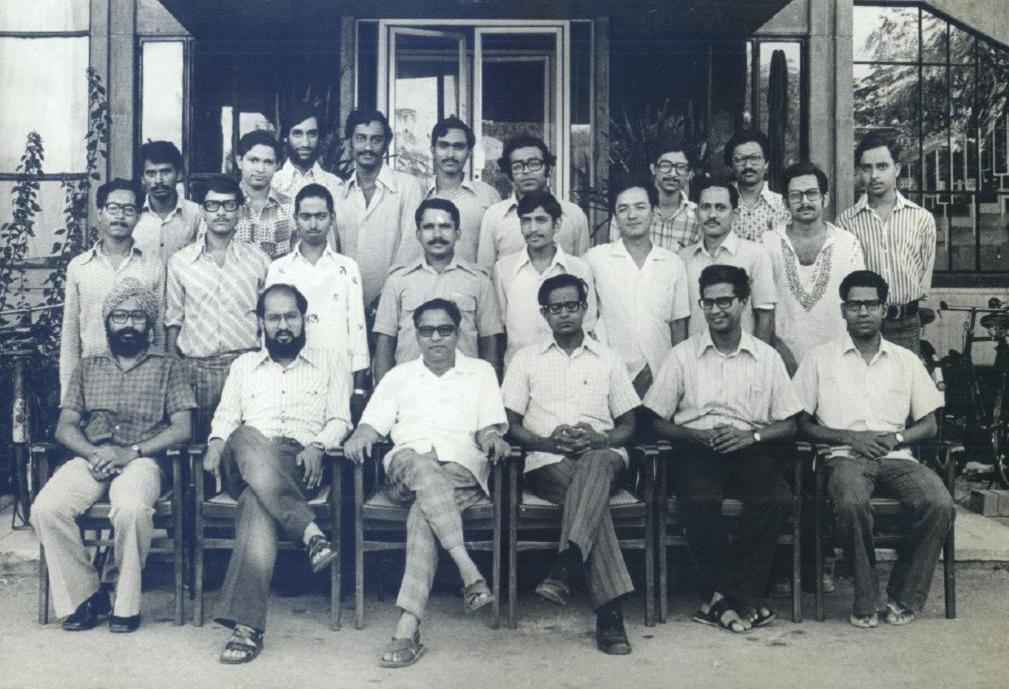
The IITK CSE Faculty with the MTech graduating class of 1978.
Seen here (L to R) are Row 1: Professors A.S. Sethi, Arvind (visiting from MIT),
V. Rajaraman, R. Sankar, H.V. Sahasrabuddhe, M.S. Krishnamoorthy; Row 2: T. Sanyal, Agarwal, Murthy,
Lt. Gyan Prakash, Ashok Modi, Flt. Lt. Routela, Gorthi, Madhav Prabhu; Row 3: Alok Khare, Satish Goyal, Satpal,
Laxman Badiga, Mukkamala Ravi, M. Pramod Kumar Rao, R. R. Gargeya, Ambrish Mathur, Bhasker
Picture shared by Professors Hari Sahasrabuddhe and M S Krishnamoorthy
Introducing the B.Tech. Programme in Computer Science
By the mid-1970s, the faculty of the Computer Science programme felt that CS was maturing as a discipline, and the time was ripe to start an undergraduate programme. As the convenor of the CS programme, I prepared a proposal, after consulting the faculty, to start a BTech programme in Computer Science. I discussed this proposal with the Acting Director Dr. Jagdish Lal in 1975. He was convinced and as Chairman of the IITK senate introduced the proposal in a senate meeting. There was extensive discussion in the senate with many members opposing the resolution.
748
The arguments against its introduction included thoughts that: it was not a major discipline; had little content besides programming; was already being offered as programming diplomas by private companies; would not offer employment for BTech graduates; and was not an Engineering course. Finally, other departments would have had to give up some seats as the total BTech intake was fixed by the Government of India.
I and my Computer Science colleagues in the Senate pointed out that it was indeed a mature discipline; it was not just programming; there were professional societies on computers in India, the UK, the USA, Japan, and several countries in Europe; there was an International Federation of Information Processing Societies (IFIPS); it was growing rapidly, and would become essential knowledge for all engineers. Many countries in the world including the UK, the USA, and several countries in Europe already had Computer Science departments in their universities.
Despite our attempts to convince the senate members, no decision was taken. Dr. Jagdish Lal left IITK in 1976 and returned as the Principal of Motilal Nehru Regional Engineering College (MNREC), Allahabad, from where he had come to IITK. While the IITK senate was continuing the debate on the BTech programme in Computer Science, Dr. Lal convinced the Board of Governors of MNREC and started a BTech programme in Computer Science in 1976 two years before IITK did, thus becoming the first institute in the country to offer this.
In 1976, Dr. A. Bhattacharya took over as the new Director of IITK. I had a long discussion with him and he was convinced of the importance of starting a BTech programme in CSE. He re-introduced the proposal in the senate. The arguments for and against were repeated. Finally, Dr. Bhattacharya steered the discussion successfully and the senate approved a BTech programme in Computer Science with a student strength of 20 in 1977. He also steered the proposal through the Board of Governors. The programme was slated to begin in 1978. A few seats were taken from other departments and allocated to the BTech programme in Computer Science.
BTech Programme Begins
BTech in Computer Science was announced as a discipline in the Joint Entrance Examination (JEE) of 1978. Many parents came to me to discuss Computer Science and its prospects before choosing the department for their children. I distinctly remember Rajeev Motwani’s father and Jaideep Srivastava’s father who were anxious about the future of Computer Science and had long discussions with me. Both Rajeev and Jaideep joined the first batch of the BTech Computer Science programme.
To the surprise of the entire faculty of IITK and the other IITs, BTech Computer Science became the first choice of a large number of students who qualified in the JEE. By 1980, the last student admitted to the program had an All-India Rank of 40! The students from the first (1978) batch were uniformly good and many of them distinguished themselves as world leaders in Computer Science.
749
The IITK CSE Department circa 1982, with many of the faculty and members of the first B. Tech. batch present.
Seated on chairs in the second row are Prof. Chandrasekhar, Prof. RMK Sinha, Prof. H.V. Sahasrabuddhe,
Mrs. Veena Sahasrabuddhe, Mrs. Dharma Rajaraman, Prof. V. Rajaraman, Prof. R. Sankar, Mrs. Padmavathy Sankar,
Prof. Somenath Biswas, and Mrs. Kiran Biswas.
Picture shared by CK Mohan (seen in the middle of the front row), and Prof. V Rajaraman
Epilogue
A professor of IIT/Kharagpur collared me after a meeting in Delhi and asked how IITK could give a BTech degree in Computer Science when there was no department. I retorted that IITK was a pioneer that broke many existing norms. IITK was the first IIT to have a core curriculum, letter grades, grading “on a curve”, a semester system, sizeable humanities courses in the BTech, etc.
When the other IITs saw the success of IITK’s BTech programme in Computer Science, they unitedly requested the Ministry of Human Resources Development to allow them to start a Department of Computer Science and Engineering. The ministry agreed in 1983 and all IITs started a CSE Department. The Computer Science Programme at IITK became the CSE Department in 1984. I was not at IITK when the new department started as I had left IITK to join IISc in 1982.
Originally published in The Spark, Issue 3, April 2022, pg. 79-83, available at: Issue 3
750
Catching Up with Old Friends
Professors V. Rajaraman, H.V. Sahasrabuddhe and R. Sankar, three of the faculty that helped steer the Computer Science B.Tech. Program at IIT Kanpur, stayed in touch with each other over the years. With their inputs, IITK defined the Undergraduate CSE curriculum, with the first batch joining in 1978, and graduating in 1983. Here are some images clicked in Bengaluru, August 2019.
 resized and edited.jpg)
Prof HV Sahasrabuddhe (on the Right) with Mrs. and Prof. Rajaraman, Bengaluru, August 2019
Picture: HV Sahasrabuddhe
 resized cropped brightened.jpg)
Prof. and Mrs. Sankar, Mrs. and Prof. Rajaraman, Bengaluru, August 2019
Picture: Ananth Sankar (BT, EE, 1982-86)
Full story appears in The Spark, Issue 3, April 2022, pg. 84-87, available at:
Issue 3
751
CSE at IITK: The Arrival of the DEC-1090
V. Rajaraman (Professor EE/CSE, 1963-82)
Earlier, I had written the story of the purchase of IBM 7044/1401. These systems became fully operational in 1966 in the new Computer Centre building. From day one they were used 24 hours a day, 7 days a week. Besides this system, there was an IBM 1620 that continued to be used for undergraduate teaching and laboratories until it was sold to SAIL R&D. We also bought an IBM 1800, a small process control computer, for experiments in real-time control.
The (Late) Professor John McCarthy, head of the Artificial Intelligence Laboratory at Stanford University visited IITK in 1971. He saw that students were using a computer that had a batch processing operating system (OS) which did not allow interactive computing. He was a great believer in interactive time-sharing systems. He had written a famous memo to the Director of the MIT computer centre in 1959 pointing out the advantages of interactive time-shared use of computers for better human-computer symbiosis that would improve the productivity of computer users. That memo led to the development of the first time-sharing operating system in the world, called Compatible Time-Sharing Operating System (CTSS) in 1961, for the IBM 709 at MIT.
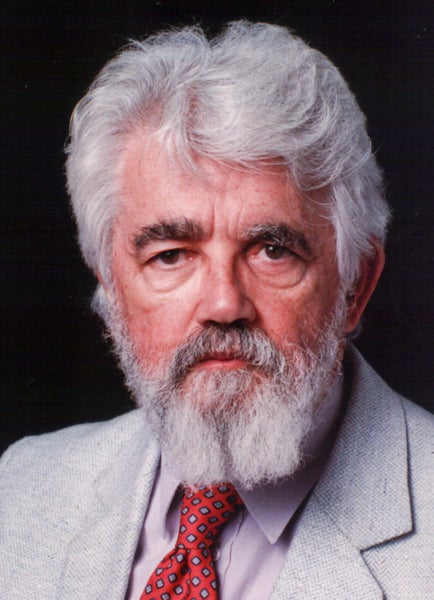
Professor John McCarthy, Turing Laureate, 1971. Picture: Stanford University archives
Professor McCarthy told me that his laboratory at Stanford had a DEC PDP 1 computer with a time-sharing OS which was in good working condition but was being replaced with a larger computer. He wanted to donate the PDP 1 to IITK. I was at first reluctant as it is normally difficult to maintain a used computer. On second thought, after consulting my colleagues in the computer centre, I decided that such a machine in the laboratory would allow students to have hands-on experience with both hardware and software of a computer that was not possible with IBM machines used by all departments and maintained by IBM engineers.
The PDP 1 computer was shipped courtesy of KIAP and arrived at Kanpur in 1972. It was installed in the Computer Centre by our students who were assisted by Professor H.N. Mahabala and it started working. The computer came with only two terminals. One was a graphics terminal and the other a teletype. Several users could not use it simultaneously. Its greatest attraction for students was a large display terminal that came with it. It was used to play one of the early computer games called Star Wars. I gave both hardware and software projects on PDP 1 to many undergraduate students of the EE department. I remember R.S. Nikhil and Bhasker, among others, who worked with it.
752
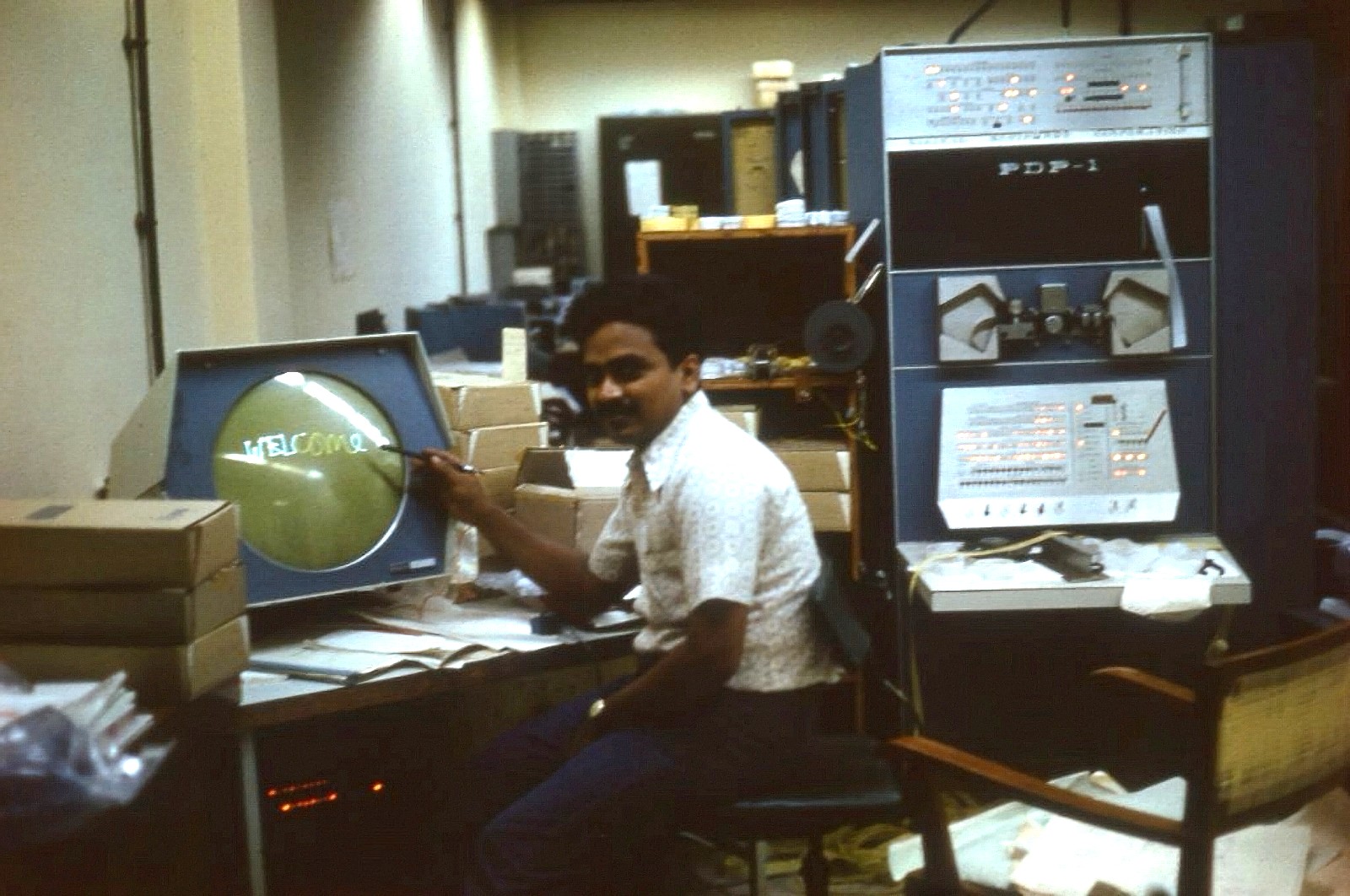
The PDP 1 at IIT Kanpur. Visible in the picture is MTech student, MV Rao. Picture: Amrit Yegna Narayan
A 20 MB disk (one of the largest IBM disks in the 1960s) was added to IBM 7044/1401, but by 1976, it was saturated and IITK wanted to replace it. However, during the 1970s there was a serious balance of payments deficit in India, and the import of computers was highly restricted. IITK’s budget also was not adequate to buy a new machine that would have cost around Rs. 1 Crore.
I was a member of the Electronics Commission of the Government of India, chaired by the Secretary of the Department of Electronics (DoE), now called the Ministry of Electronics and Information Technology (MEITY), from 1978 to 1982. I was also a member of several committees of the DoE that approved buying computers for the Regional Computer Centres being set up by the DoE and computers requested by other organizations during the late 1970s. I was able to convince the Secretary of the DoE of the need to replace the aging IBM 7044/1401 system at IITK. The Secretary agreed to fund IITK up to Rs.50 Lakhs in 1978 provided IITK was able to contribute matching funds from its budget.
IITK was short of funds, and it was difficult to allocate Rs. 50 Lakhs from its budget for a new computer. I felt that we could raise some money by selling the IBM 7044/1401 computers. As I pointed out earlier, there was a foreign exchange crunch during the latter part of the 1970s. When the Janata Government was in power after the defeat of the Congress party in 1977, George Fernandes was the Industries minister. A new government policy required foreign companies to dilute equity and take an Indian partner. IBM and Coca-Cola refused to comply and were asked to leave India in 1977.
The IBM 1401 was a highly popular computer in India with over 100 companies having 1401 installations. Many of these companies had saturated their 1401s and wanted to expand by renting/buying additional 1401s for their software packages. Their investment in 1401 software was enormous. The IBM plant in India was the only one in the world refurbishing used 1401s and renting/selling them for reuse. IBM had discontinued the sale of 1401 for the rest of the world in 1971. Many Indian companies were thus in a bind with IBM’s exit and I knew that there would be a market for IITK’s 1401. Besides this, IITK had a stockpile of critical spare parts for both 1401 and 7044.
I told the then Director of IITK, Dr. A. Bhattacharya, that we could raise some funds by selling the 1401 and 7044. He felt that it might be pittance but agreed. Consequently, a committee was appointed that included Srivastava, the then chief accounts officer, and some other professors besides myself. The committee discussed the procedure to conduct the sale. It was decided to advertise it in the papers and separate tenders were invited for the two computers with an earnest money deposit of Rs. 5 Lakhs each. Many prospective buyers visited IITK to inspect the machines to see whether they were in working condition and also to assess the availability of spare parts. On the day assigned to open the tenders, all the tenderers were present, and the committee met them and explained that their tenders were final and that there would be no negotiation. It was also pointed out that in case a tenderer reneged, the earnest money they had deposited would be forfeited.
The tenders were opened one by one. There were around 10 bids for 1401 and only one for 7044. The committee was flabbergasted when one of the bids was Rs.30 Lakhs for 1401! The next highest bid was 15 Lakhs. There was only one bid of Rs. 15 Lakhs for 7044 – a much more powerful computer. The highest bid for 1401 and the lone bid for 7044 were from the same company. This company was owned by two entrepreneurs, Sadasivan and Raghunathan, and was based in Bangalore. Sadasivan was an ex-IBM customer service engineer with many years of experience in maintaining 1401s and Raghunathan was a financier. Sadasivan was confident of maintaining the computers and had assessed that the spare parts IITK was offering were adequate. I learnt that they had already lined up a customer who had contracted to buy two shifts of IBM 1401 time to run their existing programs. They had second thoughts on 7044 and withdrew their offer. The committee explained that they would forfeit Rs. 5 Lakhs, the earnest money deposit.
753
After the formal tendering process was over, I invited Sadasivan and Raghunathan for a discussion. I asked them why they were withdrawing their bid for the 7044 which was at least 10 times faster than the 1401. Their trepidation was a lack of customers as most companies in India were not familiar with the 7044 and all their software was for the 1401. I then offered to depute programmers from IITK to write software for the 7044 to enable 1401 programs to be run on it much faster. I also assured them that if the software did not work, they could return the 7044. They agreed to take the 7044 and paid Rs. 15 Lakhs. The software was developed in Fortran by our programmers, Nirmal Roberts and K.S. Singh with the guidance of Professor H.V. Sahasrabuddhe. It was good software and ran 1401 programs faster in 7044 than in 1401.
Dr. Bhattacharya was pleasantly surprised to learn of the sale of the computers for Rs. 45 Lakhs after they had been used for 13 years. We had bought the two machines for around Rs. 95 Lakhs in 1966. The circumstances during 1978-79 were fortuitous for the sale of used mainframe computers in India. Later mainframe computers were sold as junk.
With the time-sharing operating system, the terminals of the DEC-1090 (right) replaced the punch card machines of the IBM-7044 (left).
Visible on the right, in front of the camera, is Rajeev Motwani of the first Undergraduate CSE batch. Pictures: (L) Echoes In Memory,
IITK photo yearbook, 1982; (R) Growing Up, photo yearbook, 1983
754
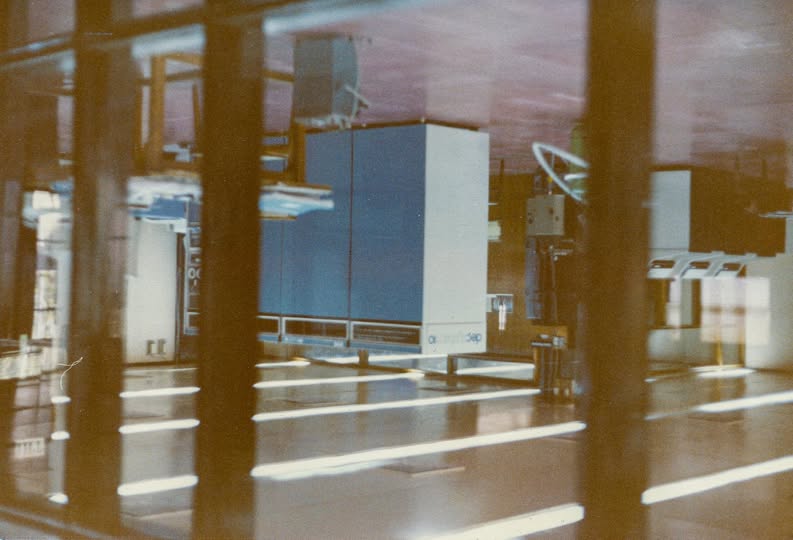
The DEC1090 at IITK c. 1979-80. Picture: Clicked by the Late Mahadevan Ramesh (MSc Physics 1972-77), shared by Murali Monagur.
With Rs. 45 Lakhs from the sale, IITK allocated Rs. 5 Lakhs from its own budget and we were able to match the grant of Rs. 50 Lakhs by the Department of Electronics (DoE). With Rs. 100 Lakhs in the kitty we started exploring the market for a new machine. An evaluation committee was appointed by DoE that invited quotations for a high-end time-sharing computer. Digital Equipment Corporation won the tender. DoE negotiated for two DEC 1090 computers, one for IITK and the other for IISc, Bangalore. IITK had a larger budget and got a bigger DEC 1090 computer. The DEC 1090 was installed in 1979 at the location vacated by IBM 7044/1401.
Originally published in The Spark, Issue 3, April 2022, pg. 89-91, available at: Issue 3
Cover Pictures by Shirish Joshi (BT, ChE, 1973-78)
Front – Prof Rajaraman at his home in Bengaluru, Dec 2023
Back – Prof and Mrs Rajaraman at their home at IITK, with a thali of Laddoos to feed the hungry hordes. Clicked at Holi, 1978.
Cover Design: Enakshi Jain (Outreach Cell, IITK)