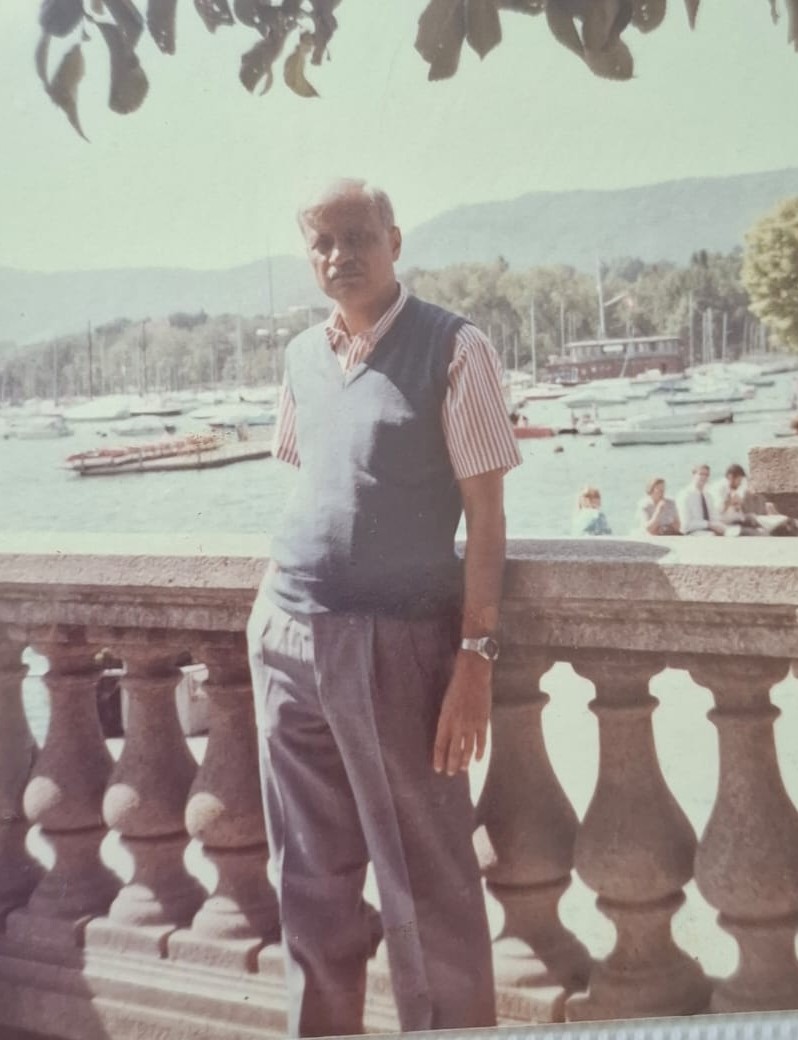
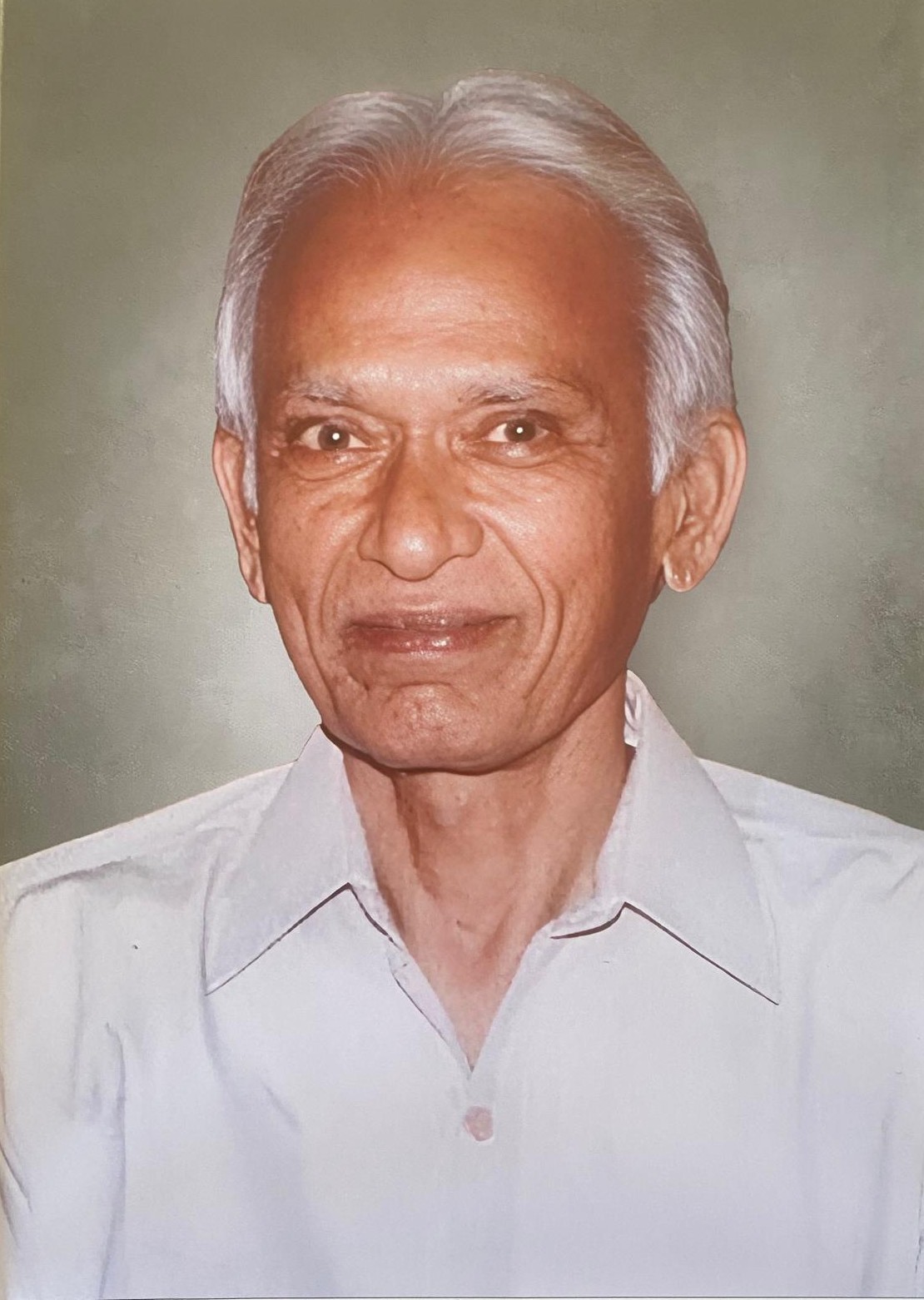
Thank you very much for sending us a copy of the December 2025 issue of The Spark. We are deeply grateful for the heartfelt tribute you have shared, which has brought immense comfort to our family. On behalf of Dr. P. Dayaratnam's family, I would like to convey our heartfelt gratitude to The Spark Editorial Team for the thoughtful tribute to my father included in this magazine. It truly means a lot to our family.
We are deeply moved by the manner in which his contributions to IIT Kanpur have been remembered and articulated. The tribute reflects the care and respect with which the magazine has acknowledged his role in the establishment of the Civil Engineering Department and the enduring legacy of the Structures Laboratory. It is profoundly meaningful to us to see his work and dedication remembered as part of the Institute's living history.
We would also like to commend "The Spark" Editorial team for the effort that has gone into preserving and sharing the broader institutional memory of IIT Kanpur through the magazine. It was a joy to read about the many wonderful developments at IITK. The articles brought back beautiful memories of campus life; the peacocks were a delight to see once again. My two sisters, Nirmala and Sarah, and I grew up on the IIT Kanpur campus and have been connected to it for over 25 years.
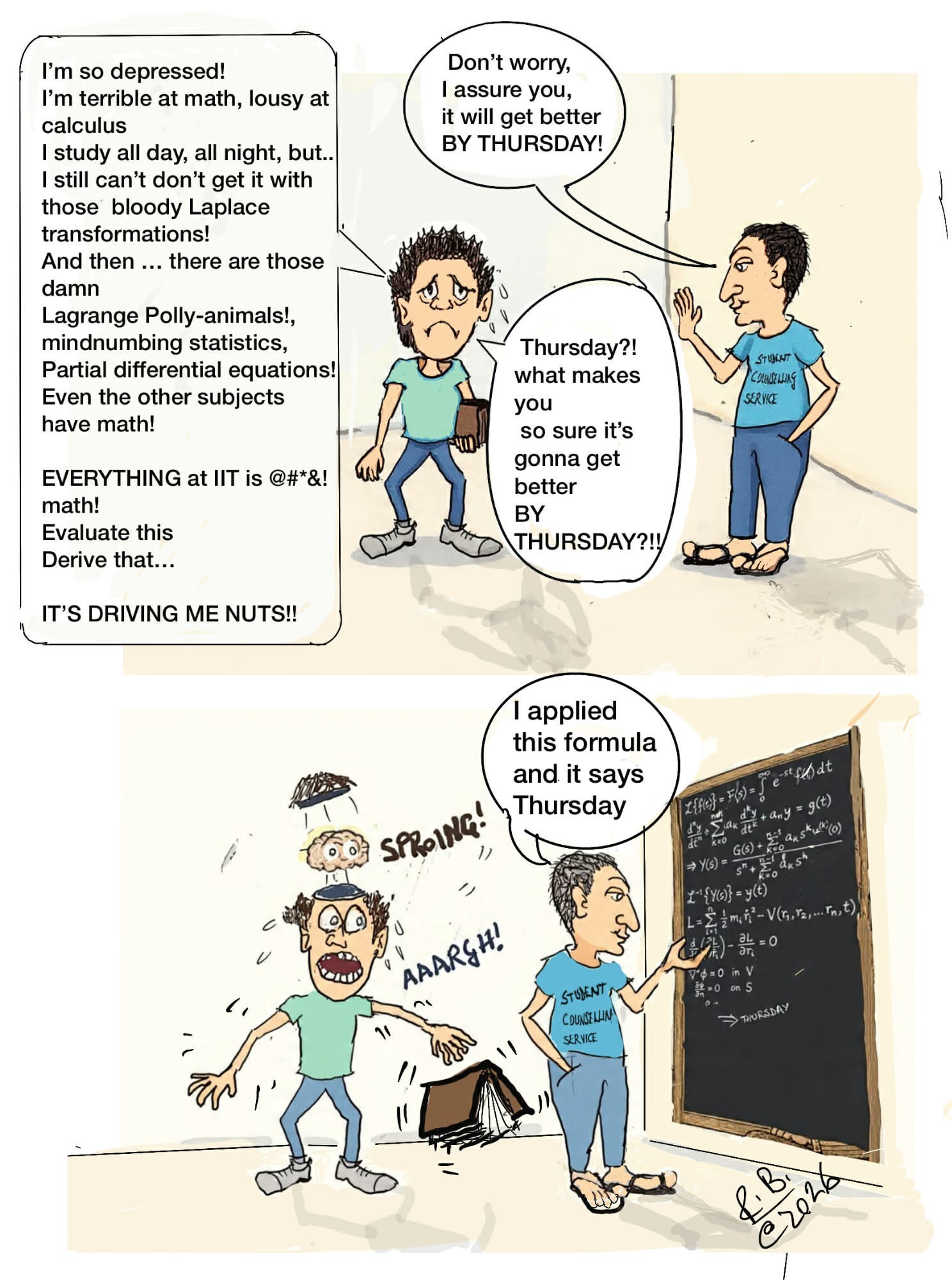
The feature on the IIT Kanpur Counselling Service was especially interesting and inspiring. It was wonderful to read about its unique role and the positive impact it has had on students over the years.
The tributes to Prof. V. Rajaraman and Prof. P. Dayaratnam are both dignified and fitting, and it is heartening to see how the magazine continues to chronicle the people and values that shaped the Institute. The kind words and tributes shared by Prof. M.R. Madhav and Prof. Raj Bhattarai, as well as written by many of my father's students/colleagues/friends across other forums, were deeply touching. My mother, Mrs. P. Vijayalakshmi, was especially comforted by these messages during this difficult time, and they brought her great solace.
Please accept our sincere appreciation for the warmth and respect extended to our family.
Thank you once again for honouring my father's life and his work in such a meaningful way.
With sincere thanks and best wishes,
Nischala and Dayaratnam's family
Mrs P. VijayaLashmi, Dr. P. Nirmala and Dr. P. Sarah
Dear Nischala,
it is fitting for us, who, as students, were taught by Dr. Dayaratnam, to acknowledge his contributions to IITK as well for making a difference in our lives. While in class, a student might see yet another course to pass, it is later in life that we understand the value of what we were taught by an excellent teacher, doing his best to teach us how to approach and address the problems we might encounter in our professional lives.
761
Counselling on Campus
I did my B.Tech at IIT Delhi and M.Tech Civil Engineering at IIT Kanpur (1989–1991). Then I went to the U.S. for my Ph.D.
Coming from IITD to IITK, I found that IITK was better in several ways. I admired the deeper commitment to academic excellence, the academic rigor and the pursuit of knowledge at IITK. Also, the camaraderie, friendship, mateship and the informal atmosphere were all a lot better and refreshing at IITK.
But then, the seclusion of IITK also seemed to have a negative effect. In-fighting among faculty was significantly worse at IITK than IITD. Unfortunately, Kanpur being a "horrible" city (in those days) did not help the situation. At IIT Delhi, if a professor had tensions with their colleague, there were numerous places (such as Connaught Place) where they could relax, cool off and chill out… However, in IITK, in those days, there was no such "release valve" — tensions got "bottled up" — so tensions sometimes reached boiling point… It seemed that many IITK faculty members needed psychological support and counselling!
I hope things are a lot better now, since IITK is not as secluded as it once was.
Best,
Prabhu Manyem, MT, CE, 1991 ·
Retired Professor of Applied Mathematics, Adelaide, Australia
Remembering Prof. Rajaraman
Prof. Rajaraman was a true pioneer of computer science education in India and one of the earliest builders of IIT Kanpur's academic legacy. As an IIT Kanpur CSE BTech student and now a faculty in the same department, I feel a profound sense of gratitude for his vision in initiating one of the first formal Computer Science programmes in the country and for shaping the very discipline that now defines our education and careers.
Even though I never had the privilege of being his direct student, every course outline, lab tradition, and academic standard in our department carries a part of his immense contribution. His work in establishing computer science as an academic field in India, his leadership at IIT Kanpur and later at IISc, and his many influential textbooks have guided generations of teachers and students alike. It is because of pathbreakers like him that students like me can dream, learn, and innovate in this field today.
Amey Karkare, BT, CSE, 1994–98
Professor CSE and Dean of Resources and Alumni, IITK
It is sad to hear that Professor Rajaraman has passed away. May his soul rest in peace.
At the beginning of my 4th year (of the 5-year B Tech program) when we had just started interacting with our respective departments, I had met with Professor Rajaraman and had requested him to allow me to take his master's course in Computer Science. He talked with me and then permitted me to do so. As I recall, I was the only bachelor's student in that class.
The following year, I decided to do my project under his supervision. My batchmate (Rajiv Gupta) and I designed, implemented, and tested the first electronic taximeter in India. The project received the second highest rating from the evaluators.
In 1974, I joined the DCM Data Products. Later that year, I moved to the Department of Electronics of the Government of India. I interacted with him on several ideas and proposals. Eminent people who were trained on this computer include Ashwani Vaishnaw, Honorable Minister of Information Technology and Railways; and Arvind Krishna, worldwide CEO of IBM. Both of these distinguished professionals have received DAA awards from IIT Kanpur.
In all of these interactions, I found Professor Rajaraman to be very supportive, constructive, and helpful. He was also goal oriented and handled tasks with a clear aim and strong dedication. Whereas most of the other computer luminaries at IIT Kanpur from that period opted to go abroad again, this time on a permanent basis, Professor Rajaraman was always focused on fostering wide computer education in India.
I cannot think of another person who has nucleated computer services and industry in such an effective manner in India.
All the best,
Amar Gupta, BT, EE, 1969–74 ·
Computer Science and Artificial Intelligence Lab at MIT ·
Concurrently Distinguished Professor, University of Texas
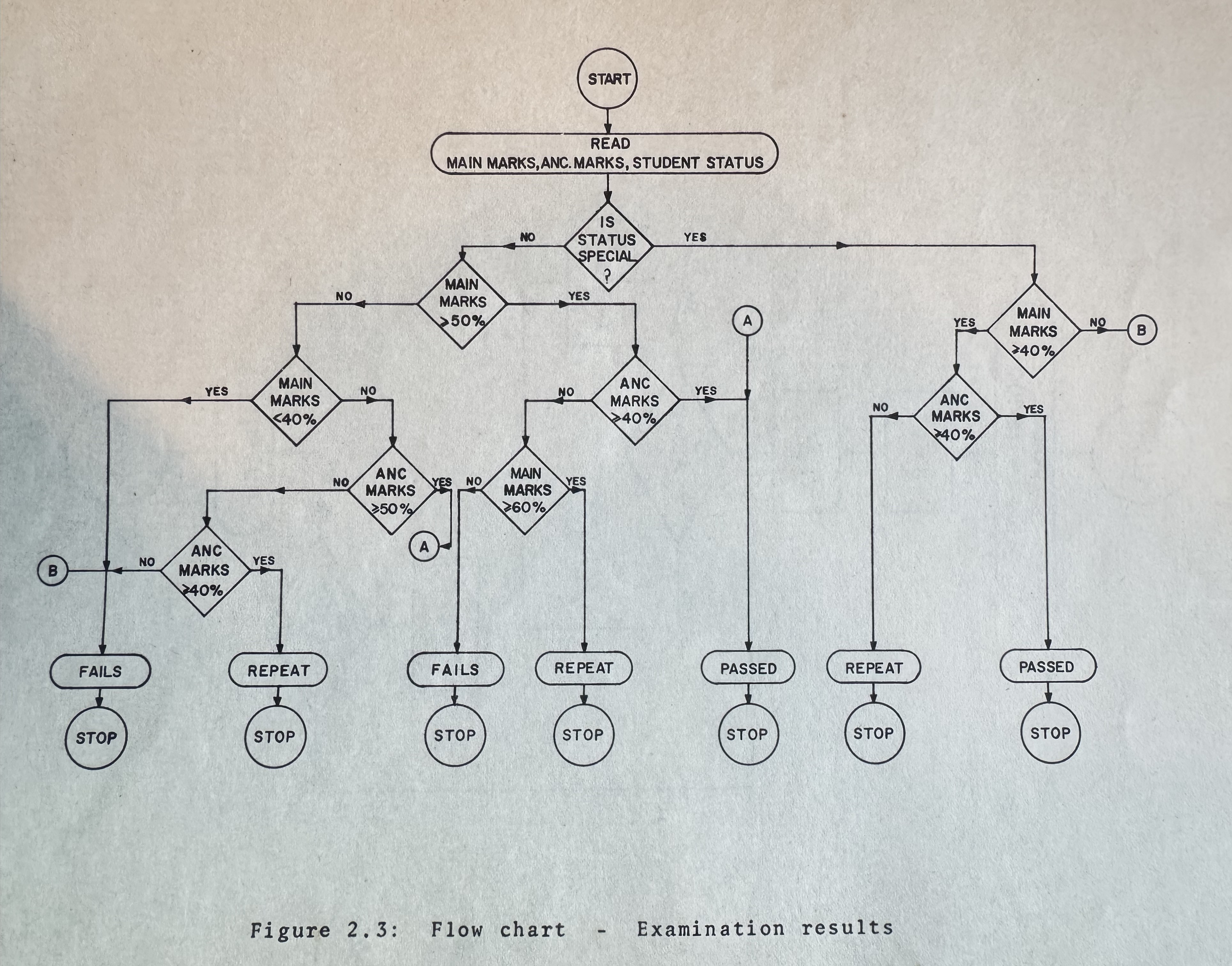
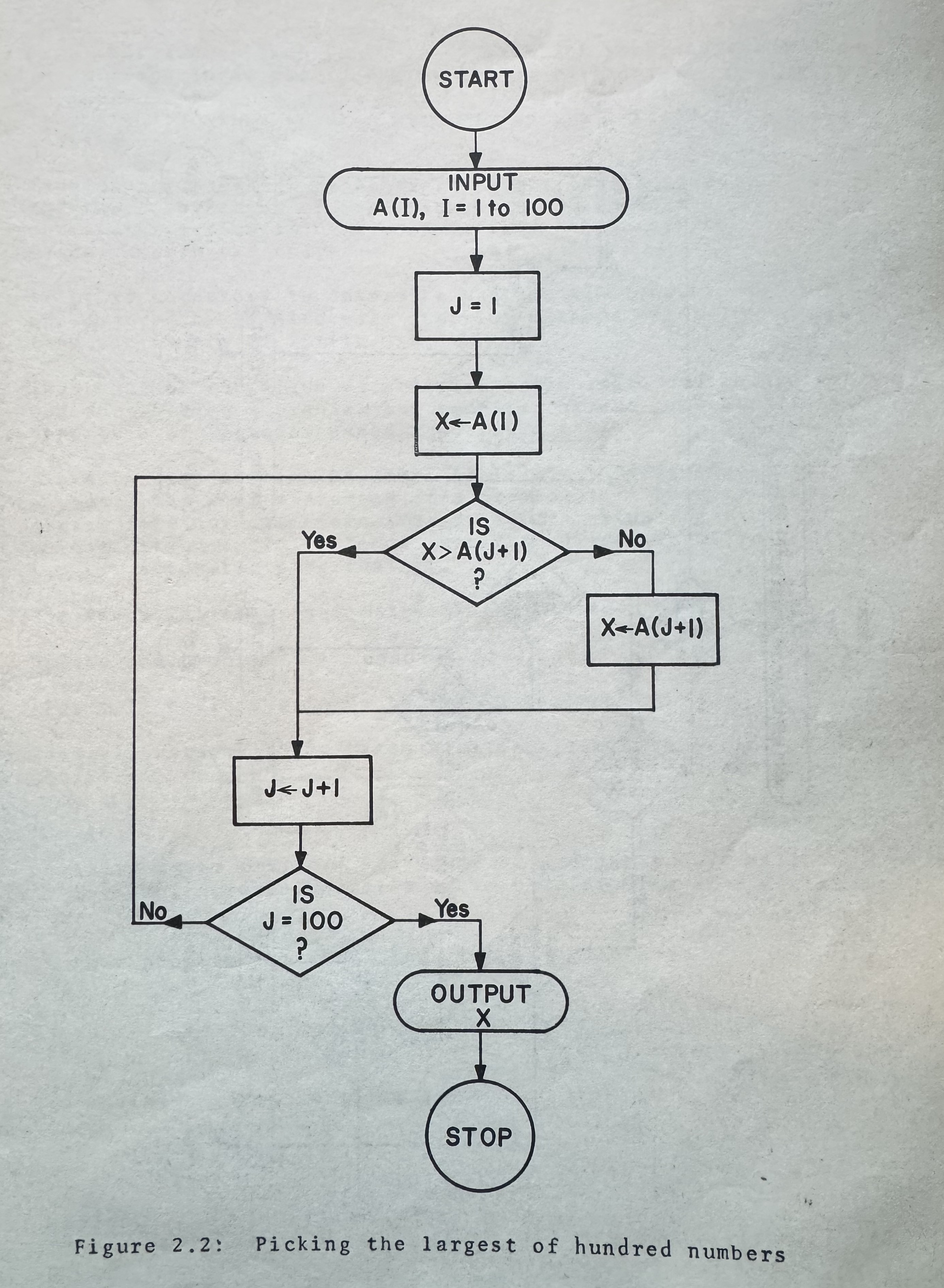
Finding the largest of 100 numbers.
762
From Computer Programming in Fortran IV, V. Rajaraman, shared by Raj Bhattarai (BT, CE, 1971-76).Prof Rajaraman followed Prof Kesavan as Director of IIT/Kanpur Computer Center. At the time, aside from TIFR in Mumbai, IIT/K, funded by the US "Kanpur Indo-American Program" (KIAP), the IBM 7044 was the highest-performance computer in India. Prof Rajaraman encouraged and supported the policy that enabled IIT/K to host computer use by Indian universities, the Indian Railways, and other industries. Safe to say that with Professor Rajaraman's policy to encourage access to IIT/K computers, IIT/K pioneered Indian industry use of computer applications.
With best wishes,
Rachel Oberai-Soltz, IITK Computer Centre, 1966-78
MIT Fellow, MIT Open Learning
(Previously Associate Director of MIT Corporate Relations)
Amazing effort pulling together this Spark issue tribute to Prof Rajaraman. Kudos to the team. Prof. Rajaraman was a true legend for his brilliance and his humility. The issue did him due justice covering the many aspects of his impact. I most enjoyed the personal reflections from his family and friends. The photo showing his Berkeley bound nephew how to knot a tie is priceless — though I doubt he ever needed that skill at UCB. Great job.
Christopher Flores
BT, EE, 1973–78; PGM, 1978
763
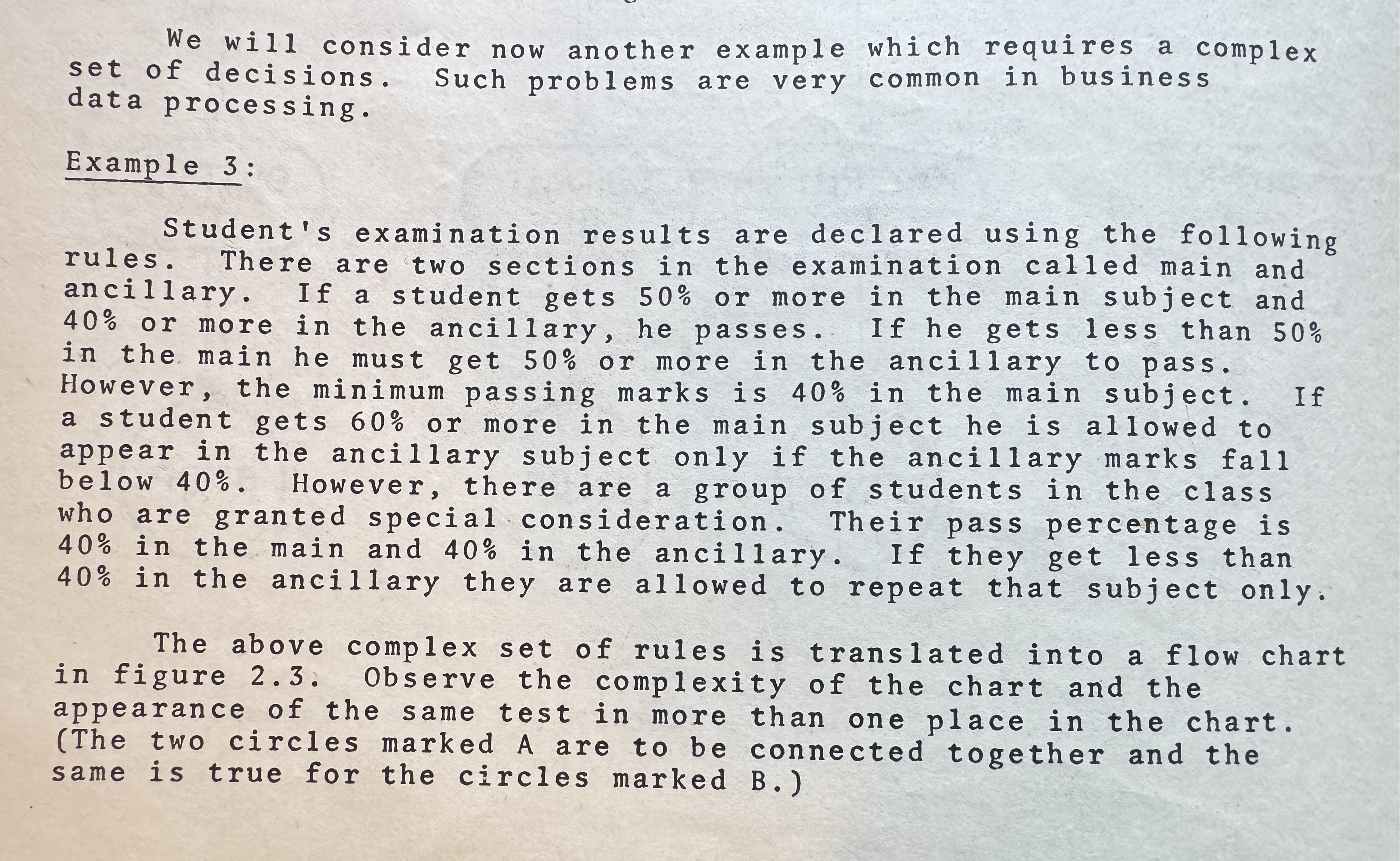
The Examination Results Problem.
Computer Programming in Fortran IV by V. Rajaraman, shared by Raj Bhattarai (BT, CE, 1971-76)
The Examination Results Problem.
Computer Programming in Fortran IV by V. Rajaraman, shared by Raj Bhattarai (BT, CE, 1971-76)
I just received the latest issue of Spark and immediately read every word of it. You have done a great job of covering the various achievements and personal greatness of Professor V. Rajaraman. I was happy to see the acknowledgements of the contributions of Mrs. Dharma Rajaraman, who was a pillar of support and companion to him.
In my view, Rajaraman became a LEGEND in his lifetime through his contributions and personality. Please keep up the good work of the Spark.
EC Subbarao
Professor MME, 1963–84, Institute Fellow, 2005
764
This is perhaps the grandest issue of The Spark. It not just highlights one of the greatest professors of IIT Kanpur but also reminds us of the luminaries surrounding him at that time. It refreshes our memories about the glorious time where the apex thinkers influenced rapid evolution of computer science, culminating into this age of the AI.
Prof Rajaraman has perhaps been the most influential in the science/technology seeding through his prolific writings, lucid lectures, personal example and a sweet and inspiring nature. I was so lucky to have him as a guide.
BTW, Mrs. Dharma was the sweet inspiration who always stood beside him. She not only inspired him to ascend new heights, but his students as well.
Why do we need Gods and Godmen? Prof Rajaraman and Mrs. Dharma have been much more! Their inspiration has
worked wonders more than any blessing. I am still hands-on with computers — thanks to his guidance and inspiration.
Even now, just visit Smt. Dharma to pay homage, and you will realise what I mean.
Mohan Tambe
BT, EE, 1975–80; MT, CS, 1982
Distinguished Alumnus, 2003
Member, The Spark, 1975–79
As one of the old Alumni of IITK, I remember Dr. Rajaraman, and our Computer Center, where the first generation IBM analogue computer IBM 1620 was installed.
Remembering the way we were taught, let me tell you, that our Dr.Rajaraman, would deliver lectures, and we the students would make the notes! There was no book available to us, and the Professor would pick up the notes of those students, who could write properly, and cover all the concepts, and articulate them. The edited version of such work came out in the form of books, covering Fortran 4 etc.
Later, our computer centre obtained the IBM 7044,
by the time we reached our final years! And, then came the digital computational machines.
I pray to God that our old Teacher Dr. Rajaraman, rests in peace.
Thanks for your communication.
P.R. Swarup
Director General, Construction Industry Development Council
765
Thank you for the recent issue of Spark. Who in IITK does not know Prof and Mrs. Rajaraman? Both of them have been stalwarts and have contributed immensely!
Prof Rajaraman led the Computer Education from Basic to Supercomputers; from Bachelor to Doctorate; from teaching/research to policy making; from writing the fundamentals to advanced books on computer learning, etc. He was a pioneer in this upcoming field in India in those days. His simple, affable and transparent personality influenced one and all greatly.
On the other hand, Mrs. Rajaraman had her own sphere of influence. Her ever helping and innovative nature inspired many. Through Student Counselling Service, her contributions were unparalleled. We all loved her for her ever happy and reassuring disposition.
Both of them have played a very important role in my life personally. Mrs. Dharma's support and guidance along with financial assistance received from DOSA Dr GK Lal, helped me to set up the Book Bank, which assisted students like me from very modest economic backgrounds to get costly books at affordable cost for the use in a semester.
Prof. Rajaraman's theory of n+1 syndrome helped me take the decision to write the Civil Services Examination and that has made me contribute immensely to nation building.
Hence, I am indebted to both. My journey to Bangaluru never got complete without seeking their blessings and I'll miss Rajaraman Sir greatly.
Durga Shankar Mishra
BT, EE, 1978–83; Distinguished Alumnus, 2023
Retired IAS, Former Chief Secretary, Government of Uttar Pradesh
766
Thank you for bringing out the special issue on Professor Rajaraman.
Heartiest congratulations.
This issue looks great. The Spark team have worked with so much dedication.
Thank you for bringing out this issue within such a short time.
Yours affectionately,
Dharma Rajaraman
Dear Mrs. Rajaraman, without your extensive help in connecting us with the many people who were touched by Prof. Rajaraman, in sharing your family photographs, and so much other assistance, this issue would not have been possible. Thank you so very much for your help.
767
The Inter-IIT Tech Meet 14.0
Alumni from the 1970s and 1980s will remember the Students Gymkhana with the Games and Sports Council, the Cultural Council, and the Students Film Society. The Gymkhana was expanded to include the Science and Technology Council in the 1990s.
The Science and Technology Council of IIT Kanpur is a student body comprising various technical clubs, hobby groups and technical teams, which foster innovation and creativity, empowering students to explore and excel in cutting-edge technologies. It is led by an elected team of fourth year undergraduate students, namely, the General Secretary and the three Institute Secretaries.
The Science and Technology Council encourages participation from students from across batches, departments and programs, to work on various domains like robotics, machine learning, artificial intelligence, electronics, finance, consulting, etc. Over 400 students are currently involved in the activities of the council.
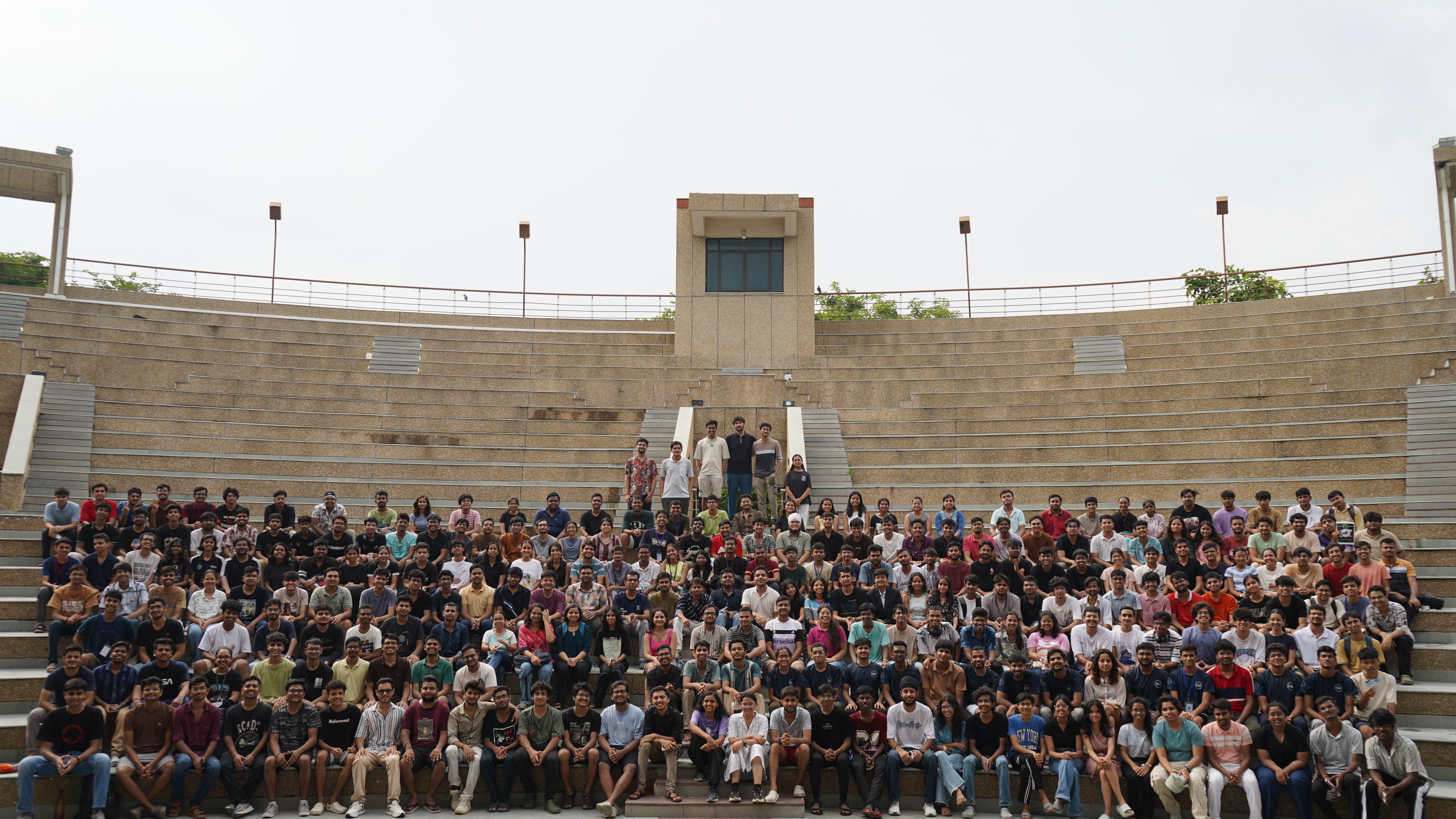
Members of the SNT Council, 2025-26
The Inter IIT Tech Meets
The Inter IIT Tech Meet is the annual technological competition organized by the Indian Institutes of Technology and qualifies as the only technical event wherein all the IITs participate. This event is hosted in cycles by one of the participating institutions each year, to celebrate a tradition of excellence and bring together the brightest minds to push boundaries of technology. The problem statements are prepared by various companies and organizations that align with real-world research and technology to provide the students with industry-level problems. Each participating IIT submits one solution for each problem statement that is presented to the panel of professionals from these companies and organizations.
The Contingent Leader and the two Deputy Contingent Leaders along with the council's General Secretary and Institute
Secretaries are the student leaders of the IITK team.
768
Though IIT Kanpur had a long history of podium finishes in the Inter IIT Tech Meets, it had seen mixed results in the recent years. The two most recent meets had seen IITK drop out of the podium finishes.
- Tech Meet 8.0 — 3rd Position (2019–20)
- Tech Meet 9.0 — 1st Position (2020–21)
- Tech Meet 10.0 — 2nd Position (2021–22)
- Tech Meet 11.0 — 3rd Position (2022–23)
- Tech Meet 12.0 — 5th Position (2023–24)
- Tech Meet 13.0 — 6th Position (2024–25)
Inter IIT Tech Meet 14.0
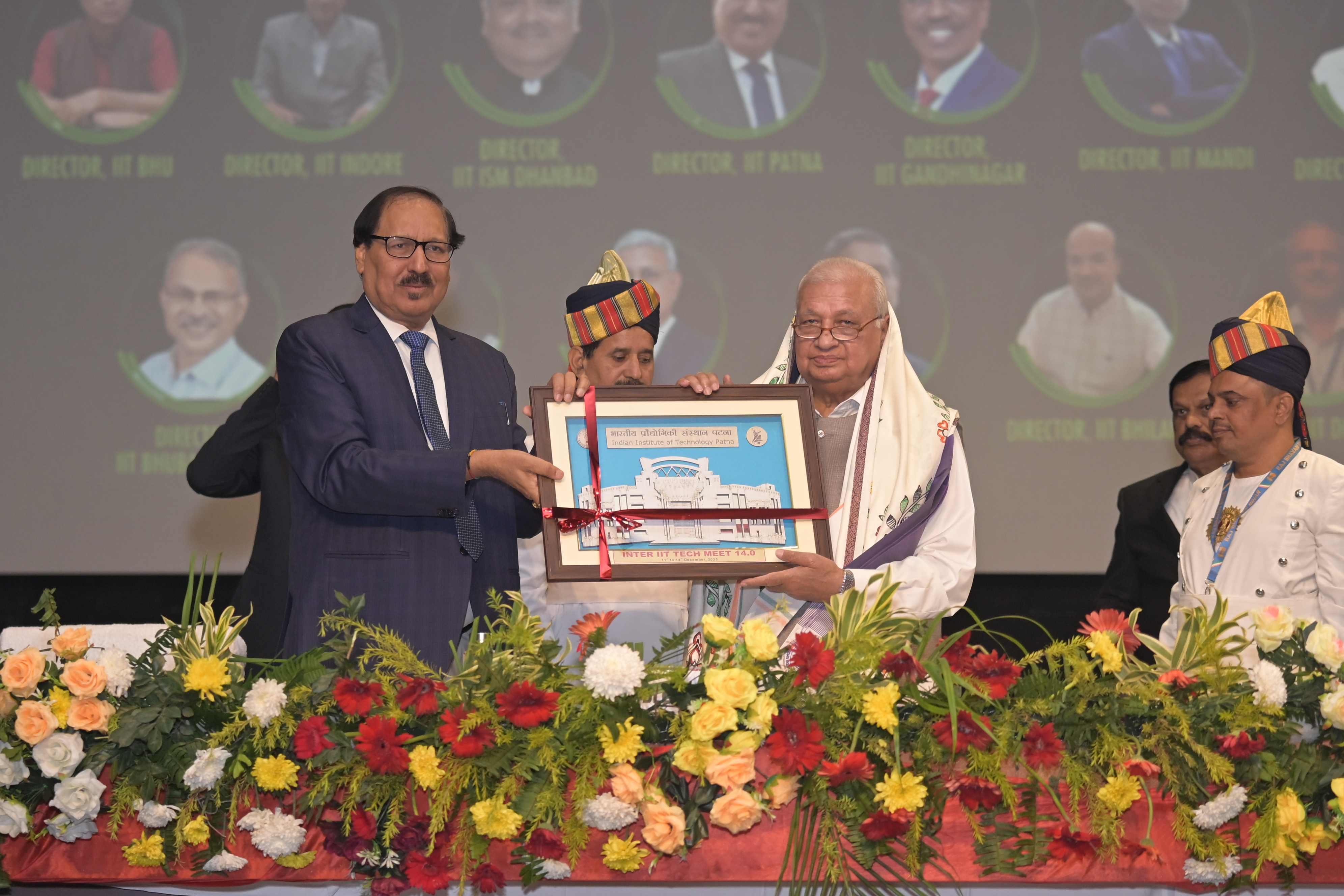
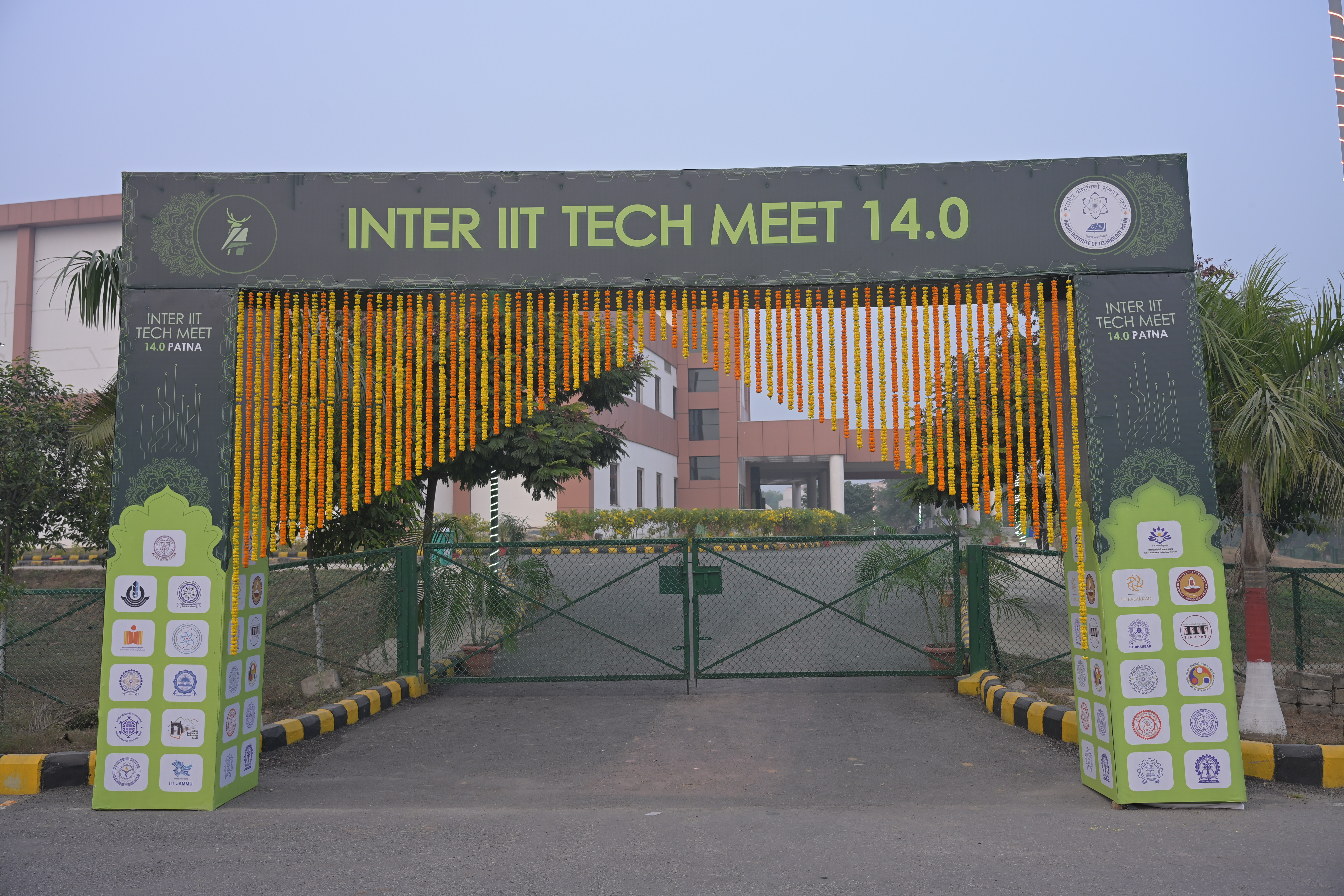
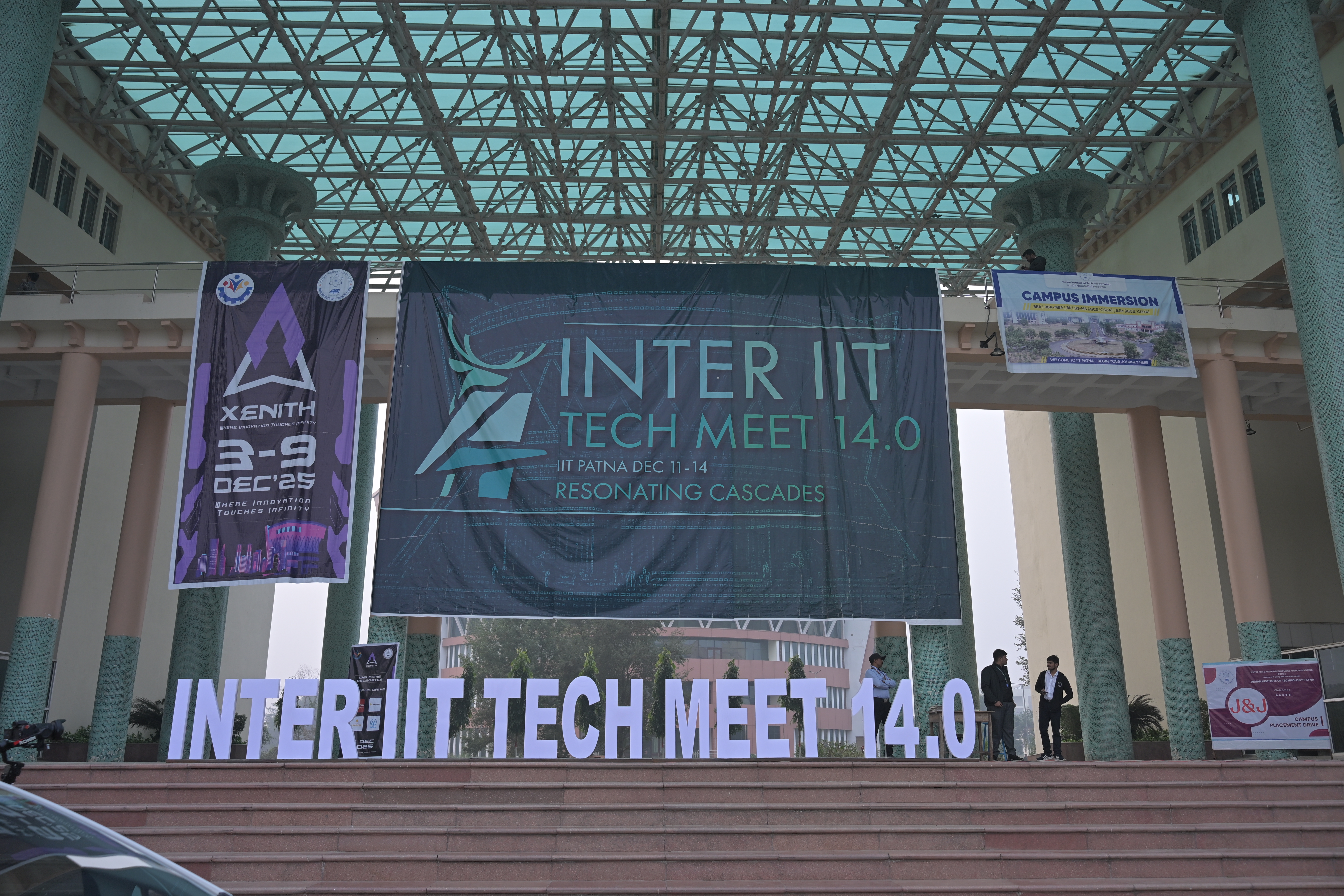
IIT Patna hosted the fourteenth edition of the Inter IIT Tech Meet from December 11–14, 2025, with the theme of "Resonating Cascades", with Shri Arif Mohammad Khan, Hon'ble Governor of Bihar and Prof. T. N. Singh, Director, IIT Patna as the chief guests to the opening ceremony of the event.
The opening ceremony with Chief Guests Prof. T. N. Singh, Director, IIT Patna and
Shri Arif Mohammad Khan, Hon’ble Governor of Bihar
"Resonating Cascades" captured the dynamic spirit of Inter IIT Tech Meet 14.0, the power of ideas to amplify one another and set in motion a chain reaction of innovations. It reflects how a single spark of creativity, when nurtured and shared, can trigger successive breakthroughs, each building on the last to create waves of progress that reach far beyond their origin. The word resonating evokes the energy and harmony born from collaboration, while cascades signify the momentum of discoveries flowing forward, shaping technology, society, and the future.
769
The following problem statements were a part of this year’s Inter IIT Tech Meet:
High Prep Problem Statements
Ebullient Securities - Quant/Algorithmic Trading
LAT Aerospace - STOL Aircraft Aerodynamics
Arista Networks - RF Optimization
Mid Prep Problem Statements
Adobe - Product Development + AI/ML
ISRO - Geospatial Vision-Language Model
Observe.AI - Conversation Intelligence
No Prep Problem Statements
Jilo Health - AI/ML in Healthcare
GenuityIO - Algorithmic Optimisation
Research & Innovation
Student’s Academic Conference - Research Papers
Engineer’s Conclave - Research Projects
IITK's Performance at Meet 14.0
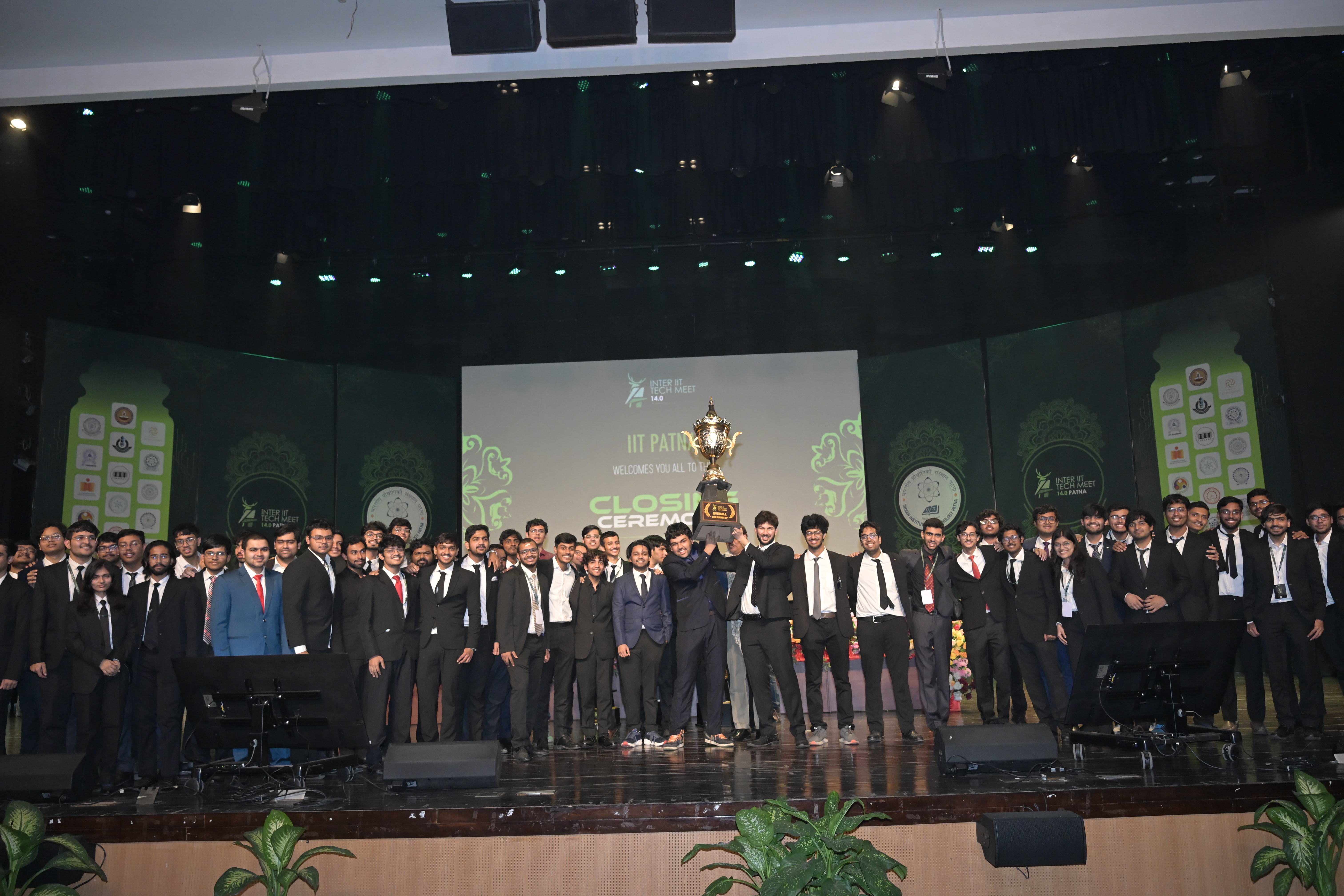
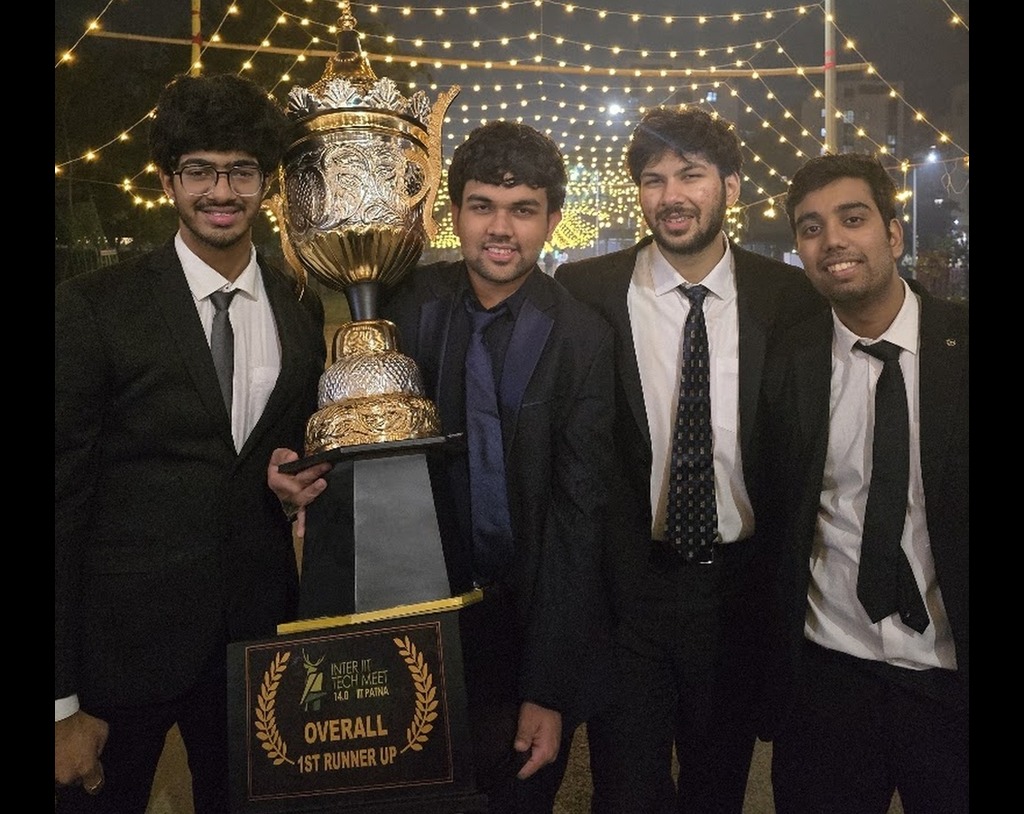
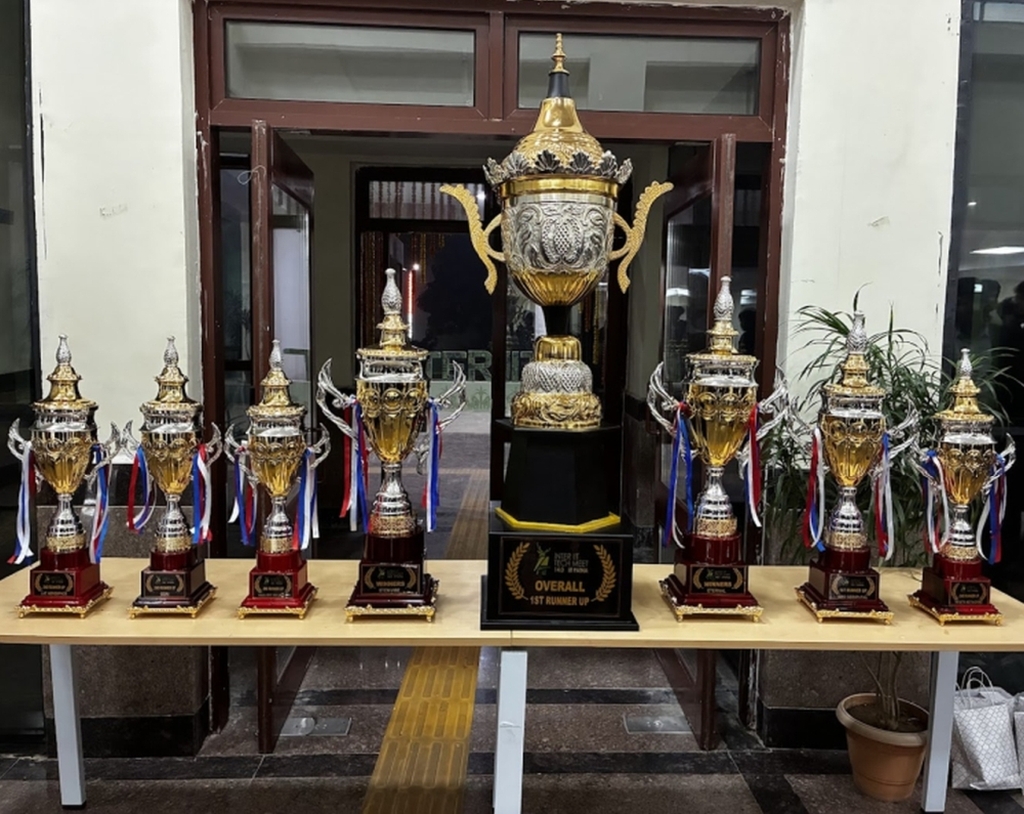
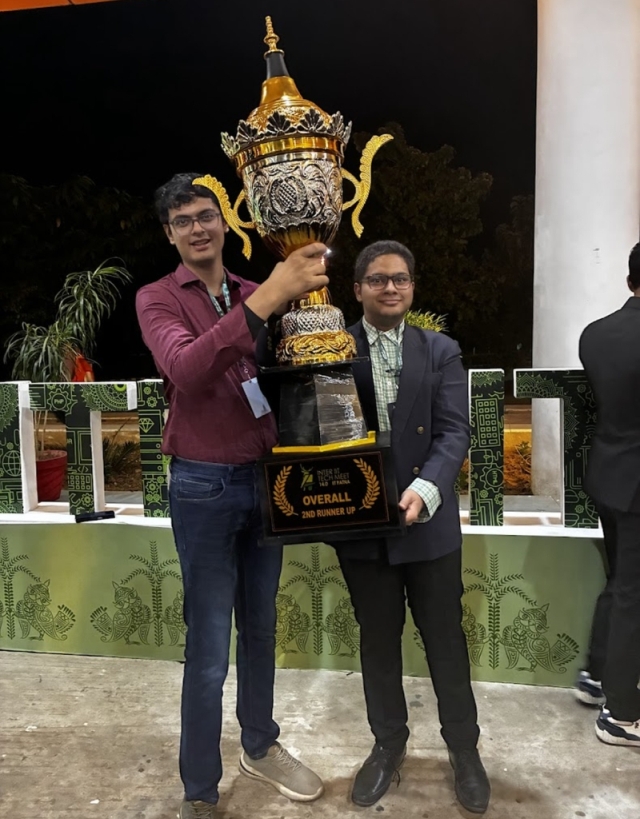
After two years of declining results, IITK delivered an outstanding performance at Meet 14.0, securing an overall second position. IITK was represented by the Science and Technology Council, Students' Gymkhana, whose remarkable performance brought pride to the entire institute.
The Award Ceremony at IIT Patna
770
Throughout the competition, students showcased exceptional technical acumen, creativity,
and innovation while solving complex problem statements posed by leading companies and organizations.
Led by the Science and Technology Council, this achievement reflects IIT Kanpur's strong problem-solving culture,
interdisciplinary collaboration, and practical technological excellence.
Days (and nights) of work by the team, supported by the Contingent Leader and deputy Contingent Leaders, paved the way for a success that brings laurels to our institute.
The IITK Team Leaders; (R) IITK finished as the overall runner up with podium finished in seven problem statements
IIT Kanpur teams delivered impressive performances across multiple problem statements, securing several podium finishes. This year’s medal tally included two gold medals, one silver medal and four bronze medals.
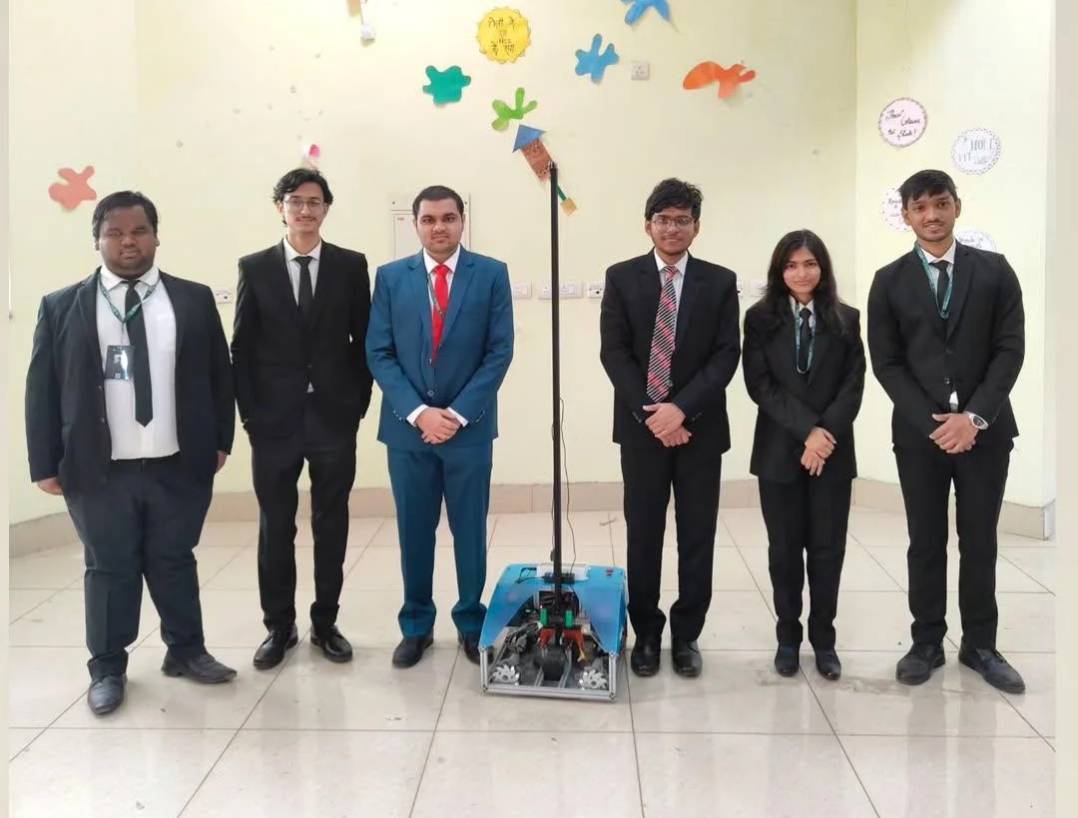
The mid-prep problem statement, released by Eternal, was aimed at making a
fully autonomous warehouse robot that can be used to keep track of inventory items without any human involvement.
The members of the Robotics Club and Team ERA worked on the problem statement
dedicatedly over the course of over a month to develop the robot and won the Gold Medal IIT Bombay secured the second position,
with IIT Mandi and IIT Indore jointly securing the third position.
Team Eternal - Robotics
771
The problem statement by STEMvibe was a mathematics on-spot competition. The students of IIT Kanpur had come prepared and scored the highest points to win the Gold Medal. IIT Bombay secured the second position, with IIT Kharagpur and IIT Delhi jointly securing the third position.
Team STEMvibe - Mathematics
In the ISRO – Geospatial problem statement, IIT Kanpur won the Silver Medal. The teams also secured third place in problem statements from Ebullient Securities, Arista Networks, LAT Aerospace, and GDAI, which contributed to the institute's overall ranking.
| Institute | Points | Rank |
|---|
| IIT Kharagpur | 3438.92 | 1st |
| IIT Kanpur | 2951.93 | 2nd |
| IIT Indore | 2915.63 | 3rd |
| IIT BHU | 2420.98 | 4th |
| IIT Madras | 2382.22 | 5th |
Future Goals of the Science and Technology Council
After these achievements at the Inter IIT Tech Meet 14.0, the Science and Technology Council of IIT Kanpur looks forward to rebuilding IIT Kanpur's legacy of consecutive winning streaks at the upcoming Tech Meets. The establishment of SNT Makerspace will also boost the institute's performance by providing the students with a workspace and resources.
Contributed by Tanush Goel, Trijal Srivastava, Rachit Choudhary, Mayank Agrawal,
Yash Pratap Singh, Yuval Bansal and Aniket Nandi, all of whom are fourth year B. Tech.
students and current members of Science and Technology Council.
772
IITK Counselling Service – one student’s story
(Anonymous)
Like most kids entering IITK, I too was 'the smart guy' in school. You should already know the rest of the story. Everybody entering IITK was smart, or mostly, even smarter. With the usual result – unbelievable grades in assignments, mid-term and end-sem exams. Unbelievable of the bad kind, just to be clear.
I stumbled along for a while, bemoaning the situation. My grade sheet was a disaster, with the rare A and B, bunches of Cs, and the occasional D or F.
A few semesters in, the kind academic advisor (I had to meet him before registering for classes at the beginning of each semester) thought life was getting difficult for me and suggested I take just four instead of five courses, and make up the rest in the summer semester. That seemed like a great idea; just two classes in the summer, and the rest of the time in the swimming pool.
However, reality was different. Two classes meant even less attention to academics. I mean, with just one class to attend each day, why even bother to go, right? It took so long to get ready and go to class. Not worth it.
But what had to happen, happened. Scoring a D and an F that summer got the attention of the Counselling Service. Clearly, it was one foot out the door for me. The second foot was not too far behind either.
The Counselling Service team was a group of thoughtful, caring faculty, faculty spouses and some senior students who provided gentle guidance to students with problems like mine. My case went straight to the top because my situation was well beyond 'gentle'.
Little did I know how well-networked the counselling service was. They not only knew my grades, they knew the professors who taught me, they knew the hostel wardens, the class tutors, my hobbies and interests, probably knew the company I kept, and pretty much all of my activities on campus. Everything. I had no idea that they knew so much. I thought they just saw my grade sheet.
As it turned out, it was the information they gleaned via that informal network that saved my neck. As it happened, I used to be fairly active in several constructive extra-curricular activities and showed some level of talent there. Fortunately, not smoking, not drinking, and not doing other 'interesting' activities, kept my non-academic record clean.
With that clean sheet, they probably felt I was worth sending out into the world with a B Tech degree of some sort, rather than with no degree at all. I think (and there is some hearsay evidence to that effect) that word was sent to my instructors and tutorial assistants to help things along. That I was not as deficient in grey matter as my grades suggested; that what was needed was not a hard stick all by itself, but a stick with a carrot at the end of it.
773
As a result, my academic performance in the later years on campus improved. I used to meet two senior people on the Counselling Service every week in their office in the FB, and get invited to dinner at their homes perhaps once a month.
All of the counselling, if you can call it that, was very carefully managed. Never was there a mention of classes or assignments or grades. More like de-stressing, calmness, home away from home. There wasn't even a boisterous welcome at their home. Just a casual – 'nice to see you here' got me settled, I would get a cup of tea, a snack, and settle down to some music or a casual conversation. Super-cool. And unless I volunteered some info, not a word about academics. Of course, I remained blissfully ignorant that they knew my academic performance all the way till that very morning. Looking back, it was a peaceful and unstressed couple of hours away from the hostel where the super-genius types were solving Navier-Stokes equations.
Life worked out OK. I graduated, got a job, and went on with my life. Somewhere in the back of my mind lived my counselors.
Much water has flowed down the Ganges since then. IITK has grown several-fold, and the Spark, a student-run magazine got revived some years back. The editors wanted to do a series on the Counseling Service, and reached out to ask if I knew someone who might have benefited from the counseling team. I raised my hand, and it was only then that they asked me to write about my experience with the Service. Thus, I sat down to put some thoughts together.
As it turns out, I had been in touch with Mrs. Dharma Rajaraman, one of the original counselors in the Service (together with Dr. M R Madhav – Civil Engg. and Dr J D Borwankar - Maths). Mrs. Rajaraman suggested I write something about my experiences from the 'student' side of the business, and as a recipient, I thought it would be appropriate, given that she and Dr. Madhav had written for the Spark from the 'Delivery' side.
So, I agreed, but to do so only after I had filed my tax returns.
We had a very interesting conversation over WhatsApp after she and Dr. Madhav had finished their article;
She wrote:
Dr Madhav has sent the articles. We are waiting for your response. Meanwhile I wonder whether your article is ready. As yours will be from students’ side it will add value to the Spark issue. Looking forward to your reply.
After so many years, she was playing her role perfectly. There was no pressure, just a nudge to get going.
I told her I would start right after I had sent in my tax returns, 14th April.
A couple of days later, she asked:
How are you? Still busy with working out the tax?
There she was, right on top of things.
I told her I was still working on my taxes, and there was a deadline.
She wrote: Sorry to inform you that Dr Marjory Foyle passed away last night. She was our mentor. She was the Director of Nur Manzil, Lucknow. Four of us went to Nur Manzil to attend her lectures. Dr. Foyle was a well-known psychiatrist. She has written many books. She was a missionary. She was 103.
And then, another nudge.
Best wishes for a successful completion of your Tax project. Take complete rest for a day.
I got the hint: the nudge and the push – take rest, but not too much!
Thank you, Mrs R. Actually, I finished taxes today, and rested.
Will start writing tomorrow.
…and I said to her: You haven't changed.
To which she replied: Rest first. I am always concerned about your health first.
And I told her: You haven't changed. Gentle but persistent nudging. Rest up, but get going soon.
That was the approach. Caring, considerate, but focused on what needed to be done.
In a high-pressure environment at IITK, it is vital to ensure that the students, accepted after the toughest admission criteria anywhere, remain on an even keel. The support from concerned IITK people, properly trained but separate from the academic side, makes a lot of difference at that moment, as well as later in life. In my case, the Counselling Service was that stabilizing force, and it did its work quietly, unseen, and very effectively.
774
Campus Corners
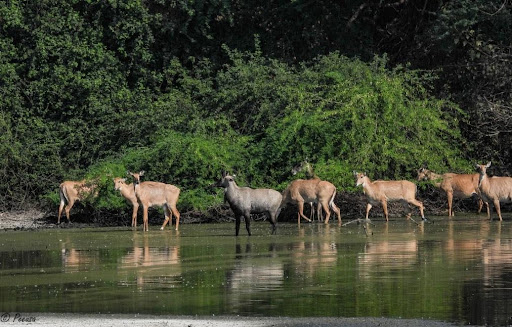
A herd of Neelgai march for water. As a part of our great backyard bird count,
the IITK bird-watchers group visited many jungle covered parts of the campus.
On this morning, they encountered a large group of neelgai entering the oxidation
pond to quench their thirst!The oxidation pond at IITK is located in a limited access area (to protect the environment), on the North side of the campus, near the airstrip. Credit: Peeusa Mitra, March 2026.
775
Counselling Service: My Journey of Love and Learning
Sharmistha Chakroborty (Student Counsellor, 2003-17)
My story of the Counselling Service (CS) begins in the year 2003. Our students (i.e. the student guides, coordinators, and academic mentors who were part of the CS team) played a critical role in the functioning of the office.
We had just one office when I started. The office soon became so active that not only did we have to open it full-time, but the then-dean of students arranged for a second room for us so that I could take sessions without interruptions. By the year 2011, even the three rooms given to us were not enough and we moved to a much bigger location (House 503) that still houses the CS today.
The initial years of my work as a part of CS influenced much of my future roles as a psychologist and a counsellor. The regular meetings with student teams, where I listened to their experiences, taught me a lot about student mentality, their thought process, language and culture. With every passing year the number of students accepted into the Institute increased, leading to an increasingly complex psycho-socio-emotional dimension. We saw 'wings' in every hostel becoming so large that they finally split into smaller units. The 'everyone knows everyone' pattern in the hostels changed, and groups became smaller. Unfortunately, some students ended up as not being a part of any group. Accessing the social world virtually, these loners became lonelier. Instead of having a physical social support network on campus, they often relied on their home support structure, and the ones who did not have any strong connection with the family felt even more isolated.
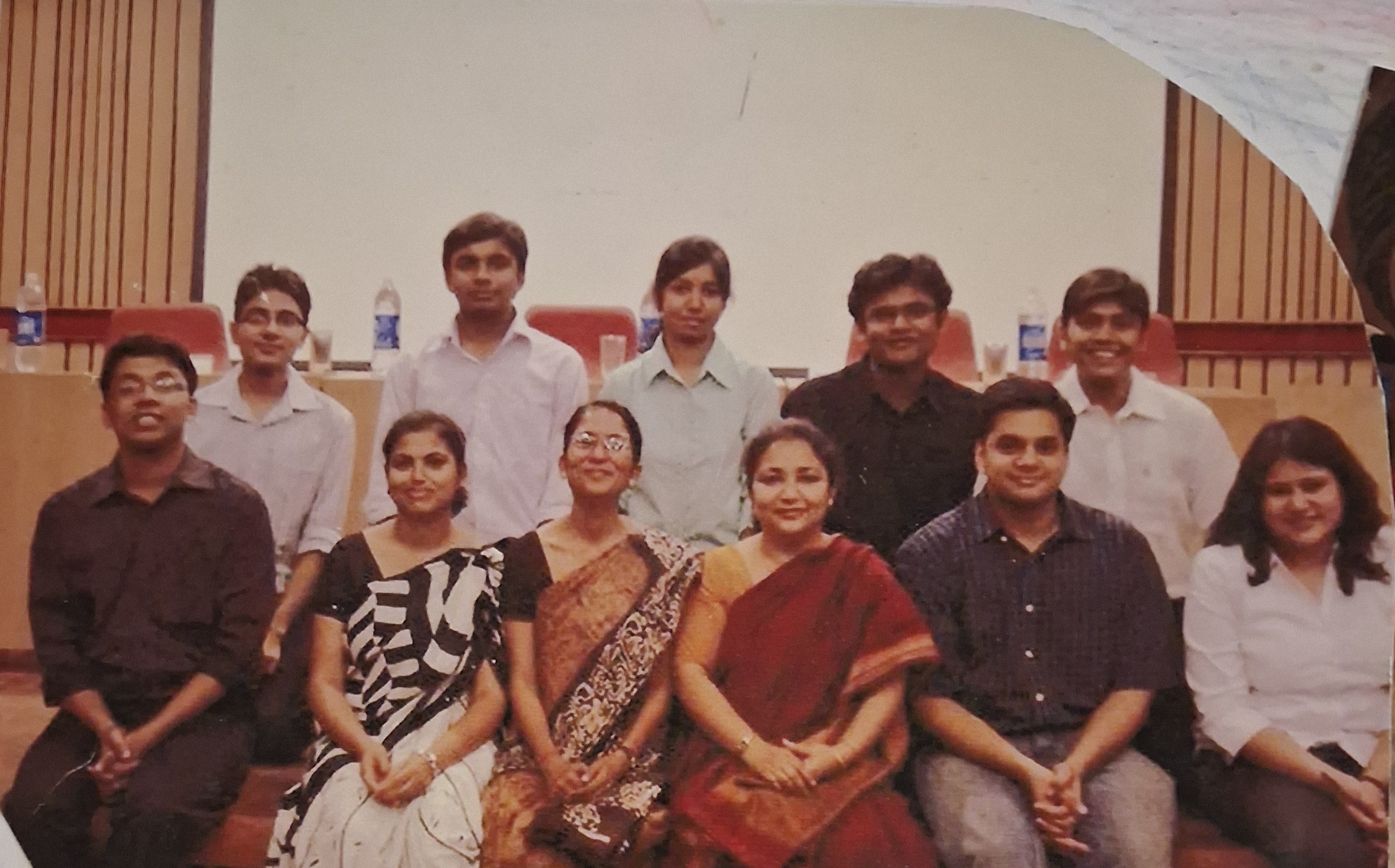
Dr. Sharmistha Chakroborty, seated third from right, with the Core Team of the CS, late 2000s.
776
Thus, as psychologists, we were clear in our understanding that counselling in a residential institution had to be approached differently. We focused on a community model of counselling rather than a medical model (which is based primarily on diagnosis and treatment of mental health conditions). It became important for us to create bonds and affiliations for students who were very young and for whom the crucial time of adolescence had been spent in isolation trying to prepare for a competitive world (ie, preparing for the JEE, frequently from Class 9 onwards), rather than establishing meaningful relations within and beyond their families.
Our emphasis on a very interactive orientation programme for the new entrants, creating enduring bonds between them and their student guides, a supportive 'wing life' and a personal connection with faculty guides were all rooted in our fundamental belief in the community approach to counselling. Even the professional counsellors took turns visiting hostels and having interactive sessions in every wing, knocking on every student's door to encourage them to come out and talk. Conversations included issues pertaining to their life on campus, academics, gender issues, relationships or anything else that came up impromptu. These informal chats helped in building familiarity and encouraging the perception of the counsellors as approachable and friendly. Hostel visits during semester exams remained one of our most popular initiatives. CS also focused on regular community activities to help foster bonds, like yoga, meditation, sessions about nutrition and sleep, and the sport event called 'hakoonamatata', informal interaction with professors, cycle rides and many more. The Zoomba sessions remained an all-time favourite.
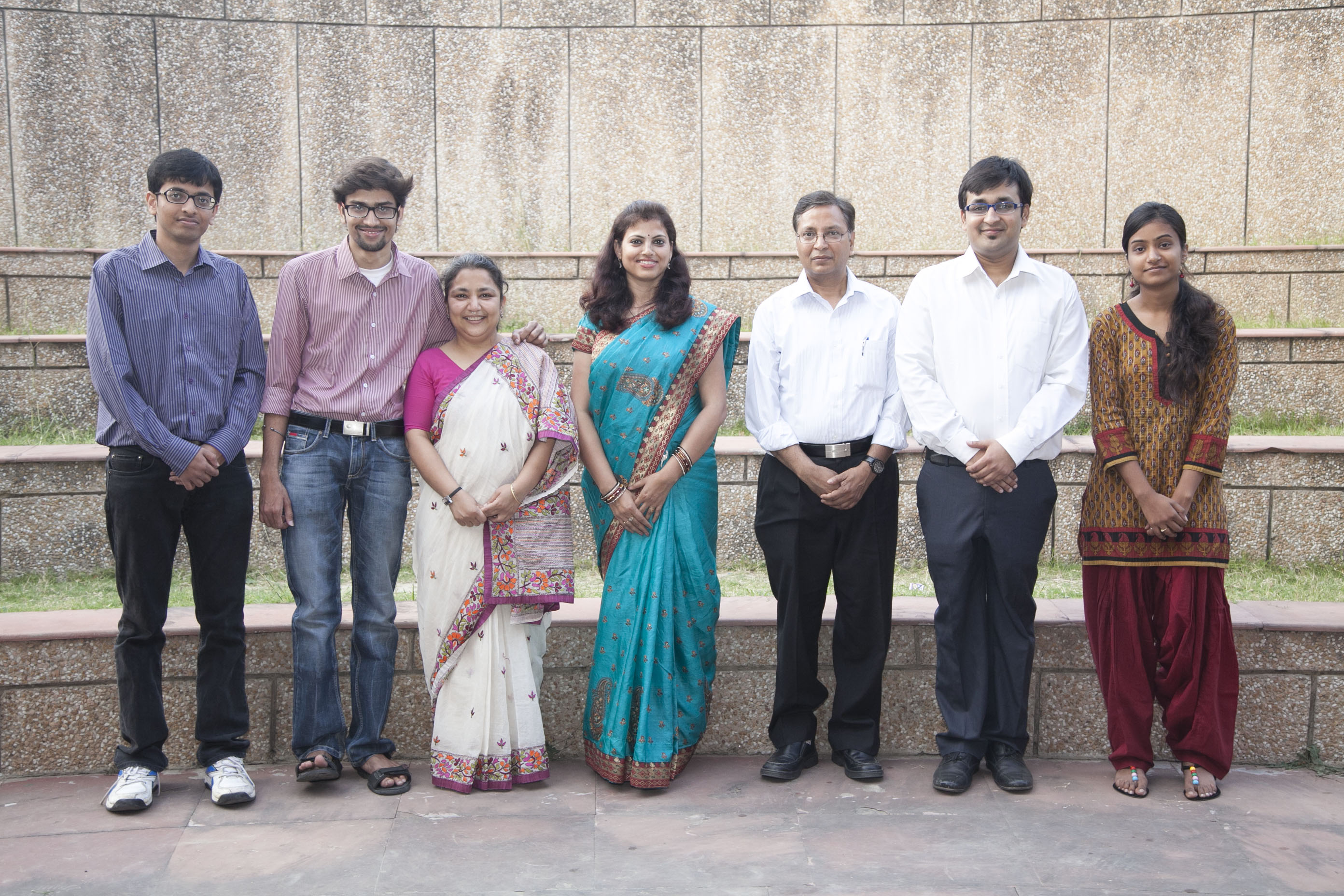
Dr. Sharmistha Chakroborty, third from left, with the Counselling Service coordinators, c.2013. Also visible is Prof. Mukesh Sharma, third from right, who served as Head CS, 2012-14
777
The growing size of the Institute, changing priorities of administration and the complex inter-personal dynamics because of a gradual shift in social values did not make our journey easy. But accepting change is inevitable! We tried to counter it with extensive training and sensitization of the student guides, academic mentors and most importantly the student core team of CS. Counsellors established a deep bond with the student teams by actively participating in their selection and training so as to make them aware of the various nuances of a changing social world. Our student teams were our bridge to the extended student community. We would teach them how to identify fellow students in turmoil and how to establish a safe network around them so that they felt supported. Teaching student teams the value of confidentiality was very important to us as the foundation of friendship and support stood on respecting disclosures.
That CS became so active is a testament to the success of the numerous outreach initiatives undertaken as well as the triumph of a deeply held belief that for a residential counselling unit, clinical practices need to go hand-in-hand with a community-based network of social affiliations.
By 2017, when I was bidding adieu to my favorite workplace, our campus had been suicide-free for an extended period. Although that was never the only measure of success for CS, it was indeed a great relief and a blessing for all of us actively involved with the mental health of the community.
The IITK Counselling Service team, c. 2013
Dr. Sharmistha Chakroborty, a psychologist by profession, has a practice of her own where she currently focuses on working with mainly schoolchildren and young adults. She also works as a consultant psychologist and counsellor for some eminent schools of Kanpur where she not only counsels students and staff members but also ensures integration of academic curriculum with the social and emotional learning of the students, as recommended by the National Education Policy.
She is a former student counsellor at the Institute Counselling Service of IIT Kanpur from 2003-17.
778
My days at 503
Shanu Vashishtha (BT, ChE, 2017)
I was a part of the Counselling Service during my second, third and fourth years of the UG program. During my second year, I volunteered as a Student Guide (SG), as well as the Academic Mentor (AM) for PHY102. During my third year, I was selected to be one of the Assistant Coordinators from Hall 2. I went on to lead the Core team as its Coordinator in my fourth year. But since I am writing this for the Alumni magazine, let's stick to the terms actually used — Bapu, Asst Coord & Coord!
Part of my motivation to get associated with the service stemmed from them being the first group of people who I met as a fresher during my Orientation Week. But I would be lying if I didn't admit that I wanted to have a peer group who would push me to perform to my best. I've always been of the opinion that the people who surround you eventually shape how you progress through life. In hindsight, it turned out to be truer than I had thought. Thankfully, I had great people around me during my time at campus. I thoroughly enjoyed my time and had fun, leading to my spending a lot of time with my CS friends.
My year as a SG turned out to be a relatively easy task. My 'kids' were quite chill and mature for their age. One was a 'kholu' for the junior batch (the highest JEE AIR for the batch, who 'opens' the entry to the campus), the other shared his name with a famous Bollywood star (you can imagine how I got famous in the hall as the Bapu of that star); two kids that I am very proud of as they had a rocky start academically but went on to grow in confidence and became strong students in their departments; one who ended up clearing Algorithms questions for me during a course we took together and the sixth one who still endearingly refers to me as Bapu whenever we are in a conversation. It was such an amazing year with this 'family' that one of my closest friends described me as their 'Bapu' in the yearbook 2 years later!
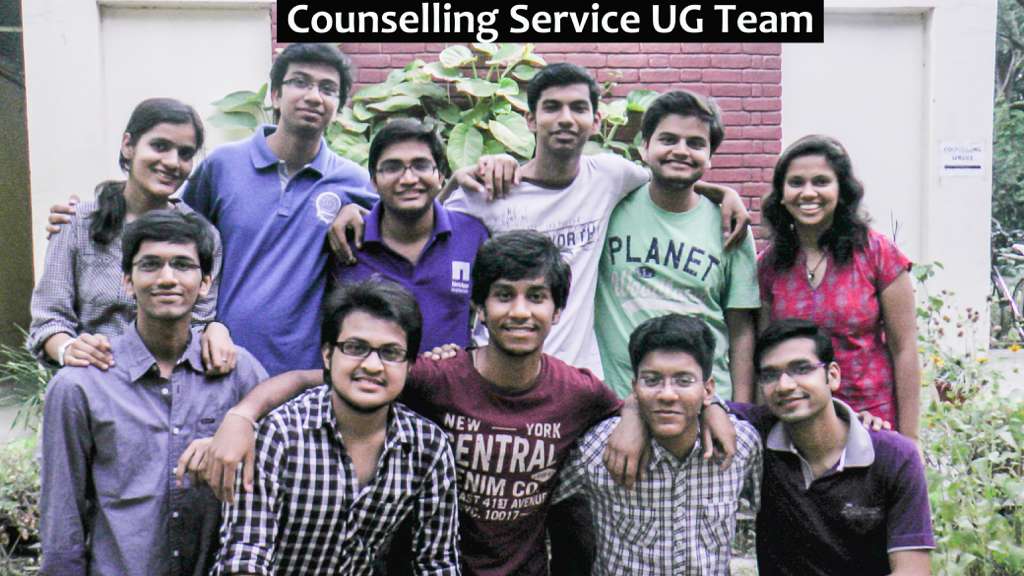
Starting out with the Counselling Service, the UG Team of 2014. Shanu is visible standing second from right in the Planet shirt.
If this was my first CS family, my second CS family was even closer. Our group of 11 Assistant Coordinators (we were selected early in the summer of 2014) were tasked with a never-before-done Orientation Programme. The years prior had been 4-day events, whereas this event was going to be 14 days long. It took the dedicated efforts of the entire team for
2.5 months to prepare and deliver on it, and deliver we did!(Below is a FB status I dug up while writing this piece!).
779
"I guess it was just yesterday that we were being assigned our work for the upcoming summers. A long and tedious task lay ahead of us…… The journey began with a bang. Brainstorming, Planning, Discussions, Debates, Deadlocks, Fights, Resolutions, Solutions, Preparations … It covered everything …We hope the new students liked the programme & enjoyed it to the fullest as much as we enjoyed developing it in its entirety. Personally, I would like to thank the new students…. amazing team of Student Guides … And last, thanks to my team … Just a big hug to all of you!"
Even now, many years later, reading that floods me with vivid memories of that summer! Throughout the year, we conducted workshops on Suicide Prevention, English Conversation, Know Your Department, Stress and Time Management, but none of these compared to the 1:1 guidance we provided. Meeting with students who were tackling issues — the ones who actually needed help, following up with the counsellors to make sure we were all moving in the right direction — the difference that we were able to make just by being there in any way possible.
A visibly mature CS Team, clicked a few months later, on the last day of the 2014 Program, with Shanu visible second from right.
I remember an incident when a really strong lady parent broke down in front of me because of what her son was going through. I clearly remember her crying on my shoulders while I tried my best to console her. If anything, it provoked me to accept that, yes, I was in it as a 21-year-old having fun with the team, but the responsibility bestowed upon me was much greater.
Talking of greater responsibility, towards the end of our Asst Coord tenure, we created a new team structure. Over the years, the Academic assistance provided had grown from organizing 1-1 assistance to doubt-clearing sessions and remedial classes warranting a clear compartmentalization of responsibilities in an expanded core team. It was the need of the hour and we ushered in the change. Usually when a change is made, the incoming team gets most of the responsibility but as I was chosen to be the Coordinator, I was able to select a team and make sure the transition was ironed out. As a Coordinator, we had to attend many more official meetings at the Institute and with the Counsellors. One of the very few regrets I have is that towards this part of my tenure, I had fewer interactions with freshers directly.
780
The Core team interactions were quite varied in perspective as we had a really smart bunch of people who thought through things before deciding on an execution plan. The Operations Core Team was focused on the organizational aspects of the service while mentoring students who needed guidance. The Academic Core Team was involved in providing 1:1 remedial classes for subjects as well as doing classroom style teaching while the Guidance Core Team was there for students who needed more assistance in the halls. Eventually, we made a few adjustments to this structure before I handed it over to the next team of chosen Coordinators during spring 2016, bidding goodbye to my last CS family.
The CS Team with Dr. Sharmistha Chakroborty, 2016. Shanu is visible on the bottom left.
Throughout these years, there was one constant in the CS family. And this was the team of Counsellors that we worked with. Day in and day out, we'd invariably discuss so much with them — from the origins of the service, listening to stories of how the previous teams got us to where we were and together shaping its future ahead. Sharmistha ma'am was undoubtedly the bedrock throughout all this, helping us navigate our responsibility while making it a memorable couple of years with her ever-cheerful radiance.
Well, one would ask - What did I gain from my time at CS? Lifelong friends? True! In the US or at home, much of my friend circle has been CS alumni. Recognition? For sure! People reach out just because they remember me as one of the CS members during their time on campus. Nitty-gritty of how an organization operates while balancing multiple stakeholders? Absolutely! Some of my job interview rounds have focused on problems & solutions from my CS years. But most of all it has defined me and who I've chosen to become in the past decade after my days at 503.
Shanu Vashishtha received his B. Tech in Chemical Engineering from IITK in 2017. He went on to pursue an MS in Computer Science from the Univ. of Massachusetts, Amherst and then worked in Data Science roles for several years. Currently based in Patna, Bihar, he works for a startup called Kahuna Labs. During his time on campus, Shanu served with the Counselling Service from 2014 to 2016 and his emotional connection with the campus remains unbroken.
781
The IITK Counselling Service Today
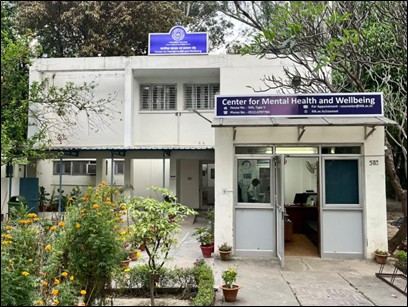
House 503 in the Faculty Type-V residences has served as the home of the Counselling Service (and now CMHW) since 2011
Introduction
For over six decades, the Institute Counselling Service (presently, Center for Mental Health and Wellbeing (CMHW)) at IIT Kanpur has played a vital role in promoting the emotional and psychological well-being of the campus community. In response to the growing mental health needs of students and the evolving landscape of higher education, this commitment has now taken a significant step forward.
On 1st December 2025, the Institute Counselling Service was formally expanded and restructured into the Center for Mental Health and Wellbeing (CMHW). Operating under the Directorate, it offers services aligned with the Mental Healthcare Act (2017) and various policies of IIT Kanpur and Government of India to support the mental and emotional well-being of about 10,000 students; as well as that of the faculty, staff and their dependents.
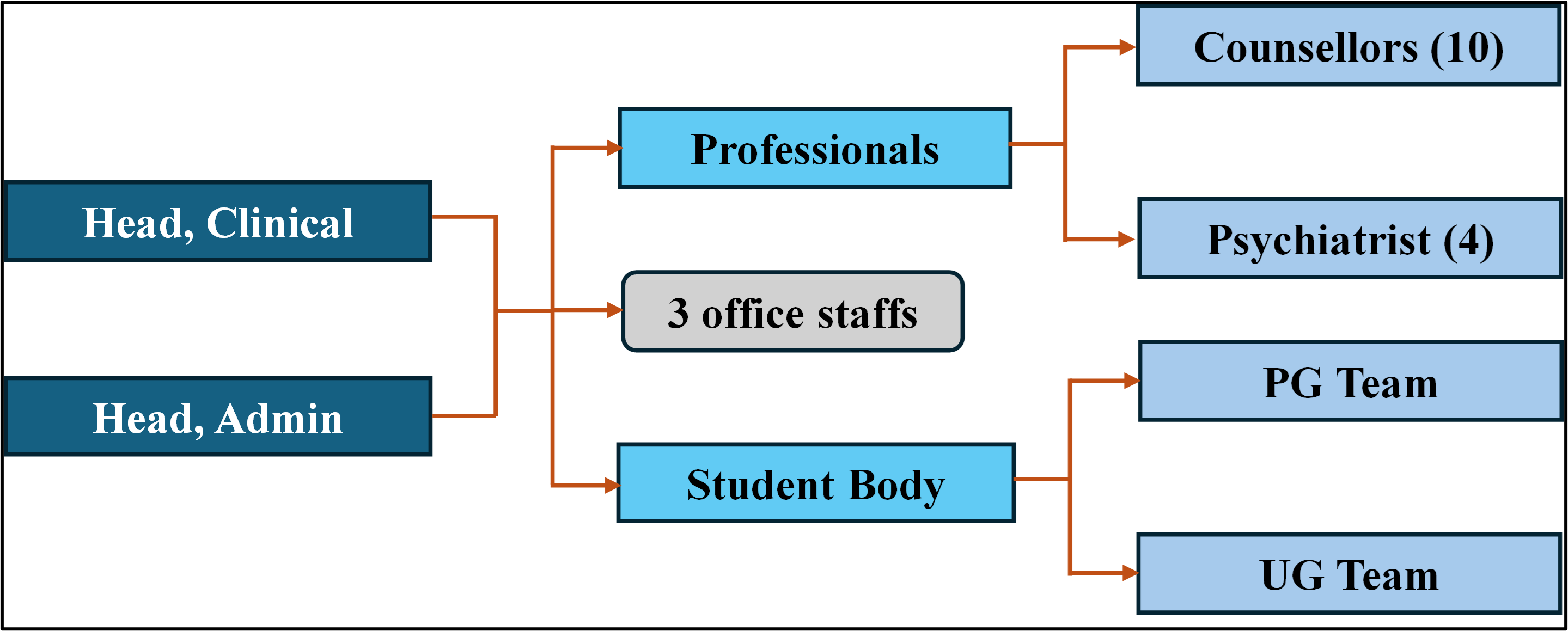
The Center follows a dual leadership model, with a Head (Administration) overseeing operations, coordination, and policy implementation, and a Head (Clinical) guiding the delivery of psychological and psychiatric services. The center has 10 professional full-time counsellors, 1 full-time psychiatrist, 3 consultant psychiatrists for OPD services and three office staff members.
The CMHW Team Structure as it exists today
782
Mental Health Support, Counselling & Psychiatric Services
The mental health services at IIT Kanpur are coordinated primarily by the CMHW and the Health Centre (HC), to meet the needs of a large and diverse student body. The ten permanent and experienced psychologists who reside on campus are available for consultations. For around-the-clock and continuous support, one on-call counsellor is accessible 24×7. Students can schedule appointments through various channels, including the CMHW website, email, phone, or by walking in. In urgent situations, students or concerned individuals can approach the Health Centre directly. Students can also use the Tele MANAS (telemanas.mohfw.gov.in) and YourDOST (yourdost.com) for support. For mental health emergencies, a robust protocol has been put into place, in coordination with the CMHW Head, hostel wardens, campus security, and relevant officials.
Therapy/case supervision sessions are held regularly between Counsellors and Clinical Head, to reflect on complex cases, share insights and strengthen their clinical skills, all while maintaining strict confidentiality to protect student privacy. The Wellness Mandali initiatives, started by CMHW counselors, offers group-based spaces for emotional expression, peer connection, holistic well-being and normalize conversations around Mental Health. For students facing serious psychological challenges, the counsellors regularly follow-up to provide continuous care and track improvement.
Psychiatric care at IIT Kanpur is provided through weekly outpatient clinics and fortnightly de-addiction clinics conducted by consultant psychiatrists. In the HC, there are four Psychiatric OPDs to provide easy support to the needy individuals every week. The institute has an established tie-up with two psychiatric hospitals in the city for students requiring in-patient care.
Students who are academically vulnerable, such as those on warning, probation, reinstated after termination, or struggling to keep pace with classes, are guided by a student team to address academic, mental health, or addiction-related concerns. For those with limited English proficiency, special English language classes are arranged regularly during the semester and flexible exit options are available to support their progress.
Students with disabilities receive support from the Centre for Differently Abled Persons (CDAP) and CMHW. These bodies reach out to such students even before their arrival on campus to understand their needs. When required, arrangements such as separate accommodation or ground floor accommodation are provided.
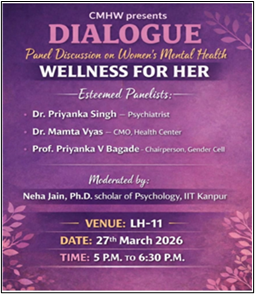
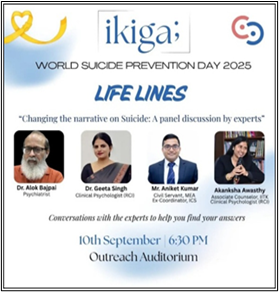
Panel Discussions organized by CMHW. (L) On Women’s Mental Health as part of ‘Dialogue’ initiative held monthly for awareness; and (R) Life Lines, as part of World Suicide Prevention Day 2025
783
CMHW regularly conducts preventive and promotional activities to support campus mental health. These include awareness programs, support groups, panel discussions, and observance of key days, such as World Suicide Prevention Day and World Mental Health Day. Initiatives such as "Gatekeeper Training," "Sneak Peek into the Therapy Room," and sensitization sessions for hall cleaning staff aim to build emotional resilience and mental health awareness. CMHW also runs online initiatives, including monthly wellness posts on Instagram (@cmhw_iitk), internships, comic series, and social media campaigns.
CMHW offers four lectures in the ETH111 (Practical Ethics) course for the first-year students. In addition, in collaboration with Prof. Pragathi P. Balasubramani of the Department of Cognitive Science, CMHW is piloting "Mindcheck" – a self-guided wellness App for the IIT Kanpur community.
There is also an anonymous referral system that allows students to confidentially recommend help for a peer who may be in distress. All student cases are handled with special attention paid to confidentiality and protecting privacy. The CMHW requests anonymous feedback after counseling sessions, as a guide to improving its services.
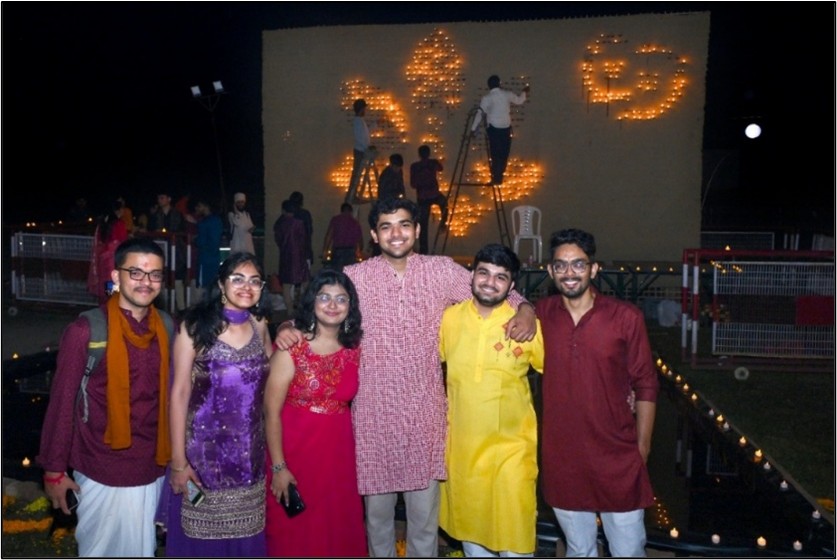
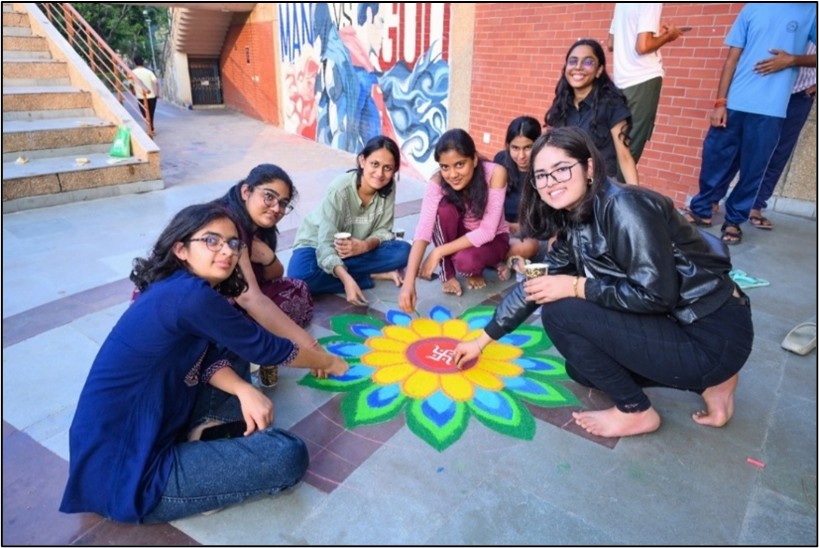
(L): CMHW Student Team enjoy Hakuna Matata (Diwali celebration), and (R) Rangoli Making at OAT
784
The CMHW Students Team
The students' team of CMHW plays a key role in welcoming and orienting new undergraduate and postgraduate students at the
start of each academic year. The orientation program typically spans about 8–10 days and is designed to help
students adjust smoothly to campus life. During this program, institute officials and mental health professionals
provide an overview of academic expectations, student life, and the mental health support system available on campus.
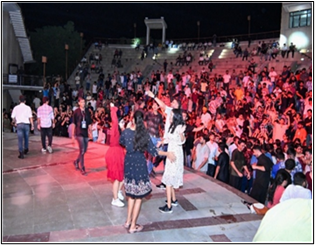
Throughout the orientation, students are introduced to various student clubs, gymkhana, academic resources, CMHW services, internship and exchange opportunities. The program is a mix of informative and recreational activities, including Zumba sessions, DJ nights, science demonstrations, and guided campus tours, designed to extend community building and ease the transition and building relationships. To engage families, a dedicated session is held for parents of new undergraduate students.
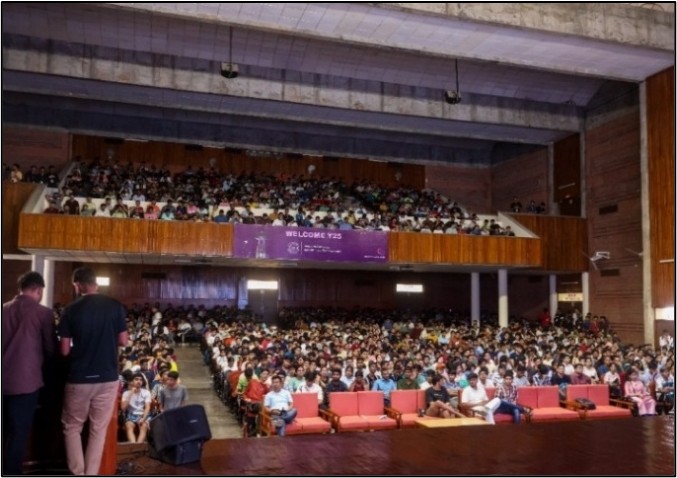
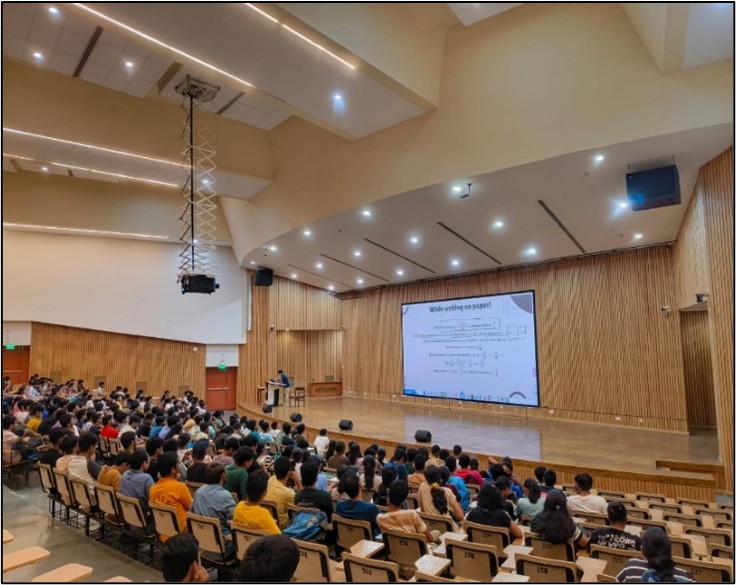
(L) The orientation ceremony for students and their parents in the Main Auditorium for Y25 batch
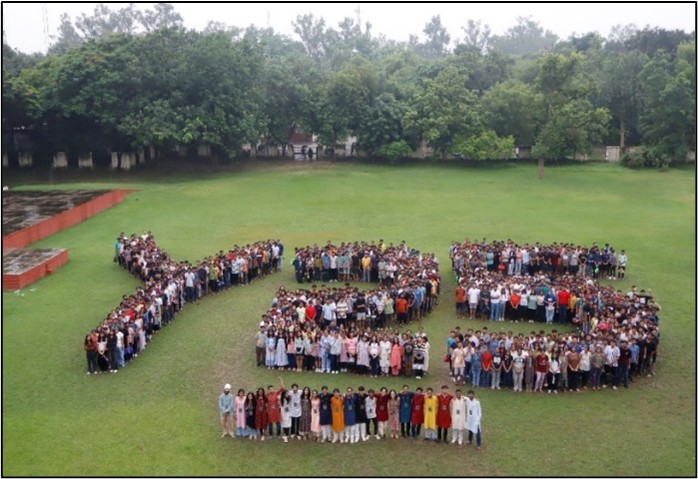
(R) Skyphoto is a ceremony held during the orientation program for both UG and PG students. In this activity, each batch gathers on the Main Auditorium ground and forms shapes or letters representing their batch name, captured from an aerial view. It involves the entire batch (UG and PG separately) and helps build a sense of unity.
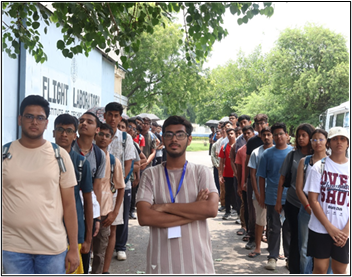
On campus tours student guides and OTMs (Orientation Team Members) help freshers explore and get familiar with the important locations on campus.
785
One of the most important support systems run by the CMHW students' team is the mentor-mentee program. Before arriving on campus, the new students (Bachhas) are assigned with a 2nd year senior student (Bapu or Amma) as their mentor. These mentors are friendly guides who help the new students adjust to campus life, answer their questions, and provide emotional support when needed. This system helps students feel more confident and connected, knowing that someone is there to support them.
In addition to this, CMHW's Academic Mentors, who are academically excellent senior students, organize academic mentoring sessions, especially for core first-year courses. The academic mentors explain difficult topics in an easy-to-understand way and help students to clear concepts and prepare for quizzes and exams. These sessions often feel more informal than regular classes, which makes it easier for students to ask questions and learn at their own pace.
Supporting Classes. Here Academic Mentors, mostly (UG senior students) take group classes in the lecture halls to support students academically
The Student Benevolence Fund (SBF) has been set up for students in need of financial help. The SBF Scholarship provides Rs. 2000 per month for 9 months in an academic year. It is meant for students who do not receive any other fellowship, and academic performance is not considered for selection. Students can also apply for SBF Loan, which offers up to Rs. 50,000 interest-free loan. This loan can be used to cover academic registration fees, hostel charges, conference participation, and other educational needs. To receive this loan, students must obtain a recommendation from their department and an endorsement from the Head-Admin of CMHW.
The CMHW students' team are active throughout the year. They organize various talks and sessions on important topics like managing relationships, time management, using smart study techniques, and staying away from addictions. They also host events that help students relax, make friends, and create lasting memories. Alongside these, the CMHW student teams regularly post blogs and content online to offer guidance and share helpful stories and tips.
Extra-curricular activities: First-year students vibing and enjoying a Zumba session at the OAT during unwinding time, usually held in the evenings amidst the busy orientation schedule.
786
Addressing the Recent Suicides on Campus
The recent instances of student suicides on campus have been deeply distressing for the IIT Kanpur community. Each loss is profoundly felt, and our thoughts remain with those affected. In response, CMHW has strengthened its focus on prevention, early identification, and outreach.
Key Initiatives Taken
- The number of psychiatrists and their availability have increased. Currently, there are 3 psychiatrists for OPDs and every week there are four Psychiatric OPDs to provide easy support to the needy individuals. Furthermore, in addition to the one existing hospital, IITK has empaneled one more psychiatric hospital in the city for students requiring in-patient care.
- Department sensitization programs for faculty and staff to recognize and respond to student distress, covering all the departments of IITK.
- Interactive monthly dialogues led by psychiatrists to encourage open conversations around mental health.
- Regular hall (hostel) visits (twice a week) to improve accessibility, enable informal check-ins and support early intervention.
- Wellness related activities, offering group-based spaces for emotional expression, peer connection, and holistic well-being.
- Collaboration with YourDOST (yourdost.com), providing students with additional avenues for accessible and confidential mental health support.
- More events are being organized to promote awareness about Mental Health.
The CMHW at IIT Kanpur remains committed to promoting the emotional and psychological well-being of the campus community while adapting to the evolving needs of its residents. Looking ahead, its vision is to build a more inclusive, resilient and supportive environment by expanding outreach, strengthening peer support systems and integrating innovative approaches to mental health care. As the community grows and changes, CMHW aims to proactively address emerging challenges and ensure accessible, holistic support for all.
Authored by the CMHW team, led by Professors Sudhanshu Shekhar Singh (Materials Science and Engineering)
and Santanu Misra (Earth Sciences), the current and former heads of the Center for Mental Health and Wellbeing, IIT Kanpur.
787
Professor PRK Rao (1936–2026)
Professor Ponamgi Ramakrishna (PRK) Rao
Ponamgi Ramakrishna Rao, popularly known as PRK, was a faculty member in the Electrical Engineering Department of IIT Kanpur from 1967 to 1996. Subsequent to retirement as Professor, he settled down in Hyderabad where he worked in IIIT Hyderabad as a professor for many years. He passed away in Hyderabad on January 6, 2026. He is survived by his wife Shanta, daughter Kavita, granddaughters Kavya and Kriti and son-in-law Kalyan Basu.
PRK earned his DIISC and AIISC (equivalent to Bachelors and Masters degrees, respectively) in Electronics and Communications from the Indian Institute of Science, Bangalore, and Ph.D from IIT Kanpur (advised by Prof. V. Rajaraman). For a short time, he worked in Bharat Electronics Limited, (BEL), before joining the IIT Kanpur faculty.
PRK was deeply oriented towards a career in academics and research. His depth and range were out of the ordinary. His professional engagement was primarily in the rapidly developing areas of communication and information theories. He was an outstanding and sought-after teacher with significant influence on his students. He contributed in various ways during his career: as Head, EE Department, as Project Investigator in R&D projects, as a research guide of many students, etc.
Early generations at IIT Kanpur were still in the shadows of the horrible things that happened globally – the holocaust, the Second World War, the violent upheavals and unimaginable suffering in the partition of India, the ever-present famines and death, emergence of weapons of mass destruction due to R&D in the sciences and technologies, etc. Sensitive young people such as PRK were deeply affected by these happenings. Big questions loomed in their minds, about life, about existence, about purpose, about inevitability, about hope, etc. Daily conversations among them were often centered around these topics.
PRK realised that much of human suffering was caused by human social mores and arrangements, and by power structures which enabled exploitation. He always sympathised with the exploited and supported their struggles.
PRK gravitated towards deep engagement to understand human life and its destiny. He read widely and interacted with expert colleagues to find answers, in Greek philosophy, epics and myths, works of European philosophers of the 20th century, especially in existential philosophy, and in eastern philosophical thoughts in Upanishads, epics and stories, and in the Buddhist and Jaina lores.
788
Many STEM practitioners believe in the infallibility of science and its methods. In a pioneering effort, PRK developed a course, with a few colleagues, on the history and philosophy of scientific ideas where this question was examined.
PRK is best described as a philosopher, teacher and activist, all rolled into one persona. He thought that education must be holistic, we should teach living and not merely impart technical skills. His philosophical mind saw the existential dilemmas of being human. His awareness of all sides of an issue made him acutely conscious of the uncertainty to be certain, and his incisive mind could make others alive to this. It was his compassionate persuasiveness that made his home a meeting place for enriching discussions for colleagues and many generations of young students.
PRK used to refer to the Sisyphus story often. Arthur Miller's "The Death of a Salesman" was one of his favourite works. These are rather dark and sad themes. He admired Jiddu Krishnamurthy immensely. He travelled once to Benaras Hindu University to be there for several days to listen to Jiddu Krishnamurthy give a series of talks in his unique Socratic way.
PRK lived an unostentatious and simple, almost spartan, life. He was always friendly and welcomed company. It was a pleasure to be with him. You got so much from the interaction. He maintained life-long engagement with a large number of scholars and thinkers, in India and abroad.
In the passing away of PRK we have lost a great analytical thinker, teacher and philosopher. He enriched the lives of so many of his students and friends.
Rest in peace PRK. We miss you a lot. Om Shanti.
S S Prabhu
Retired Professor, Electrical Engineering, IIT Kanpur
K S Gandhi
Former Professor, Chemical Engineering, IIT Kanpur and Retired Professor, Chemical Engineering, IISc, Bangalore
Friends of PRKR for more than half a century
Prof. and Mrs. Rao, shortly after their arrival at IITK
789
PRK Rao: The Builder of Bridges
Achla Raina — Retired Professor, HSS, IIT Kanpur
IIT Kanpur has a way with abbreviations – they invariably transfigure into proper names. Prof Rao was always PRK; when I met him way back in October 1983 at his Campus house (H. No. 421, I think) and when we spoke last over the phone in September 2025. That first visit happened to be a social one. I do not remember when the social became so personal that we remained in constant touch even after he had moved to Hyderabad. Our phone line was active for over thirty years for those early morning conversations even as we transitioned from black dial phones to WhatsApp. I believe that in his heart and his mind, PRK never really left his Kanpur home and its people. And so, towards the end of his journey, when he was very unwell, he was heard telling his physician in Hyderabad over phone, "I am PRK Rao from Kanpur."
PRK was a teacher by vocation, but he seemed to extend his vocation to life and, even more likely, carry life-notes to class. The distinction was never obvious which is perhaps why even though I was never his student, I learnt many life lessons in his company. I did not attend his classes in detection estimation and allied engineering fields, but I did have the privilege of sitting in his lectures in a variety of other fields that he took a deep interest in. In these ruminations, he relished nothing as much as an astute disagreement. Indeed, his method was a summation of argument and counter argument, truth and counter truth. He was many people and in the many worlds that he straddled, these many people were one.
PRK was endowed with the sensibilities of a scientist and a poet (even in his prose). It is not that in his head he did science and, in his heart, poetry. His head and heart both partook of science as well as poetry in an equal measure. His multitudinous worlds invoked a plural vision that included, as a view within a view, life's uneven, and often dichotomous truths, and as he lived them and reflected on them, he sought to build bridges. Between action and faith, fact and value, disdain and empathy, arrogance and humility, despair and hope, truth and mere possibility. He seemed to have the time and the space for the ordinary and the extraordinary both with their respective capacities and incapacities. He sought to build bridges here and now between dichotomies given to us or those of our own making. With his prodigious intellect and with small, unnamed acts of kindness, care, and love.
PRK was deeply mindful of the possibilities of language, and each turn of phrase made one pause and wonder in awe. Our last in-person interaction was in 2019 when I was in Hyderabad. We spent an entire day together at his beautiful Secunderabad home. Age had not diminished his love for a good argument. In his last days, he was visibly in pain and he spoke of it with an unusual candour. It looked like his body was unable to keep pace with his mind which remained acutely aware until the very end. As he traverses the many bridges between life and beyond, he is most likely savouring the panoramic view with a thoughtful line from the poet he so loved: In my end is my beginning! May he travel well!!
Dr. Achla Raina is a retired professor of linguistics, IIT Kanpur. She works in the areas of cognitive linguistics, pragmatics, and descriptive linguistics. Her empirical domain covers Indic and Dravidian languages, and occasionally, sign languages.
790
PRK Rao -- A Life Immeasurable
Kalyan Basu
How can one measure the flickering fire that enlightens? The flowing river that enlivens? The unwavering star that guides? How can one measure the immeasurable?
Yet the compulsion of language binds us to circumscribe, measure and judge. P.R.K, ever sensitive to those risks, warned using the words of Ludwig Wittgenstein: Whereof one cannot speak, thereof one must be silent. So here we stand now, at the pyre, resisting the dying of light, where the only resonance the flames elicit is the betrayal of silence by our words. Of course, P.R.K. would have preferred a different metaphor: the game of chess played by the knight of faith with the implacable figure of death at the edge of the sea. He would resign but only under protest. He would scorn, since there was no fate that could not be transcended by contempt. That was P.R.K. forged in the fires of Bergman and Camus.
Nights lost themselves in a peculiar timelessness as the lights went out, one by one in the lane where he lived. One light burned through the darkness, where impassioned dialogue, contemplative silences, the smoke of cigarettes and the bittersweet fragrance of coffee kept oblivion at bay. A question on the Bayesian interpretation of probability evoked the unsettling rejoinder from P.R.K. that the Bayesian prior has no canonical formulation since it can be measured incommensurately by different subjects. We were duly flummoxed – which he used to introduce us to Kolmogorov and thence to Martin-Löf. The discussions meandered and ramified, played by the mysterious logic of conceptual thought, into the arbitrariness of axiomatic foundations, language games, the dogmas of empiricism, to the archaeology of knowledge, finally ending up in the basin of the strange attractor of Buñuel's surrealism. We left finally, our minds on fire, having glimpsed a tiny bit of the infinite realm of questioning which is the ground of all knowledge.
Three philosophers played crucial roles in shaping P.R.K.'s thinking: Camus, Foucault and Merleau-Ponty. In Michel Foucault's writings, P.R.K. found a deep resonance with his own critique of knowledge systems. Where other thinkers found the certainties of empiricism, P.R.K. found metaphors, dogmas, norms. He excavated such things based on the critique of historical discontinuities, the stability of orthodoxies, the revealing of the fissures and seams between truth, effectiveness and requirements of control.
P.R.K. was a master of words, yet vigilant against the power of thought to enforce a closure around what was essentially open and infinite. In this, he found an ally in Maurice Merleau-Ponty, finding the unsayable as essential. It was the openness to Being, forged against the closure of language, and the "clearing" where the World, at the edge of its apprehension, formed the horizon at which objects appeared to reflection, then receded into their essential mystery.
791
Albert Camus was a revolutionary force on P.R.K.'s life – a force that made him into the man, the teacher, as we knew him. The central question that animated PRK was the question of what it meant to be human. His thoughts and his life were ceaseless struggles against efforts to foreclose, determine or otherwise delimit this subject – whether by an implacable fate or human oppression. To be human, for P.R.K., was to live in the unending and irreducible contestation between the limitless call of human transcendence and the fateful limits of Man's material and symbolic existence.
For P.R.K., politics was the necessary response to a world where no truth was innocent of power, and no norm could claim universality. P.R.K.'s life moved fluidly from the abstractions of philosophy to concrete action in solidarity with the struggles of the powerless. Whether protesting outside the Director's house for the rights of construction workers, demonstrating for the rights of the dhobis, rescuing a child migrant enslaved in the home of a faculty member, sheltering a colleague from the anti-Marxist crusade by the police during Indira Gandhi's emergency, or crusading against the unjust actions of a colleague against his wife – P.R.K. would unfailingly be at the forefront – organizing, inspiring, protesting, erasing the divisions of class, caste, religion in one unified moment of solidarity, one humanity asserting its subjecthood.
The mystery and sublimity of human redemption, animating every authentic experience, bound P.R.K.'s mind to the living of his existential being. Beyond language, beyond contestation, beyond difference, lie the silent murmurs of the body and its memories of love, the joys of friendship, the absolution of forgiving. This was the origin and ground of P.R.K.'s profound humanism.
The light that burned brightly through night after night, in that house in IITK, kindled many lights in the minds and hearts of students fortunate to be drawn into its glow. This was the light of PRK's love of learning, of the ineffable and immeasurable quality of being human, and of the redemptive freedom of the beautiful, the ironic and of the committed life. This light have we carried through the smoke of the years, burning even brighter if ever we felt that the darkness of the night was deepening around us.
That was PRK's singular, immeasurable and irreducible role for many generations of students who entered the gates of that great institution of knowledge – asking the question about Lyapunov, but then willing to be led to the beginning that was the end in Fellini's great cinema. I could not have been more fortunate.
About the author:
Kalyan Basu, Prof. PRK’s son-in-law, completed his B.Tech. in CSE from IIT Kanpur (1983-87), his MBA from IIM Calcutta (1989) and his PhD in Computer Science from IITK in 1994. Kalyan is a technology strategist and an architect for AI systems by profession. Outside of his professional life, he maintains a deep interest in philosophy and the humanities, and in research into the foundations of information and computing in natural processes. He lives in the Seattle area with his wife, Kavita.
792
Remembering my grandfather
Kavya Basu
As a young child my maternal grandfather was a bit intimidating. While other grandparents called me silly pet names, told funny stories, and gifted my favorite foods and toys, Tatha carried a certain gravity. I don't have a single memory of him hugging me or picking me up. My parents and family members sung his praises and referred to him as this great, warm-hearted person but I saw him as stern and slightly distant.
This continued until I was around 10 or so, when my parents moved us to America. As my sister and I got older, we started becoming more aware of the world around us—we were forming our nascent opinions on politics (this was right in the middle of the Bush administration and the US occupation of Iraq), noticing injustices, and constructing our belief systems. This was when I finally started to connect with Tatha. As many know, he was not a fan of the United States to put it lightly and happily indulged our anger towards it and the problems we noticed in the West. Our phone calls turned into hour long venting sessions complete with book recommendations and emails with links to news articles. Does anyone else have a grandfather who suggested the Communist Manifesto when they were 12?
I now realize that what I had interpreted as aloofness as a child was actually a kind of respect. He didn't jibe with kids because he chose not to—or maybe was unable to—treat them like kids. He never talked down to me. No topic was too serious, and no idea was too grown up for us to tackle together. If I expressed irritation at someone, he'd quote Sartre: "Hell is other people". If I complained about something, I was reminded to imagine Sisyphus happy. Whether we were discussing history, philosophy, or politics, he listened to my opinions as if they carried real weight.
Some of this may sound strange to his students and colleagues who speak of him as a kindhearted and warm person. I've heard many stories about how he was an emotional sounding board to troubled students, a passionate activist on campus, and someone who embraced all the disenfranchised of Indian society—gay people, lower castes, Muslims. But this warm, fuzzy persona was not the Tatha I knew. Maybe his family got a side of him that the outside world didn't.
There's a general understanding that the intellectual and emotional worlds oppose each other and most of us tend towards one or the other side. My grandfather was rare in that he contained both. I didn't get to see him in the spheres of teacher, mentor, and activist. Instead, I saw a brilliant mind who intensely needed to operate with the full range of human intellect and emotion, which is why he couldn't connect with me until I reached an age that I could access it.
When I was thinking about what to write about him, I looked up one of his favorite quotes: "Don't walk in front of me, I may not follow. Don't walk behind me, I may not lead. Walk beside me and be my friend." It was surprising that he loved that quote because it seemed saccharine and unlike the serious, cynical Tatha I knew. This quote is commonly misattributed to Camus, but there's no evidence he ever said it. Now I can only ever attribute it to Tatha.
About the author:
The granddaughter of Prof. PRK Rao, Kavya Basu is an experience designer by profession with a background in cognitive science. She lives in Chicago with her husband and their two cats.
793
Faculty-Student Cricket, c. 1977-78
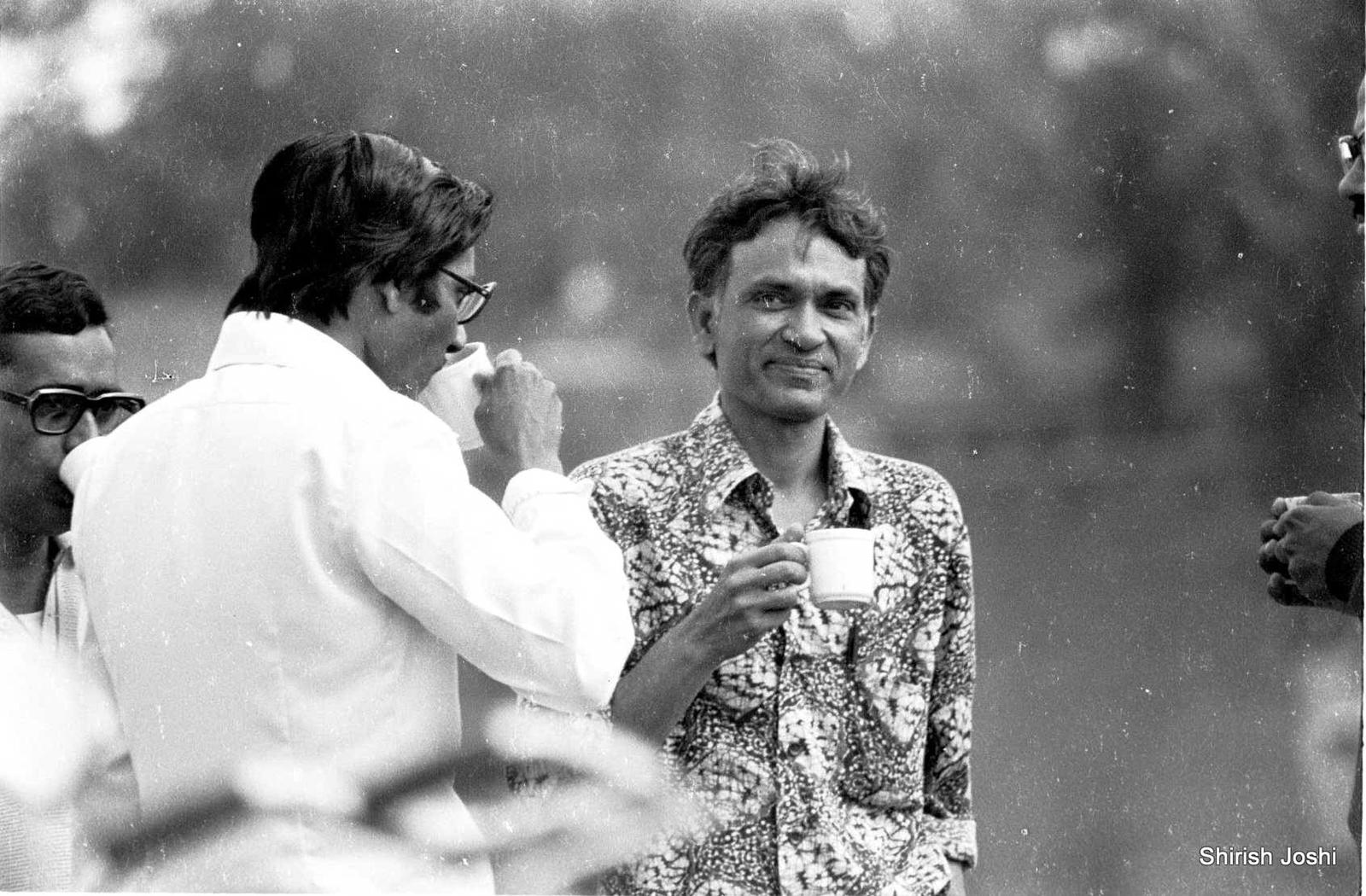
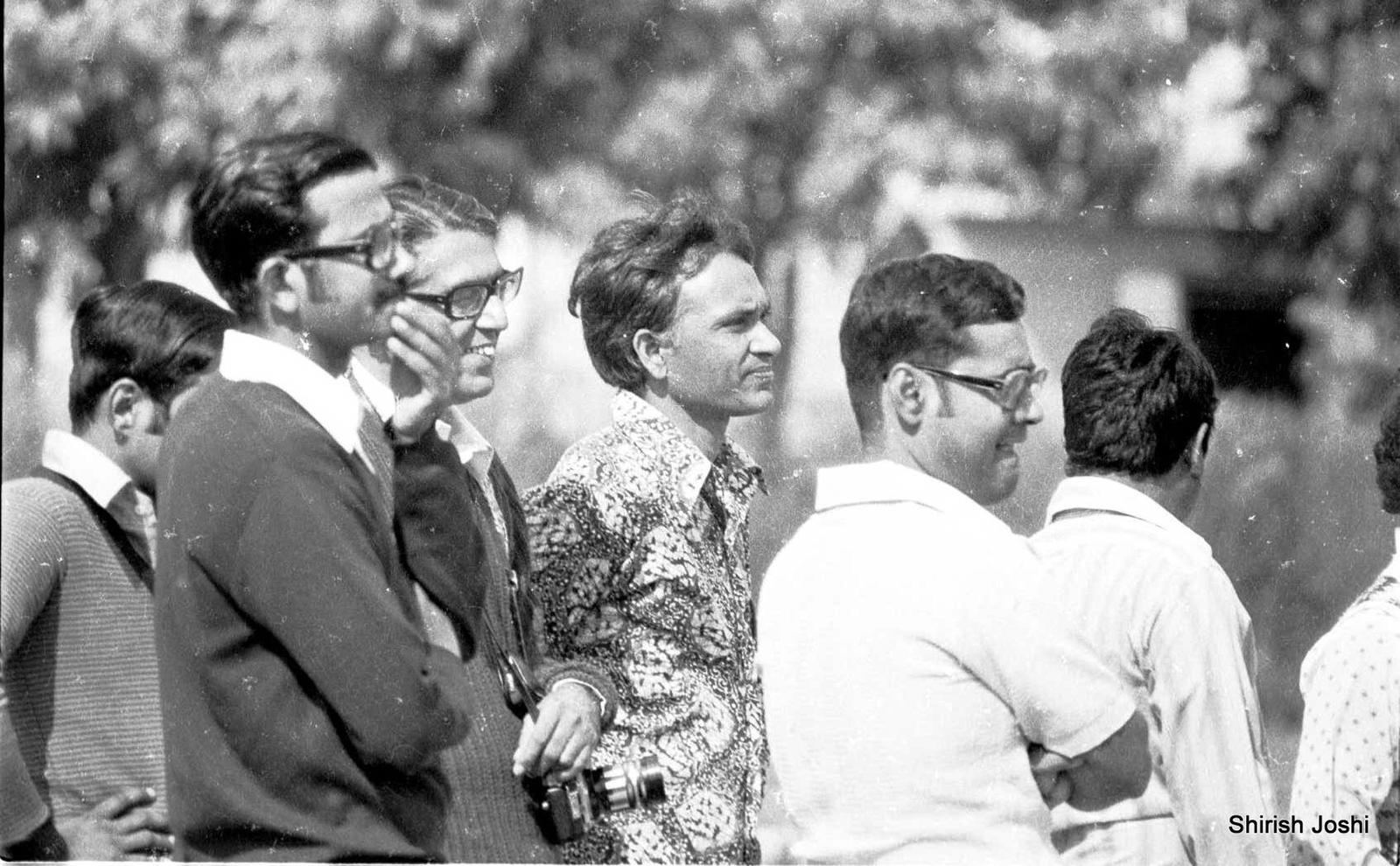
Faculty – student interaction was very strong on the IITK campus, with interactions extending well beyond the classrooms and lecture halls. Here are images from a student – faculty cricket match, c. 1977-78. Prof PRK Rao can be spotted in the top picture with a cup of tea in hand. The bottom picture has Prof PRK with friends enjoying the proceedings. Also visible are Professors SK Mullick and V Sinha. Pictures: Shirish Joshi
794
The Meaning of Compassion
Chilikuri Krishna Mohan (BT, CSE, 1978-83)
We have had so many wonderful teachers at IITK, and even the current generations of students are blessed with similar wealth of wisdom and guidance. But is anyone teaching them the meaning of compassion, in words and in actions? Is there a PRK still biking home from the ivory towers of IITK in his trademark carefully ironed white shirt ready with a smile on his face for anyone who needed his help?
Not pity, nor sympathy, not empathy—compassion requires that one does something to help another, even if it requires considerable effort or involves risk to oneself. It means not making excuses for someone else's misery—"he's not smart enough" or "he doesn't work hard" or "he must have done something bad in his previous life". Compassion requires that we recognize individuals as struggling through the circumstances that circumscribe them in a stochastic world where the consequences of one's actions depend on a zillion things other than oneself, especially on the accident of birth and the choices made by those who have the power to deny access to resources to others. We live in a world with constrained resources, and some are doomed to struggle through life with little hope and no confidence that tomorrow will be any better than today.
I have spent many evenings in conversations with PRK discussing philosophy, science, literature, and many other things—more listening than talking, of course. Sometimes I saw a new way of looking at things, sometimes an appreciation for something that I had not perceived before, sometimes a confirmation of prior intuitions, sometimes a change of opinion, and (of course) sometimes I came away a little confused. But I grew. Thanks in part to those conversations, I believe I can distinguish sense from nonsense in the web of words that may be weaved about me, and also to know when I don't understand something.
I remember listening to PRK when reasoned public debates on social and political matters were held by the Forum for Social Awareness, with faculty members who cordially disagreed with each other. When PRK and a few other professors, along with some students, started discussing the history and philosophy of science, I remember eagerly reading the works of Thomas Kuhn, Karl Popper, and others. When a bus-load of people from IITK went to see the movie "Gandhi" in the city of Kanpur, I remember discussing Gandhian ideas with PRK, whereas in the past I had mostly dismissed them. Perhaps the most learning occurred when PRK would argue for a position with which I drastically disagreed—learning involves listening, understanding, figuring out why we disagree, and possibly even changing one's opinion.
Finally, I blame PRK partly for my habits of reading and writing poetry, persisting over 40 years after those evenings of endless conversations. Those long hours spent with students must have been difficult for his family, and I thank them belatedly for their patience and kindness.
C K Mohan is a Professor of Computer Science at Syracuse Univ. and an Editor of the Spark.
795
PRK - The Zen of Teaching
Nikhil Nigam (BT, EE, 1981-85)
There are Teachers ... and then there is PRK.
Professor PRK Rao of Electrical Engineering, IIT Kanpur is no more. He has fallen silent. He earned his rest but at the same time left very big shoes to fill.
My journey with PRK commenced four decades ago.
I had been his student, marked indelible for life as if by the ink from the fountain pen,
that he carried in the left pocket of his cotton shirt. I cherished every opportunity to meet,
see him in action, and interact with him. It was unfailingly an uplifting, sublime, magical and
mystical experience to even hear his voice. And I say this as a seasoned intellectual with
feet entrenched in the deepest dust, dirt and mud of modern India.
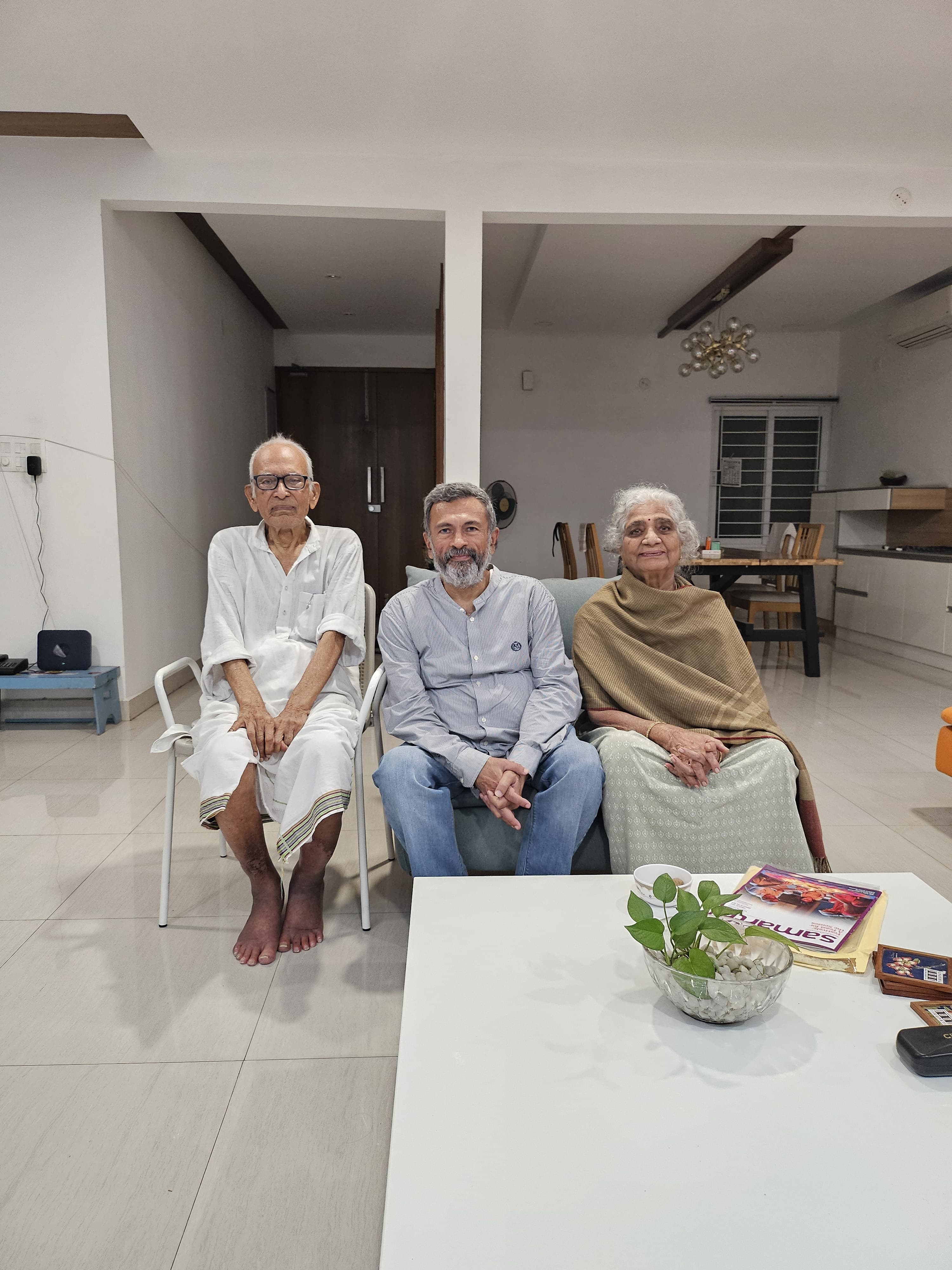
Nik with Prof and Mrs. PRK Rao in October 2025
I did travel to Hyderabad to meet him, one last time in October 2025, when Andhra and Telangana were in the grip of a severe cyclonic storm. I wanted to meet him and his wife Shanta Ji, to converse with him, to hug him. He tried his best to throw me off on that occasion. Yes, he felt poorly about physical frailty and afflictions that life bestows upon all who live to old age, like a candle burning at both ends. At the last moment he relented. The Teacher could just not refuse a Beloved Student who was insistent.
PRK fitted into IIT Kanpur and its framework like a hand in a glove. At IIT Kanpur he did find his great calling in life — that many aspire to, and very few actually find. His great calling in life was the shaping of great minds. As he would say in his chiding tone when exasperated..."you have no business to be in the teaching business, if you cannot be available and give your all to the most difficult students and all the travails that teaching involves." Being available to his students went far beyond time scheduling, frames and slots; it was a philosophical act of courage and authenticity.
He commanded the deepest admiration and respect from multiple generations of the faculty, administrators, students, and employees. He was recognised, loved and indeed one of the golden threads woven into the very brocade fabric of IIT Kanpur of 20th century India. For me as a modern Indian intellectual, PRK was of course a Teacher. But he was also a nonstop 24 hours 365 days Teacher. PRK carried his greatness as a teacher ever so lightly. But more than an intellectual, PRK was a prototype. And even more than a prototype, PRK was an archetype. He was an archetype of the infinite possibilities of precolonial classical as well as postcolonial modern Indian pedagogy, in the modern Indian institutional context. This indelible mark PRK has left behind, like a leaking pen for India.
Nik Nigam is a 1985 (B.Tech. EE) alumnus of IITK, where he had co-produced the gymkhana magazine Counterpoint. He has worked with apolitical farmer organisations across India, and covered their political impact in Mazdoor Kisan Niti, a Hindi journal. He now lives in London (UK).
796
Prof. PRK Rao — A Tribute
Prof. PRK Rao, my PhD thesis supervisor at Indian Institute of Technology, Kanpur, passed away yesterday. I was one of his last PhD students at IITK before he superannuated in 1994–95. But he remained academically active even after his superannuation.
It would be an understatement to describe him as a former Professor at IIT Kanpur. He was truly an institution in himself, leaving a profound and lasting impact on me and on several students taught and mentored by him.
I last met him during my visit to International Institute of Information Technology Hyderabad (IIITH) in late 2024, but his influence was a constant presence in my teaching at Indian Institute of Technology, Bombay. The supervision of my PhD thesis (1989–1994) was only a small part of his mentorship. Conversations with him, ranging from Communications Theory to the history and philosophy of science, were always deeply enriching and intellectually stimulating. His depth and breadth of knowledge were truly unparalleled.
I learned many fine nuances of teaching from him: how to pose questions, how to nurture curiosity among students in the classroom, and how clarity and precision of thought should reflect even in what one writes on the blackboard. He had an extraordinary eye for detail.
His insistence on clarity, rigor, and precision in writing that felt frustrating three decades ago became invaluable lessons later. I still have vivid memories of him questioning each and every sentence of my thesis drafts, shaping not just my work but my approach to careful drafting till date.
Prof. Rao leaves behind a remarkable legacy of scholarship. He belonged to that exceptional group of IIT Kanpur teachers who have shaped generations of students who are now well-established leaders in their respective fields. The void he leaves behind will be impossible to fill.
Abhay Karandikar
MT-PhD, EE, 1986-94; Director, IIT Kanpur, 2018-23
Secretary, Dept. of Science and Technology, GOI
797
Techkriti 2026: Forging Futures, Fuelling Innovation
Techkriti, the annual flagship festival of IIT Kanpur, continues to stand tall as Asia’s largest technical and entrepreneurial festival. Since its inception in 1995, it has embodied innovation and excellence. The 32nd edition, held from March 19 to 22, 2026, revolved around the theme NeoNousSingularita, symbolizing the evolution of intelligence, and brought together technology, intellect, creativity, and electrifying experiences under one umbrella.
The name ‘Techkriti’—a fusion of “tech” and “kriti” (creation)—perfectly reflects its spirit: a celebration of ideas brought to life. Over four action-packed days, the campus transformed into a hub of discussions, competitions, and unforgettable performances.
A Grand Beginning: Day 0 Highlights
Techkriti '26 commenced with a prestigious inauguration ceremony at the Main Auditorium. The event began with the ceremonial lighting of the lamp, followed by addresses from the festival leadership and institute dignitaries.
The ceremony was graced by GVG Yugandhar, Director General of the Aircraft Accident Investigation Bureau, whose keynote set the tone for the festival with insights into aviation safety and the future of aerospace innovation. This was followed by an engaging talk by Rahul Mazumdar on "Making India a Global Drone Hub," highlighting India's growing prominence in drone technology.
The evening transitioned into high-energy competitions like Hovermania, along with interactive sessions such as the Atlassian Career Café. The day concluded with thrilling aerial showcases like Multirotor, setting an exciting pace for the days ahead.
Day 1: Technology, Leadership, and Electrifying Nights
Day 1 of Techkriti '26 unfolded as a dynamic blend of intellect, innovation, and energy. Major General C. S. Mann, ADG, Army Design Bureau, set the tone with a compelling address on the growing role of indigenous technology in defense, emphasizing innovation and collaboration between academia, industry, and the armed forces as pillars of a self-reliant India.
Major General C S Mann speaking at Techkriti ’26.
798
The stage then welcomed global thought leaders, including Dr. Eric Grimson, Chancellor, MIT, who offered deep insights into the evolving landscape of medical technology, alongside industry experts decoding the future of artificial intelligence and cloud computing.
Adding a powerful emotional and aspirational dimension, Group Captain Subhanshu Shukla captivated the audience with reflections on India's return to space after 41 years—calling it a moment of national pride. He became the first Indian to return to space in 41 years when, in July 2025, he visited the International Space Station as a part of the Axiom Mission 4, a privately organised spaceflight. Sharing the challenges of space missions, he highlighted the unwavering support of family and the nation, inspiring students to dream bigger and aim higher.
Group Captain Subhanshu Shukla speaking at IITK. He became the first Indian to return to space in 41 years when, in July 2025, he visited the International Space Station as a part of the Axiom Mission 4, a privately organised spaceflight.
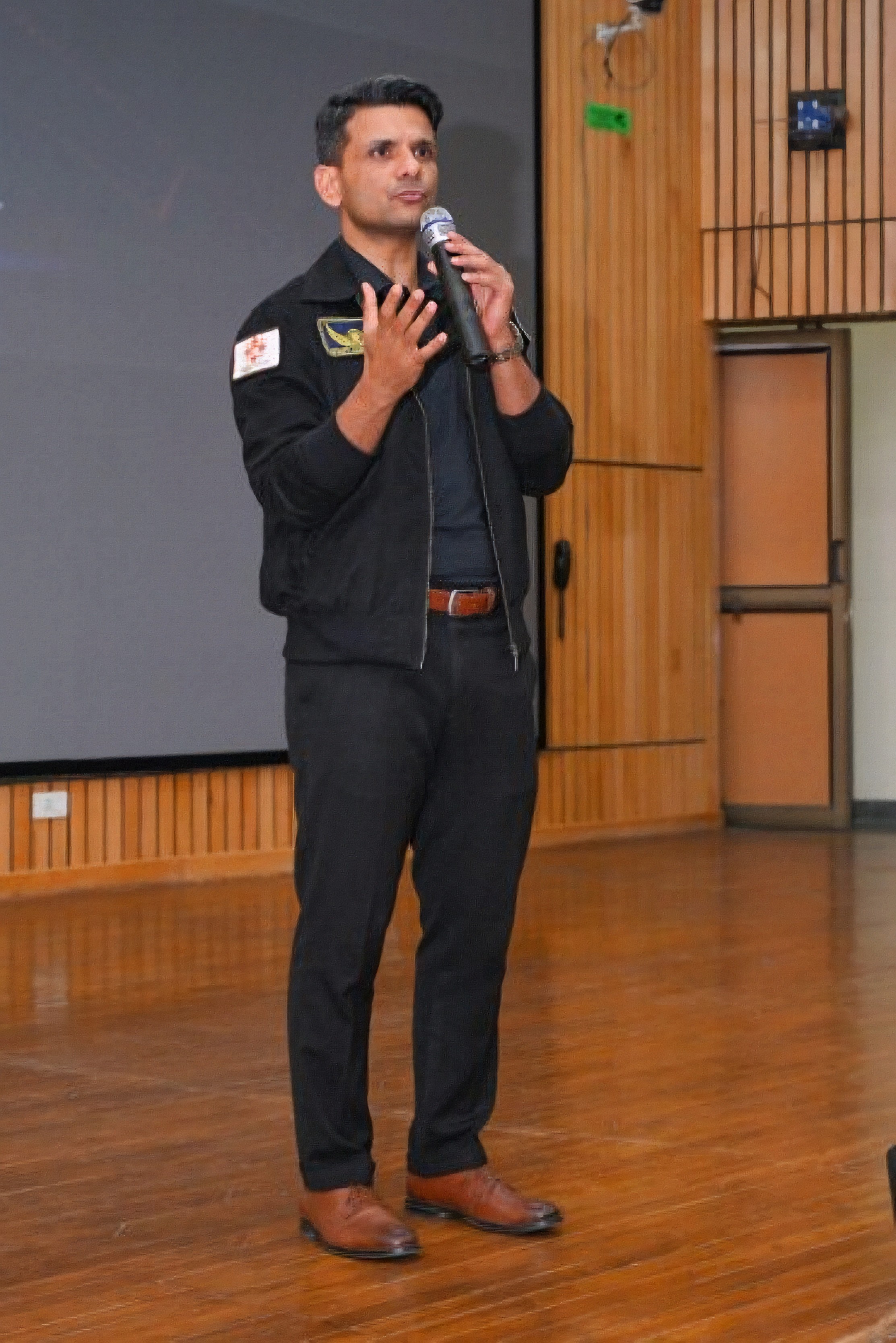
Beyond the talks, the campus buzzed with high-stakes competitions—from structural ingenuity in the Bridge Design Challenge to intense coding battles in the Atlassian and Eightfold AI Hackathons. Events like Manoeuvre, the Robotics Competitions, and CNC displays turned the grounds into arenas of technical brilliance and innovation.
Abhivyakti (Expression) is the flagship startup showcase event organized by the Startup Incubation and Innovation Centre (SIIC) at IITK. This exhibition at the Auditorium Ground, in collaboration with Abhivyakti–SIIC, featured startups like Life and Limb Pvt. Ltd. showcasing cutting-edge MedTech innovations. The expo brought together a diverse range of exhibits across AI, Agritech, Cleantech, and more, highlighting a vibrant startup ecosystem.
799
As the sun set, the energy only soared higher with EDM Night by Nucleya, where electrifying beats, dazzling lights, and an unstoppable crowd transformed the Pronite Ground into a pulsating celebration of music and energy.
Fire in the sky! Techkriti lit up with an electrifying EDM night as Nucleya took over the stage, filling the air with thumping beats, fiery visuals, and a crowd that didn’t stop moving.
Day 2: Diversity of Ideas and Unstoppable Energy
Day 2 emphasized inclusivity and interdisciplinary innovation. The Women in Tech Panel featured distinguished leaders like Shailaja Donempudi, Dipti Saudagar, and Taranjeet Kaur, who shared their journeys and insights on leadership and entrepreneurship.
The AWS Keynote by Mouna Neelkanta highlighted advancements in cloud technologies, followed by a talk by Air Marshal Balakrishnan Manikantan, offering perspectives from defense leadership.
Air Marshal Balakrishnan Manikantan speaking at IITK. Picture: Bacardi Films
Competitions continued at full throttle with events like Sky Sparks, Multirotor, and TGP, attracting participants from across the country.
800
Competitions: (Left) An exhibition of xTerra Robotics in expo at the auditorium ground, and (Right) the Manoeuvre competition at Events ground
The Techkriti Grand Prix, at the Hockey Ground IITK, saw teams bring their cars to compete on a track with different obstacles, completing a given number of laps in the minimum time possible, much like in F1 racing. The cars may be Nitro or electric powered, however they must meet the qualifying specifications on dimensions, weight, battery capacity, etc.
The evening featured Band Night by Omkar, delivering a powerful live music experience that resonated across the campus, followed by late-night performances that kept the energy alive well past midnight.
Day 3: Strategy, Strength, and a Grand Finale
The final day of Techkriti '26 was marked by one of its most impactful discussions—the panel on "Operation Sindoor: Tri-Service Operations in the 21st Century." The panelists including Lt. General D. P. Pandey, Air Marshal Philip Thomas, and Rear Admiral Ajit Thekkepat shared deep insights into modern warfare, joint operations, and technological advancements in defense.
801
The Operation Sindoor Panel with Lt. General D. P. Pandey, Air Marshal Philip Thomas, and Rear Admiral Ajit Thekkepat.
Competitions like Robowars drew massive crowds at the Open Air Theatre, where powerful, custom-built robots battled it out in a display of engineering brilliance, strategy, and raw power.
The festival concluded on a spectacular note with Bollywood Night by Sachin-Jigar, where music, lights, and an electrified audience created an unforgettable finale under the night sky.
Bollywood Night by Sachin-Jigar at the Pronite Ground.
A Celebration Beyond Boundaries
From thought-provoking talks and high-stakes competitions to mesmerizing pronites and cultural showcases, Techkriti '26 was more than just a festival—it was an experience that blended knowledge with excitement, and innovation with celebration.
With participation from across the country, visionary speakers, and groundbreaking events, Techkriti '26 once again reinforced its position as a platform where ideas are not just discussed, but brought to life. As the curtains fall on another remarkable edition, Techkriti continues to inspire the next generation of innovators, creators, and leaders—pushing boundaries and shaping the future.
Text authored by Lisa Verma (BT, MSE, 2022-26) and Rishav Raj (BT, ChE, 2022-26). Pictures have been shared by the Information Cell (IMOC), IITK unless indicated otherwise.
802
Our Bits of That IITK
50 Years of the ‘Green Issue’
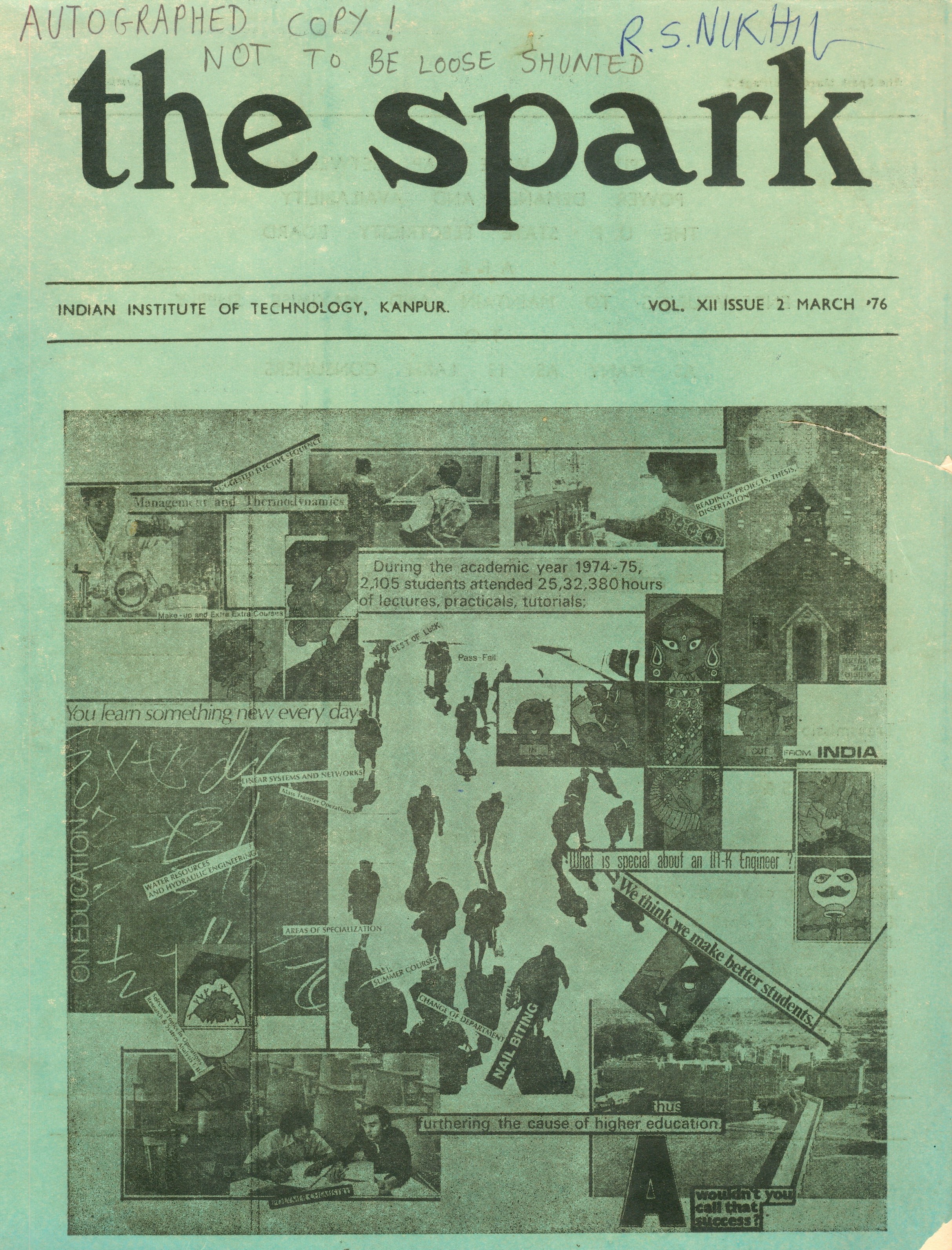
803
Ye Olde Spark
Debasish Roy (BT, MME, 1971-76)
Innocent dreams
It is nostalgia time... The new digital Spark is remembering the vintage printed version from 50 years ago. Apparently, it was in 1976 that the last issue was printed — the subsequent issues were duplicated in other ways and eventually the issues stopped appearing altogether. This is unsurprising — the printed issues took time and money and, needless to say, we were severely limited in these areas. The Spark of the 70s had to fund itself to earn the freedom to write as we felt. As writers, we wrote unrestrained through our years on campus, yet somehow managed to stay clear of getting into trouble over our writings.
Raddi to the Rescue
Just as the writing was easy, placing those few pages in the hands of readers was very difficult because of a perennial lack of funds. In these days of online paywalls, it is hard to imagine that we hand-delivered The Spark, free of charge, to students and every professor's doorstep. To make that happen we resorted to newspaper collection drives from faculty — lugging stacks of old papers straight to the "raddiwala" shop behind the Hall II mess. Once we amassed Rs 300, we were ready. The rest of the money, perhaps another Rs 300, came from advertisements, with the balance from a local Industrialist family.
The Spark, March 1976
804
A Chance Find
In 1975, a new masthead was born. While rummaging through my predecessor Arun Kumar's (Chief Editor, 1974–75) books, I came across a dog-eared, coverless book of illustrated fonts. A certain font caught my fancy and AK got to work to scale and create the new masthead with a paint brush. Somehow, we raised enough money to create a printing block. This became The Spark's second material possession, besides an old, battered Olivetti typewriter. Decades later, when The Spark (Digital) was started, the team, to its credit, revived the old masthead despite tough competition from digital fonts. Art can survive. If you look closely at the original masthead (page 803), the scaling imperfections are there to see.

The Olivetti typewriter, seen in a Vox Populi graphic from 2016
Nightly Tempo Rides to Rawatpur
The Spark was printed at the Design Press in Rawatpur, a place where we spent many nights proofreading a manually typeset mold, set in reverse, looking at its image in the mirror. Occasionally, our old typesetter gentleman would accidentally drop an almost completed page scattering hundreds of typeset letters all over the grimy floor. It would take a few hours just to put the letters back in the right bin and start typesetting the page all over again. Heartbreaks come in many forms. After many nights of proofreading, the day would arrive to start printing. It was only then, having just read a printed page, that we would discover, too late, an ugly typo. Finally, one fine day, the labor of our literary love came home on a tempo back to Kalyanpur.
The Spark Hookah Days
Just as the annual cultural festival arrived, hipsters from Mumbai and Delhi colleges would descend on our campus to showcase their versions of American Pie or Ibsen or Sashi Tharoor's debating skills. The air was electric. The Spark Hookah, a daily rag, was born in Festival '73, as another innovation introduced by AK, the title itself drawing upon the Caterpillar's pipe in Alice's Adventures in Wonderland.
The Hookah team became reporters, reviewing events and interviewing participants wherever they could find them, to be written about in an overnight, cyclostyled edition. (CY Gopinath of YS fame called it a 'spunky but garbled rag'). Whatever. He couldn't imagine the fun we had.
805
The Spark, Special Collectors Issue, 1979
Split Second
They decided to have a race; there were to be two prizes –
one for the winner, one for the second place.
Near the tape, it was the amoeba who ran neck to neck
with that speedster, the turtle. Near the end of the lap,
the amoeba inexorably crept forward and then,
putting its might into its pseudopodia,
it made a wild dash for the tape.
The turtle's aspiration level fell to the second position
as he watched the amoeba.
However, it was not to be. The ambitious amoeba,
as protozoans usually do, split on the finish line
and the turtle came third.
The Spark, March 1976
The Spark, March 1976, shared by R S Nikhil
806
The cover collage of the green issue, featuring the academic priorities of
life at IITK, became another campus classic, reprinted at least four times between the Spark,
the Festival Souvenirs, and the photo yearbooks through 1983. It lives on in the digital age…
The covers of our current issues should look familiar -- they were designed with this template in
mind.
Text contributed by Debasish ‘Chutki’ Roy (Chief Editor, The Spark, 1975-76).
Scans of the green issue have been shared by Rishiyur S Nikhil (BT, EE, 1971-76; Editor,
Spark, 1975-76). Thanks to Arun Kumar (BT, EE, 1970-75) for his inputs.
The Spark reaches out to its former members for their thoughts and recollections. If you have copies of back issues, please share them with us; we have a very sparse collection in our archives.
807
Mission Jugnu
It was a historic moment when Jugnu, a nano satellite,
developed by the students of IIT Kanpur under the guidance of Prof. N. S. Vyas,
was successfully launched into space from Satish Dhawan Space Centre in Sriharikota,
Andhra Pradesh, on 12th October 2011. For the first time in its history of nanosatellite
launching, the Indian Space Research Organisation (ISRO) used the
indigenously built separation mechanism (ejection system) designed by
IIT-Kanpur to release Jugnu into space. At 11 am, ISRO scientists and the
IIT Kanpur Jugnu team erupted in joy as the satellite was launched; their joy knew no
bounds when Jugnu gave its first radio signal at 12:48 pm. Jugnu's first beacon blinking
signal was recorded by Israel. After this, ISRO's satellite tracking and command network
in Bangalore received the radio signals and tracked Jugnu.
The ground station for Jugnu has been established on the 6th floor of the Faculty Building at IIT Kanpur. Jugnu will pass over Kanpur five times a day and will be visible to the ground station for 5 – 8 minutes on each trip. During this interval, it will send signals to the ground station. The satellite carries an infrared camera, a GPS system and a MEMS based Inertial Measurement Unit (IMU) to provide information on vegetation and water bodies on the ground, and atmospheric vibrations. It will also provide its own health data. Jugnu is expected to remain in orbit for about a year. A team of ten students will monitor the satellite from the ground station. (Times of India, Oct 13, 2011)
IIT Kanpur with its Nano Satellite Mission Jugnu scaled new heights in space research. A team of students working under the guidance of faculty members and scientists of ISRO launched India's first Nano Satellite. The mission hoped to serve the nation by providing indigenous miniaturized technologies for future space missions. Additionally, it aimed at providing real-life design and development experience of actual space systems to students.
808
Weighing less than 3 Kg (10 cm x 10 cm x 32 cm in size) with most functionalities of a normal satellite on a small platform, the payload of the satellite included an indigenously designed camera for near IR remote sensing, a GPS receiver and an Inertial Measurement Unit. Jugnu transmitted a 'Beacon' — blinking signal, at all times — all over the earth. Amateur frequency bands were used for communication, and the Beacon was tracked by the amateur HAM community globally, for more than two years.
This activity coincided with the Golden Jubilee celebrations of IIT Kanpur. Jugnu was launched from the Satish Dhawan Space Centre by ISRO's Polar Satellite Launch Vehicle (PSLV). After its launch, Jugnu was continuously monitored and controlled by a Ground Station located on the campus.
The satellite comprised nine subsystems — six for housekeeping (Attitude Determination and Control System, Communication, Data Processing and Handling, Power, Structure and Thermal Control System) and three payloads (GPS, Imaging and IMU). Additionally, another system – the Ejection Mechanism, was designed for the separation of the satellite from the launch vehicle. The Ground Station for control and monitoring the satellite was set up at IIT Kanpur. The telemetry data collected for all the subsystems at the Ground Station validated the performance of the sensors and the miniaturized technology in the satellite subsystems.
The satellite design was mostly indigenous. Some non-space grade commercial-off-the-shelf (COTS) components were used to keep the cost low. Unlike conventional satellites, which have large number of redundant systems, Jugnu had minimal redundancies at component level. Some redundancies were maintained at the functional level and efforts were made to achieve single point failure tolerant design for the satellite.
809
Most of the performance tests for the subsystems of satellite were carried out in the institute itself, using existing infrastructure. However, launch critical tests were carried out at ISRO centers. Two models of the satellite were built – a Qualification Model and a Flight model. Identical materials and procedures were used in the fabrication of both models. Integration with the PSLV clearance tests was done only on the Qualification Model. These tests consisted of Thermo Vacuum, Vibration and Radiation tests. The Flight Model was subjected to minimal tests. Satisfactory performance of the Qualification Model gave the green signal to the Flight Model for the launch.
Shashank Chintalagiri, on the left, and Amrit Sagar (in the middle) along with another student assembling the satellite
Over a one-year period, the project team comprising of faculty members from different departments, students (from first year undergraduates to final year postgraduates drawn from different disciplines), project associates and institute staff were engaged in accomplishing this challenging exercise.
The aim of this mission did not end with making a Nano Satellite – the objective was to develop a long term infrastructure and human resources in the country for future space research programs in collaboration with ISRO.
Presenting a model of Jugnu to President Pratibha Patil when she visited the campus for the Golden Jubilee celebrations in 2011. The satellite was symbolically handed over from the IITK students to ISRO; the one in the picture is not the final space model. It took about a year of testing at various ISRO facilities before the launch. Touching President Patil’s feet is Shantanu Agarwal (the Student Team Leader). Professor Vyas is visible standing behind Shantanu. Picture: Kshitij Deo
810
Kshitij Deo of the student team (seated, centre) explaining some technical details to the ISRO Small Satellite Director and other scientists during their visit to IITK for launch readiness review. Picture: Kshitij Deo
The moments of celebration. Left: The IITK team, clicked just after launch at the at Sriharikota launch facility. Right: the moment when the first beacon signal from the satellite was received, two hours after launch. The students were on their way back from Sriharikota and received a phone call from the tracking center with the recording of the beacon signal. Pictures: Kshitij Deo
811
Learnings and Updates
The objective of the project was development of the platform and technology demonstration. IITK wanted to launch this in the Golden Jubilee year, ISRO wanted to get more people involved in space technology as well as have an inexpensive way to develop and test miniaturization techniques.
On the institute's side, the project was done principally by the Dept. of Mechanical Engineering and specifically by Dr. Vyas. Other faculty members were invited to join from various departments, and several did so. There was active involvement from the top of the institute and DORD. The students were from all departments and programmes, including BSBE, HSS, and the MBA program. Over the course of the project, 100–150 students participated in the project in some capacity. The team size at any given point was around 10–15 in the early days, around 20 or so towards the end, and as many as 50 at its largest, sometime in between. The project was done primarily by the student team, with faculty playing an advisory and supervision role.
While some 150 students participated in the project, there were about 25 students who played a significant role. Four were there for most of the project and saw it through to the end. There was only one student who was there at both the start and the finish: Shantanu Agarwal.
The project succeeded in what it was fundamentally intended for, i.e. technology demonstration. The platform itself proved viable and we received communication reports for over two years from around the world, with a few reports in the third year as well. The satellite was injected into an orbit which was designed to degrade slowly. About 5 years after launch, the satellite would have disintegrated in the upper atmosphere.
However, to say we got complete data from the satellite for a year is not accurate. Our analysis at the time indicated that there was probably an issue with the power system, likely caused during launch, due to which the satellite operated in a degraded state for most of the time. We were able to prove and develop the platform. The degraded state of the power system resulted in us not receiving all of the data we expected. That said, the primary goal of technology demonstration was accomplished, and the lessons learnt could be used to improve results in a future attempt.
812
Future Projects
The project was a lot more complicated than anyone expected. It took much longer and required far more effort than planned. By the time it was completed, much of the student team actively involved (the core 6–10 people) had already graduated or were about to do so. For most of them, the project was a significant, if not dominant, portion of three years of their life. Some were probably burnt out by the end, and most had stayed on campus longer than they otherwise would have.
The majority of the faculty involved had been in an advisory capacity, and as such might not have felt a strong sense of ownership over the technology put together by the student team. This combination created a discontinuity which likely resulted in the loss of some direct knowledge and capability. An attempt to redesign this satellite has not been made since.
Nonetheless, Jugnu remains a prized achievement of the IITK student community, carrying on the legacy of a long list of IITK firsts over the years…
Prof Vyas and the faculty advisers with the student team, 2011
Text updates and photographs shared by Shashank Chintalagiri (MSc, Physics, 2007-12), Kshitij Deo (BT-MT, ME, 2005-10) and Amrit Sagar (BT-MT, ME, 2005-10), with thanks to Prof. Nalinaksh Vyas for his inputs.
It has been almost fifteen years since IITK's satellite, Jugnu went into orbit. Launched in October 2011, when current undergraduates were toddlers, and the graduates of the sixties were getting ready to retire from their careers, Jugnu flashed like a true firefly into space. The story earlier in this issue provides considerable detail of everything that went into making it possible. What is not mentioned is that against a projected life of just 1 year, and an optimistically hoped for two or three years, Jugnu, the satellite continued to be operational until February 2019, as tracked on the nanosats database.
The OAT tower, vastly larger than Jugnu, memorializes the satellite by emulating its tiny dimensions (10 cm x 10 cm x 32 cm) on a much bigger scale. The next time you look at it, The Spark hopes you see it as something great that the students of those years achieved, and not just another bit of IITK architecture.
Pictures: Aman Kumar Singh
814
The tower design complements the architecture of the SAC and OAT.
Picture: Utkarsh Maken
The tower at sunrise. Picture: Anju Meena
815
The sky acquires brilliant hues at sunset
Picture: Shreyash Nallawar
Picture: Granth Choudhary
816
At the Student Festivals Antargani (Cultural), Udghosh (Sports), Techkriti (S&T), Galaxy (Inter-Hall), the Jugnu lights up in unique colors, celebrating the occasion.
Picture: Shashank Chaudhary
Left: The SAC entrance, clicked by Aman Kumar Singh. Right: Students enjoying the festivities at a Galaxy event. Picture: Harshit Kant
817
The tower with some differing backdrops. Credits -
Left: Mohammad Saif. Right top: Krishnendu Paul,
bottom: Granth Choudhary
818
Meanwhile, at a Counselling Session...
Credit: Raman Bhatia (BT, ME, 1977-82)
Our cover pictures feature the OAT tower near the new SAC
Front: The tower lit up during Udghosh, IITK’s annual sport festival, clicked by Animesh Singh (BT, CE, 2019-23).
Back: ‘Wings over IITK’ – the tower on a cloudy evening, shared by Krishnendu Paul (PhD, Earth Sc.)
Cover Design: Enakshi Jain (Outreach Cell, IITK)
819