




Ever imagined, what would be left if everything around us is removed? By everything, I mean everything from tiniest molecules to gigantic galaxies. Most of us would say nothing, which is right; strangely we would also be wrong. But how can this be? Actually we would be left with empty space which is not nothing but something. We are not aware of Space just like fishes that are not conscious of what water is but they are in it all the time.
But basically what space is? Space is one of the deepest mysteries of physics. Fortunately, we are not completely blank about it.So, let’s try to make out something from nothing.
Newton pictured it as an arena or a stage on which the drama of the universe played out. He argued action and stage were independent of each other. In other words, space cannot affect action and action cannot affect space. No one, but Albert Einstein after 200 years, gave ideas which shook the very foundations of Newton’s theory. With his famous theory of relativity he melted space and time to be called as a single entity Space-time. According to him space adjusts itself and is more flexible than what actually he thought.Fortunately, Leonard Schiff with his two fellow Stanford faculty conducted history’s longest research in NASA, well known as GRAVITY PROBE B, which provided part of the foundation to test Einstein’s theory.
Today, we have come to know about some ingredient of space which is far more important than scientists ever imagined. This ingredient may be holding the key to the greatest of all mysteries i.e. ”The very fate of the cosmos”.
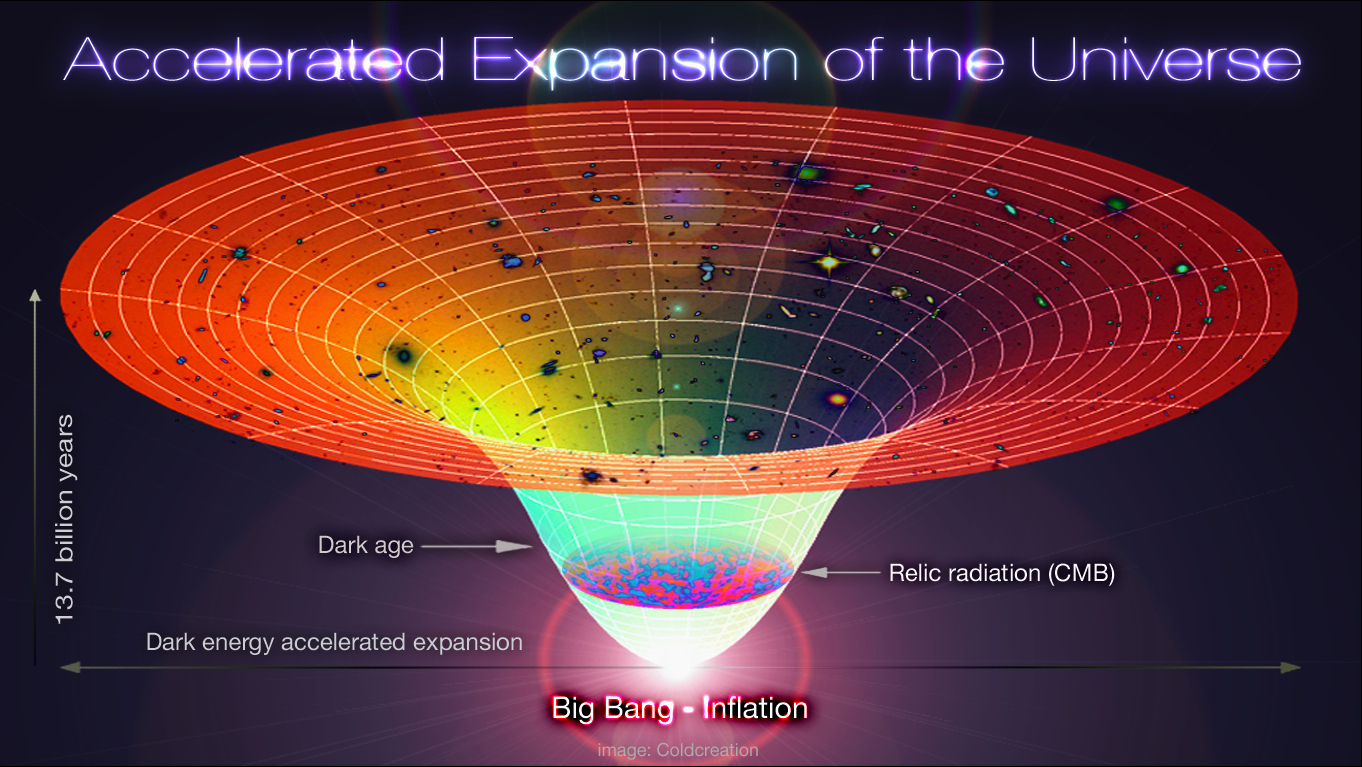
The mystery began some 14 billion years ago in what we call THE BIG BANG. In a fraction of a second, the universe underwent a violent expansion sending space hurdling outward. Space has been expanding ever since. For decades scientists thought that expansion would be slowing down due to the pull of gravity. But does that signs towards the ultimate end of the cosmos? To solve this mystery, astronomers set out to examine the slowing down of the universe by exploring stars called supernova as they very luminous. But they ended up with a very surprising result. Instead of slowing, universe was actually speeding up!!! It was accelerating instead of decelerating. This surely needs an explanation. There must be something which counteracts the pull of attractive gravity and stretching the very fabric of the cosmos. This mysterious object filling up the space has been dubbed dark energy and it turned out the picture of the universe upside down. Well, if you do a sort of survey about the energies, it would turn out that dark energy consisted of 70% of the universe and before 1990’s no one even knew of it. So, in essence, space, what we called nothing, consists of 70% of the total weight of the universe.
But what actually is universe expanding into? What is outside the space which we once called nothing? Can there be something outside nothing? When we speak of space expanding, we generally don’t envision space expanding into a pre-existing container and claiming new territory as it grows. Instead, we envision space stretching, and in the process creating new space that the universe and its contents can then occupy. Space expands, and hence grows, by virtue of creating new space. If the universe is finite, the expansion just described increases the overall size of the universe. However, a more useful marker of the expansion is to consider any two objects, say galaxies, which are being driven apart by the expansion of space. In this way of thinking, the expansion of space is reflected in the distance between two such galaxies growing larger and larger over time. So, when we speak of space expanding, we mean that the distance between objects in space increases over time and it is that space which is accelerating. This whole phenomenon can be pictured nicely if we think the space is actually stretching.
But what’s appreciable in this whole process is what we have achieved. Back from the time of Newton’s space till today, it’s only the eager to find the answers which has led our way. At the end of the day, we came to know that what we called nothing is actually something big. Scientists now realize that it’s not that what shines in the light but what hides in the dark that holds the true secrets of our sky. The deeper we dig into the mysteries, the more clear their explanationsbecome. There are many things up in our cosmos which are still unexplained. New things will continue to come before us until this quest to find answer continue.
References:The Fabric of the Cosmos by Brian Greene
