
त्वरित संपर्क
त्वरित संपर्क

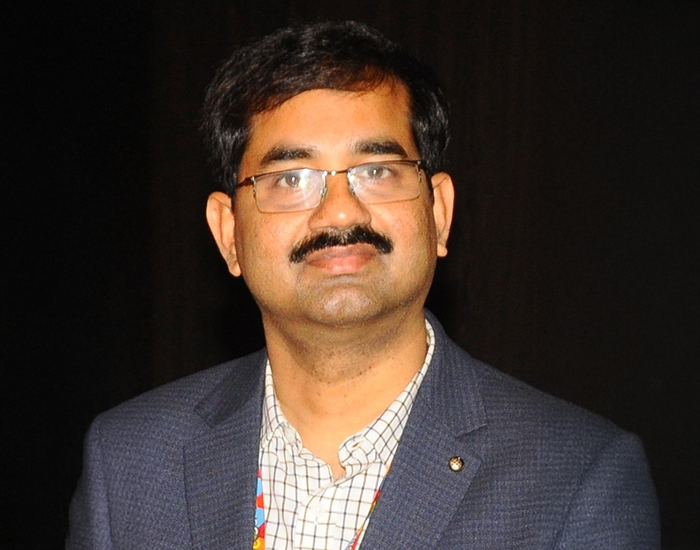
Professor, Department of Chemistry
Multiheme Proteins and Enzymes, Bioinspired cooperative catalysis, Chemical Biology, Medicinal Inorganic Chemistry, Supramolecular Chirogenesis, NMR Spectroscopy of Paramagnetic Molecules.
CL-205C ,
Department of Chemistry
IIT Kanpur,
Kanpur 208016
Bio‐inorganic Chemistry
PhD (1999), IACS, Kolkata
Thesis Supervisor:Prof. Animesh Chakravorty
M.Sc., (Specialization in Inorganic Chemistry): Calcutta University (1994)
B.Sc., (Honors in Chemistry): Calcutta University (1992)
Primary teaching area:
Inorganic Chemistry
Inorganic Chemistry
Coordination Chemistry
Bio-inorganic Chemistry
Crystal and Molecular Structure Determination
Applications of Modern Instrumental Methods
Life member, Chemical Research Society of India (CRSI)
Member, American Chemical Society (ACS)
Member, Society for Biological Inorganic Chemistry (SBIC)
Member, Society of Porphyrins and Phthalocyanines (SPP)
Life member, Indian Association for the Cultivation of Science (IACS)
Unusually Stable Synthetic Diheme bis-Fe(IV)oxo: An Intermediate in Diheme Enzymes MauG and BthA D. Samanta, S. Sarkar, D. Singh, S. Samanta, S. Manna, K. D. Dubey*, A. Dey*, S. Shaik* and S. P. Rath* J. Am. Chem. Soc. 2025, 147, 22562
Probing Substrate Binding inside a Paramagnetic Cavity: A NMR Spectroscopy Toolbox for Combined Experimental and Theoretical Investigation S. Sarkar, C.-Q. Wu, S. Manna, D. Samanta, P. P.-Y. Chen and S. P. Rath* Chem. Sci. 2024, 15, 17407
Unusual Stabilisation of Remarkably Bent Tetra-cationic Tetra-radical Intermolecular Fe(III) µ oxo Tetranuclear Complexes S. Sarkar, R. K. Tiwari, D. Samanta, T.Guchhait, E. C.Sañudo, G. Rajaraman* and S. P. Rath* Angew. Chem. Int. Ed. 2024, 63, e202402344
Modulation of Supramolecular Chirality by Stepwise Axial Coordination in a Nano-size Trizinc (II) porphyrin Trimer A. Dhamija, D. Chandel and S. P. Rath* Chem. Sci., 2023, 14, 6032
Cooperativity in Diiron(III)porphyrin Dication Diradical-Catalyzed Oxa-Diels-Alder Reactions: Spectroscopic and Mechanistic Insights S. Sarkar, P. Sarkar, D. Samanta, S. K. Pati and S. P. Rath* ACS Catal. 2022, 12, 9589
Silver(III)···Silver(III) Interaction Stabilizes the Syn-form in a Porphyrin Dimer Upon Oxidation A. K. Singh, F. S. T. Khan and S. P. Rath* Angew. Chem. Int. Ed. 2017, 56, 8849-8854
A Highly Oxidized Cobalt Porphyrin Dimer: Spin Coupling and Stabilization of the Four-Electron Oxidation Product
S. Dey, D. Sil and S. P. Rath*
Angew. Chem. Int. Ed. 2016, 55, 996-1000.
Induction of Supramolecular Chirality in Di-Zinc(II) Bisporphyrin via Tweezer Formation: Synthesis, Structure and Rationalization of Chirality
S. Brahma, Sk. A. Ikbal, S. Dey and S. P. Rath*
Chem. Commun. 2012, 48, 4070-4072.
Hydrogen Bonding Interactions Trigger a Spin-Flip in Iron(III)-Porphyrin Complexes
D. Sahoo, M. G. Quesne, S. P. de Visser* and S. P. Rath*
Angew. Chem. Int. Ed. 2015, 54, 4796-4800.
A Remarkably Bent Diiron(III)-μ-Hydroxo Bisporphyrin: Unusual Stabilization of Two Spin States of Iron in a Single Molecular Framework
S. K. Ghosh and S. P. Rath*
J. Am. Chem. Soc. 2010, 132, 17983-17985.
National Award to Teachers (Higher Education) 2026, Government of India
Silver Medal from Chemical Research Society of India (CRSI)- 2025
J. C. Bose Research Grant -2025
Elected Fellow of Indian National Science Academy, New Delhi, 2024
Fellow, Royal Society of Chemistry (FRSC), 2021
'Excellence-in-Teaching' Award, IIT Kanpur, 2021
SERB - Science and Technology Award for Research (SERB-STAR), 2020.
Elected Fellow of Indian Academy of Sciences, Bangalore, 2020
C. N. R. Rao National Prize in Chemical Sciences,, 2018
J. N. Gupta and M. Gupta Chair Professor, IIT Kanpur (2017-2020)
Elected Fellow of National Academy of Sciences, 2017
Elected Fellow of West Bengal Academy of Science & Technology, 2017
Member, Editorial Board, Chirality, 2019
Member, Editorial Advisory Board, Current Inorganic Chemistry, 2018
Bronze Medal from Chemical Research Society of India (CRSI)- 2015
Alexander von Humboldt Research Fellowship for Experienced Researcher in 2012
P. K. Kelkar Faculty Research Fellowship from IIT Kanpur (2009-2012)
Received Commendations several times from the Director, IIT Kanpur for excellence in teaching as “Outstanding Instructor”
Umang Gupta Chair Professor, IIT Kanpur (2025-2028)
Lalit Mohan Kapoor Chair Professor, IIT Kanpur (2022-2025)
Professor (HAG), IIT Kanpur (2021-)
Professor, Department of Chemistry, Indian Institute of Technology Kanpur, June 2014 to 2021.
AvH Fellow (Experienced Researcher) Anorganisch-Chemisches Institute Heidelberg University, Germany Dec. 2012-to-July, 2013
Associate Professor, Department of Chemistry
Indian Institute of Technology Kanpur, May 2009-May 2014
Assistant Professor, Department of Chemistry
Indian Institute of Technology Kanpur, Dec. 2004-April 2009
NIH Post-doctoral Research Associate (with Prof. Alan L. Balch)
Department of Chemistry, University of California, Davis, USA. 2001-2004
The Rath group at IIT Kanpur explores a broad range of bioinorganic and biological systems with the central objective of understanding how the structure, electronic configuration, and local environment of heme centers govern their biological function and reactivity. The research encompasses multiheme cytochromes and synthetic diheme models, diheme enzymes, μ-hydroxo-bridged diiron porphyrins, monoheme cytochromes, supramolecular chirogenesis, and porphyrin-based molecular cavities. Particular emphasis is placed on understanding heme–heme interactions, electronic and magnetic coupling, spin-state regulation, redox chemistry, long-range electron transfer, molecular recognition, and the effects of hydrogen bonding and counterions on metal centers. Well-defined synthetic porphyrin architectures are developed as models of complex biological systems to establish direct relationships between molecular structure and function. These investigations integrate UV–vis-NIR, paramagnetic NMR, EPR, Mössbauer spectroscopy, X-ray crystallography, electrochemistry, circular dichroism, magnetic measurements, and DFT calculations to obtain detailed structural, spectroscopic, electronic, and mechanistic insights into heme-centered processes.