
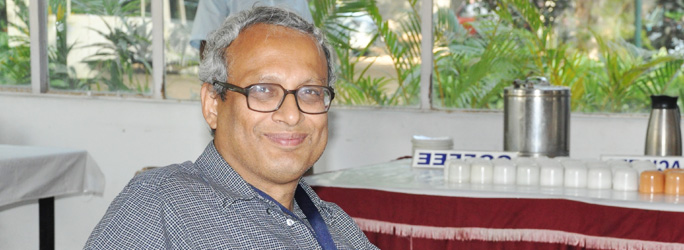
Prof. Arnab Rai Choudhuri
(MSc2/PHY/1980)
Prof. Arnab Rai Choudhuri is a distinguished theoretical astrophysicist and Honorary Professor in the Department of Physics at the Indian Institute of Science (IISc), Bengaluru. He has made significant contributions to solar physics, particularly to understanding the formation of sunspots and the generation of the Sun's 11-year activity cycle through dynamo processes. He played a key role in developing the flux-transport dynamo model of the solar cycle, which has provided theoretical explanations for several solar phenomena and enabled the first successful dynamo-based prediction of a sunspot cycle. He retired from IISc as a Professor in 2022 and continues his association with the Institute as an Honorary Professor.
Profile
Prof. Choudhuri received his B.Sc. with Honours in Physics from Presidency College, University of Calcutta, in 1978, graduating in First Division. He completed his M.Sc. in Physics from the Indian Institute of Technology Kanpur in 1980, graduating with First Class and Distinction. He earned his Ph.D. in Physics from the University of Chicago in 1985 under the supervision of Prof. E. N. Parker.
From 1985 to 1987, he worked as a Visiting Scientist at the High Altitude Observatory, National Center for Atmospheric Research (NCAR), Boulder, USA. In 1987, he joined the Indian Institute of Science, Bengaluru, as a Lecturer in the Department of Physics. He subsequently served as Assistant Professor (1990-1996), Associate Professor (1996-2002) and Professor (2002-2022). Following his retirement, he continued his association with IISc as an Honorary Professor.
Prof. Choudhuri is a theoretical astrophysicist whose research focuses primarily on magnetohydrodynamic (MHD) processes in the Sun. His research interests also extend to other astrophysical systems, including active galactic nuclei, jets, accretion disks and pulsars. He has made important contributions to understanding the generation of solar magnetic fields through dynamo processes and the formation of sunspots through the buoyant rise of magnetic flux tubes from the solar interior to the surface.
His work on the flux-transport dynamo model has contributed significantly to understanding the Sun's 11-year sunspot cycle and its irregularities. The foundational paper on this model was published by Choudhuri, Schussler and Dikpati in 1995. His research group subsequently made the first successful dynamo-based prediction of a sunspot cycle before its onset, for solar cycle 24, which reached its peak around 2014.
Together with his students, Prof. Choudhuri developed the numerical solar dynamo simulation code "Surya" to solve the fundamental equations of solar dynamo theory. He prepared a user guide for the code and made it publicly available in 2005. The code has been used in research on solar magnetic fields and sunspot cycles.
Prof. Choudhuri has authored three textbooks: The Physics of Fluids and Plasmas: An Introduction for Astrophysicists (1998) and Astrophysics for Physicists (2010), both published by Cambridge University Press, and Advanced Electromagnetic Theory (2023), published by Springer Nature. He has also written the popular science book Nature's Third Cycle: A Story of Sunspots (2015), published by Oxford University Press. His book Astrophysics for Physicists has been translated into Japanese and was selected as an Outstanding Academic Title of 2010 by Choice, the magazine of the American Library Association.
Two of his research papers, Choudhuri, Chatterjee and Jiang (2007), published in Physical Review Letters (Vol. 98, 131103), and Choudhuri and Karak (2012), published in Physical Review Letters (Vol. 109, 171103), were selected as "Editor's Suggestions" by the journal.
In addition to astrophysics, Prof. Choudhuri has a longstanding interest in the history of science, particularly the development of modern physics in colonial India. He also contributed to the academic community through his involvement in the Joint Astronomy Programme at IISc, serving as its Convenor from 2000 to 2007. He served two terms on the Steering Committee of Division E (Sun and Heliosphere) of the International Astronomical Union, from 2012 to 2018.
Achievements and Honours
- Subrahmanyan Chandrasekhar Prize of Plasma Physics, Association of Asia-Pacific Physical Societies (AAPPS), 2022.
- INSA-Vainu Bappu Memorial Award, Indian National Science Academy, 2022.
- J.C. Bose National Fellowship, Department of Science and Technology, Government of India (2010-2020).
- Fellow, The World Academy of Sciences (TWAS), 2016.
- Prof. Rustom Choksi Award for Excellence in Research, Indian Institute of Science, 2012.
- Fellow, Indian National Science Academy (INSA), 2011.
- Fellow, National Academy of Sciences, India (NASI), 2008.
- Fellow, Indian Academy of Sciences (IAS), 2005.
- Alexander von Humboldt Fellowship, 1994-1995 and 2002.
- Valentine Telegdi Prize, University of Chicago, 1981.
- Shirley Farr Fellowship, University of Chicago, 1980-1981.
- National Science Talent Search Scholarship, 1974-1980.