
Date: July 22, 2025
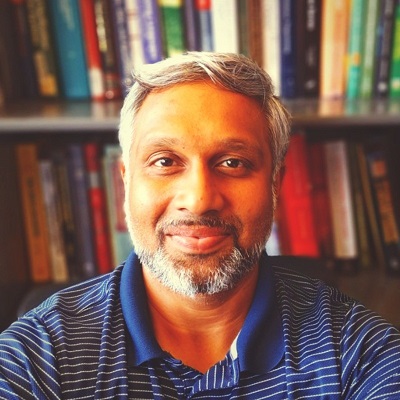
Speaker’s Name & Affiliation: Prof. Jyotirmoy Deshmukh, Associate Professor, University of Southern California; Co-Director, USC Center for Autonomy and AI.
Title: Logic-guided and Game-Theoretic Techniques for Planning and Monitoring of Multi-agent Autonomous Systems
Venue: RM101
Jyotirmoy (Jyo) Deshmukh is an Associate Professor of Computer Science and Electrical and Computer Engineering at the University of Southern California. He is also the co-Director of the USC Center for Autonomy and AI. He transitioned to his role as an educator in 2017 after five years of work as a Principal Research Engineer at Toyota Motors North America R&D. Before joining Toyota, he was the 2010 Computing Innovation Post-Doctoral Fellow at the University of Pennsylvania. He received his Ph.D. in Computer Engineering from the University of Texas at Austin in 2010.
Dr. Deshmukh has received several accolades, including Best Paper Awards at prestigious conferences such as ESOP, RV, EMSOFT, and HSCC, as well as from the IEEE Transactions on Computer-Aided Design (TCAD) journal. He is a recipient of the NSF CAREER Award and the Amazon Faculty Research Award. His current research interests include the application of formal methods to reason about cyber-physical systems, verification and testing of embedded control systems, real-time temporal logics, and analyzing time-series data. He is particularly interested in studying cyber-physical systems that use machine learning–based components, such as autonomous driving vehicles.
Designing and verifying planning algorithms for multi-agent systems (MAS) is significantly more complex than single-agent systems due to the added burden of communication, coordination, and cooperation required between agents. In a decentralized MAS, agents rely on their own sensors coupled with communication with other agents to perceive the environment. Maintaining a consistent global estimate of the environment state may thus incur significant communication cost. Agents may operate in congested environments where coordinating their planned motion is crucial to ensure that agents do not collide or prevent each other from accomplishing their tasks. Task objectives for agents may be different, agents may be homogeneous or heterogeneous, and task objectives could be simple sequences of reach-avoid tasks or more complicated long-horizon temporal tasks. In order to reason about such diverse considerations, it is crucial to develop logical formalisms that can unambiguously express MAS specifications and develop planning algorithms that guarantee logical specifications. In this talk, we examine some existing and new MAS formalisms, and discuss algorithms to perform monitoring of such MAS. We will also look at an overarching framework to design safe control strategies for MAS subject to individual and collective specifications using the framework of potential games. We will present some recent results on monitoring and control synthesis for multi-agent UAV environments based on the presented techniques.