DBT SAHAJ Centre for Biosensing Technologies

Development of Biosensor Technology for Early Disease Detection

Online Slot Booking

Summary

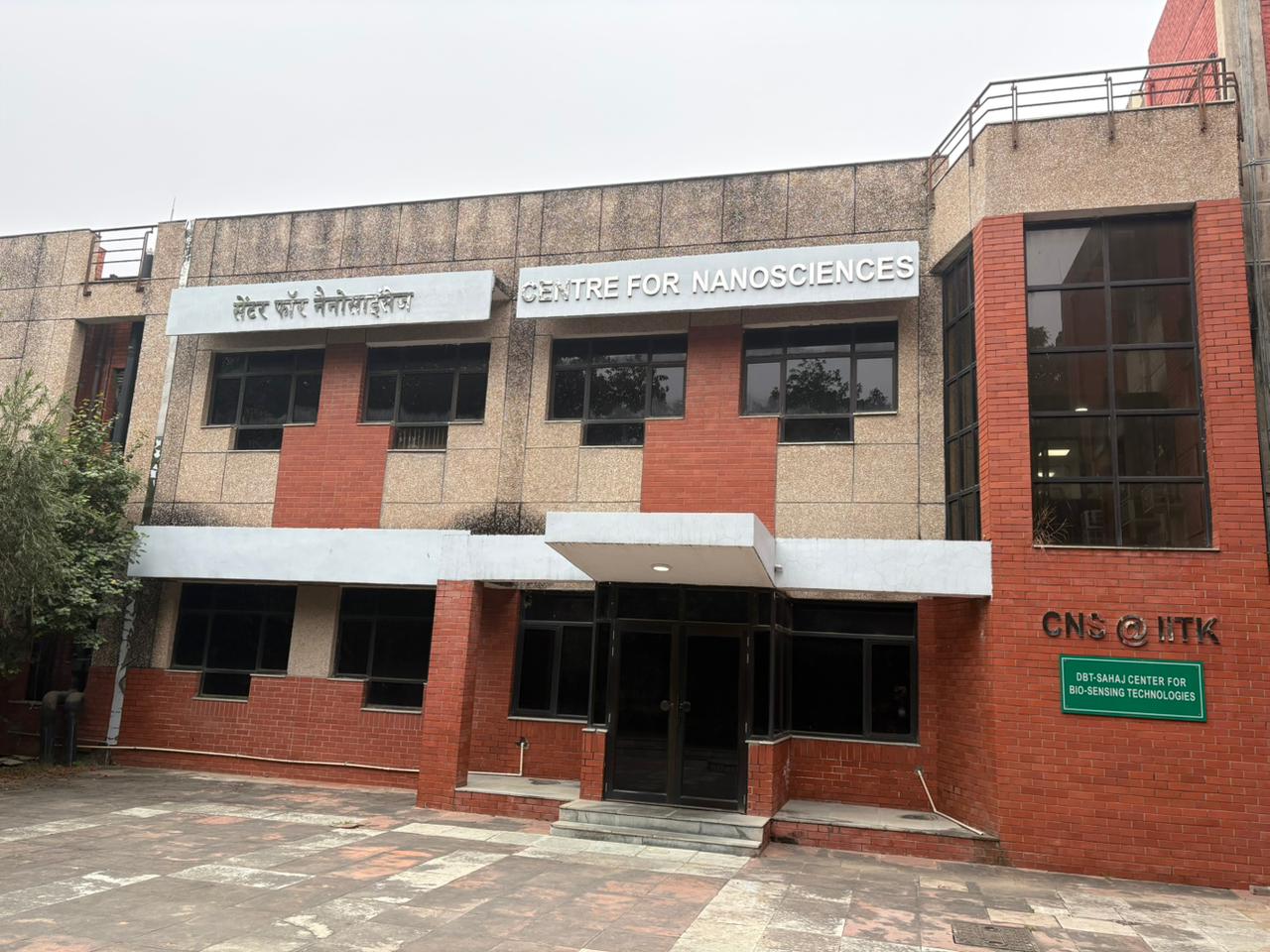
To provide a state-of-the-art facility and resources for carrying out research and development activities in the areas of Nanoscience and Technology in a shared-access, shared-cost environment to IITK users, industry, academia and defense labs.

The Center for Nanosciences empowers innovation in nanotechnology to enhance the human experience by combining cutting-edge research, expertise, and facilities to drive breakthroughs in biophenomena understanding and early disease diagnosis Our objectives include advancing nanoscience research through state-of-the-art facilities and characterization techniques, fostering collaboration among IITK users, industry, academia, and defense labs in a shared-access, shared-cost environment, unlocking biological secrets by leveraging nanotechnology, and transforming healthcare through innovative solutions for early disease diagnosis and treatment. Our facilities include e-beam patterning, maskless lithography, FESEM, Micro-Raman spectroscopy, SPMs, NSOM, WXRD, surface profilers, and nanoimprint lithography, and we invite collaboration from IITK users, industry partners, academic institutions, and defense labs to shape the future of nanotechnology and biology. Early disease detection is crucial for enhancing human health outcomes. Biosensors are innovative diagnostic devices that enable real-time, on-site, and cost-effective screening for specific biomarkers in body fluids, indicating the presence of diseases!

These biosensors measure various biological processes and produce signals in response, allowing for:

  • Fast and accurate detection
  • Predictive healthcare
  • Low-cost diagnosis
  • Easy-to-read positive or negative results

By leveraging biosensors, healthcare providers can identify diseases at an early stage, improving treatment outcomes, reducing complications, and enhancing the quality of life.

About Biosensors

A biosensor is a tool that combines certain molecule interactions with biological components to detect a target analyte with high sensitivity. These tiny sensors can measure biological processes and produce a signal in response to analyte concentration

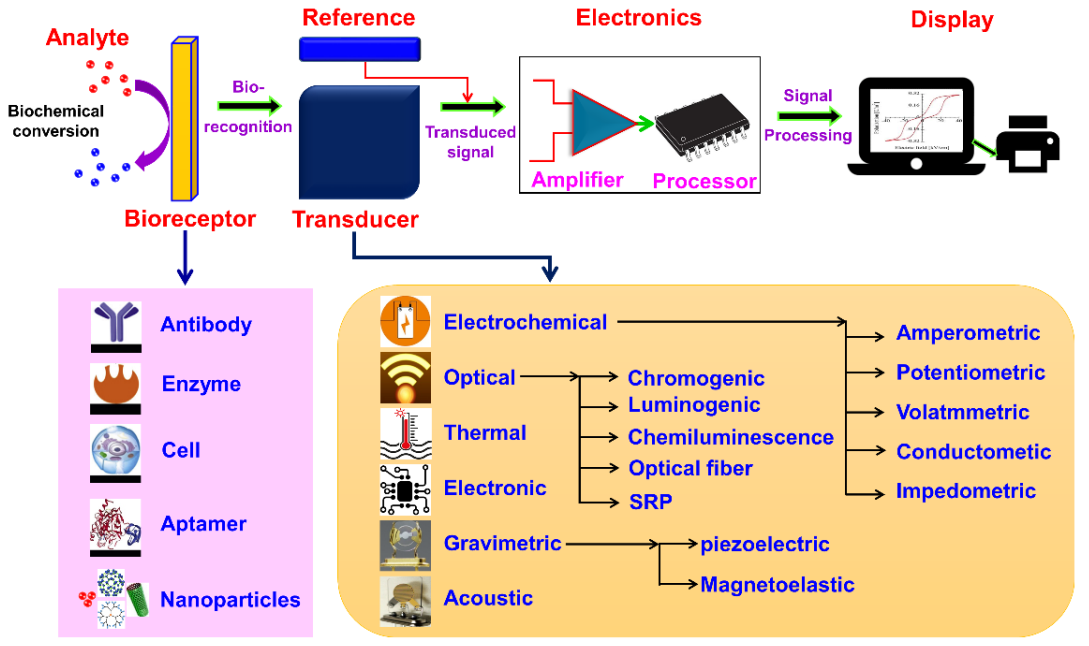
Biosensors are diagnostic device (comprises of analyte, bioreceptor, transducer, electronics, and display) that can screen specific biomarkers present in body fluids, indicative of various diseases (e.g., infectious, degenerative, deficiency diseases) for predictive healthcare in real time, fast, on-site, read positive or negative result, in-vitro easy to operate at low cost (Figure 1). For example, diagnosis and treatment of neurodegenerative diseases has been a dominating challenge across the globe which includes Alzheimer’s disease (AD), dementia, epilepsy, and Parkinson’s disease (PD). The current gold standard method to diagnose the PD is by conducting certain series of motor tasks (e.g., hand pronation-supination or heel tapping) by a trained clinician and proving the Movement Disorder Society Unified Parkinson Disease’s Rating Scale (MDS-UPDRS). However, these methods possess challenges such as poor temporal resolution and low accuracy. Similarly, many diseases suffer from the lack of proper diagnostic tools to diagnose/monitor the progress of the disease. In this regard, development of different types of sensors (e.g., electrochemical-based, optical-based, electrical signal based) gained a lot of interest to attain the data, preferably in real time.

These biochemical sensing devices for cancer and other diseases diagnostic have been developed thanks to recent technical advancements in nanoscience and material design. Further, these devices should have capability to monitor the fluctuation in concentrations of different biomarkers (e.g., Perilic aldehyde, Hippuric acid, Methyl Pentacosanoate, Octadecanol, and Eicosane) and L-dopa (treatment drug) in various biofluids (e.g., blood, urine, saliva, and sweat) of patients for a point-of-care real-time diagnosis. In this regard, many research groups (e.g., centrally funded, state funded, private universities/colleges in India) focus on the development of different biosensors. Though many publications/patents are generated from this research work, many of the concepts do not proceed to commercialization which is due to lack of bench to fabrication facility available in these institutes.

Facilities

Explore multiple facilities under one roof focuses on the development of biosensing technologies for various applications, primarily targeting health diagnostics and environmental monitoring

Team

Necessitatibus eius consequatur ex aliquid fuga eum quidem sint consectetur velit

Image

Prof Tarun Gupta

Project Coordinator

Image

Prof Sri Sivakumar

Project Co-coordinator

Image

Prof Ashutosh Sharma

Co Project Investigator

Image

Prof Sandeep Verma

Co Project Investigator

Image

Prof Bushra Ateeq

Co Project Investigator

Image

Dr Prabhat K. Dwivedi

Co Project Investigator