beta

|
||||||
|
Kanpur, February 25, 2026: Astrophysicists from the Department of Physics and SPASE (Space, Planetary & Astronomical Sciences and Engineering) at the Indian Institute of Technology Kanpur and the National Centre for Radio Astrophysics Pune have developed a novel and powerful method to estimate distances to stars that emit periodic radio flashes, such as pulsars. The work is reported in a recent paper titled "Probing the morphology of the Gum Nebula using pulsar observables and a novel distance estimation method," published in the Monthly Notices of the Royal Astronomical Society (MNRAS) by Oxford University Press. The study was carried out by Dr. Ashish Kumar (now at NCRA Pune), Prof. Avinash A. Deshpande (ex. RRI Bengaluru), and Prof. Pankaj Jain (IIT Kanpur).
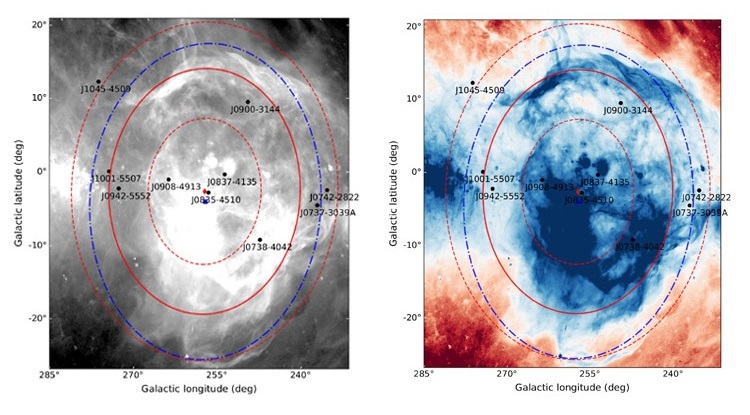
Accurately measuring stellar distances has long been one of astronomy's fundamental challenges. While astronomers can precisely determine an object's position on the sky, measuring how far they are—the crucial third dimension—remains difficult. The most reliable direct method, trigonometric parallax, is limited to relatively nearby stars, while other techniques, such as those based on neutral hydrogen absorption, often suffer from large uncertainties. The new method introduced by the IIT Kanpur team addresses these limitations by combining two independent radio-wave effects experienced by pulsar signals as they travel through interstellar space: dispersion measure (DM) and scatter broadening. Although space appears empty, it is filled with a tenuous mixture of particles, primarily free electrons, known as the interstellar medium. These free electrons produce two distinct effects on the pulsar signals: they delay the signal differently for different wavelengths, an effect known as dispersion, and they scatter the radiation, causing the pulsar pulse to broaden or smear out—both dispersion and scattering increase with distance, but in different ways. Dispersion measure increases steadily as radio waves pass through more material, while scattering depends on how that material is clumped or turbulent along the path. By jointly analysing these two observables, researchers can trace how much distance is travelled by the wave through the interstellar medium. This approach significantly reduces reliance on existing Galactic free-electron density models, such as NE2001 and YMW16, which are often poorly constrained in many regions of the Milky Way. The team demonstrates the effectiveness of their method using pulsars located toward the Gum Nebula, a large and complex structure in the southern part of our Galaxy. The technique can be readily applied to hundreds of known pulsars for which the required observables are already available. Its widespread application could lead to substantial improvements in Galactic electron density models and yield more reliable estimates of key pulsar properties, such as their true velocities, spatial distribution in the Galaxy, and intrinsic radio luminosities. Beyond pulsars, the method also shows strong potential for application to powerful extragalactic radio flashes such as fast radio bursts (FRBs), offering a new way to constrain their distances and the environments through which their signals propagate. Paper link: https://doi.org/10.1093/mnras/stag057 About IIT Kanpur The Indian Institute of Technology Kanpur, established in 1959, is recognized as an Institute of National Importance by the Government of India. Renowned for excellence in science, engineering, and interdisciplinary education, IIT Kanpur spans a 1,050-acre lush green campus and comprises 20 departments, 27 centres, three interdisciplinary programmes, and three specialized schools. With over 570 faculty members and more than 9,500 students, the institute continues to lead in innovation, research, and holistic development. For more information, please visit: www.iitk.ac.in. |

|
|||||