

NHA, ICMR–NIRDHDS & IIT Kanpur Launch National Hackathon on Digital Public Good for Health AI
NHA, ICMR–NIRDHDS & IIT Kanpur Launch National Hackathon on Digital Public Good for Health AI
Kanpur , 24 January 2026
Source: Information and Media Outreach Cell, IIT Kanpur
Federated Intelligence Hackathon empowers innovators to build secure, real- world solutions
Kanpur, 24 January 2026: The National Health Authority (NHA), in collaboration with the ICMR–National Institute for Research in Digital Health and Data Science (NIRDHDS) and the Indian Institute of Technology (IIT) Kanpur, organized the Federated Intelligence Hackathon on DPG for Health AI, pre event to the India AI Impact Summit 2026, as a national initiative focused on driving the development of secure, privacy-preserving, and scalable artificial intelligence solutions for healthcare in India from 19th–23rd January, 2026 at IIT Kanpur.
The hackathon focused on a new Digital Public Good (DPG) for Health AI developed by researchers at IIT Kanpur, which enables collaboration among healthcare institutions, data providers, and AI developers. By leveraging federated learning, secure evaluation pipelines, and open benchmarking mechanisms, the platform ensures data privacy, institutional control, and trust, while enabling innovation at a national scale.
The National Hackathon was graced by Dr. Sunil Kumar Barnwal, CEO, National Health Authority, who delivered the keynote address and felicitated the winners.
A total of 374 registrations were received, comprising 208 individual participants and 166 teams of two or more participants. About 54% of participants identified themselves as AI researchers or innovators. The remaining participants represented diverse categories, including health-tech startups, healthcare providers, graduate students, data scientists, and others.
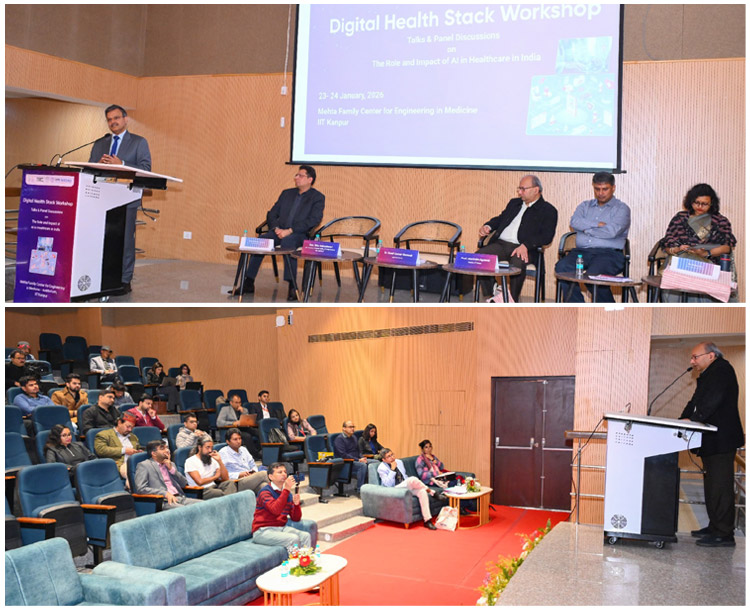
In addition to the hackathon, a workshop on Digital Health Stack was also conducted from 23rd-24th January 2026.
Speaking on the occasion, Dr. Sunil Kumar Barnwal, IAS, Chief Executive Officer, National Health Authority, highlighted that India’s digital health ecosystem is being developed with a strong focus on interoperability, data security, and citizen-centric services. He noted that through platforms such as the National Digital Health Mission, India aims to create a scalable and inclusive digital health infrastructure that supports innovation while safeguarding patient privacy.
Addressing the gathering, Smt. Ritu Maheshwari, IAS, Secretary, Medical Health and Family Welfare and Managing Director, ABDM Uttar Pradesh, stated that the integration of digital technologies in healthcare is crucial for strengthening service delivery and ensuring equitable access to quality healthcare across the country. She added that initiatives such as the workshop play a vital role in building awareness and capacity among stakeholders, enabling the effective adoption of digital public health solutions at the grassroots level.
Prof. Manindra Agrawal, Director, IIT Kanpur, emphasized the Institute’s sustained efforts in developing AI-driven Digital Public Goods for healthcare. He underscored the importance of secure data sharing, collaborative model development, and ecosystem building through India’s digital health stack to enable responsible and scalable adoption of Health AI solutions.
Prof. Nisheeth Srivastava, Centre for Developing Intelligent Systems, IIT Kanpur, stressed that building a collaborative ecosystem—where data, models, and algorithmic audits can be securely shared—is essential for advancing Health AI. He further noted that the Digital Public Good (DPG) platform developed by IIT Kanpur has been designed to enable such collaboration at scale.
The workshop was also graced by the presence of Mrs. Neha Jain, IAS, Special Secretary, Department of IT and Electronics, Government of Uttar Pradesh, and Prof. Sandeep Verma, Head, Gangwal School of Medical Science and Technology, and other dignitaries who shared insights on policy, technology, and interdisciplinary collaboration in strengthening India’s digital health ecosystem.
India’s healthcare AI ecosystem continues to face challenges such as limited access to high-quality datasets, a lack of standardized benchmarking, and concerns around data governance and security.
Therefore, the DPG for the Health AI platform has been designed to provide the infrastructure for transforming and standardizing clinical data into actionable insights, enabling researchers to validate data and develop robust AI models without compromising privacy or data ownership. The AI DPG is currently deployed at the NHA and is being piloted for use by ICMR.
Key Dates and Awards
- Registration Window: 28 December 2025 – 7 January 2026
- Pre-hackathon-orientation workshop 12 Jan and 14 Jan
- Hackathon Week: 19–23 January 2026
- Post-Hackathon Assessment & Awards: 23–24 January 2026
- Prize Pool: ₹12 Lakhs
Participants developed and refined models for three medical tracks: Bone Age Prediction, Cataract Detection, and Diabetic Retinopathy. The models were evaluated against the ‘Golden Datasets’ using a privacy-preserving Federated Intelligence framework, and the most accurate models were selected. This hackathon was a pilot for India’s Digital Public Infrastructure (DPI) for Health AI
The hackathon proceedings were structured to provide participants with both foundational knowledge and advanced insights across the Health AI lifecycle, combining technical sessions, demonstrations, and expert discussions. The programme included:
- Introduction to Traditional Machine Learning Methods offered a foundational context for participants entering the Health AI domain.
- Demonstration of the DPG for Health AI Platform highlighted its federated learning capabilities, secure evaluation pipelines, and open benchmarking framework.
The workshop had panel Discussion on Health AI, covering key thematic areas including:
- Health Technology Assessment (HTA) for algorithms: challenges and potential solutions
- Data sourcing for Health AI in India
- Clinical evaluation of AI systems and regulatory considerations
- Responsible AI practices in healthcare
In addition to these, there were scientific talks focusing on the following topics:
- Computational Pathology in India, focusing on current challenges, emerging opportunities, and pathways to scalable adoption.
- AI for Health and Computational Pathology, emphasizing real-world use cases and translational impact.
- Federated Platforms as Digital Public Goods, underscoring their role in enabling secure, privacy-preserving, and collaborative AI innovation at the national scale.
This structure ensured a holistic approach of theoretical grounding, practical exposure, and policy-oriented dialogue, enabling participants to engage meaningfully with the evolving Health AI ecosystem.
The hackathon concluded with an awards ceremony that celebrated outstanding contributions across use cases of Bone Age, Cataract, and Diabetic Retinopathy. Winners were recognised for innovation, technical excellence, real-world applicability, and adherence to responsible AI practices. Awards were presented by Dr Sunil Kumar Barnwal, CEO of the National Health Authority, highlighting the significance of their contributions to advancing Health AI in India.
Contributing to the national effort, the event witnessed participation and collaboration from multiple stakeholders passionate about shaping the future of healthcare through ethical and impactful AI. By bringing together national institutions, academia, startups, and healthcare providers, the Federated Intelligence Hackathon represents a significant step towards building responsible, trustworthy, and scalable Health AI for India. The initiative reinforced India’s commitment to developing digital public infrastructure that improves health outcomes while safeguarding patient privacy.
About IIT Kanpur
The Indian Institute of Technology Kanpur, established in 1959, is recognized as an Institute of National Importance by the Government of India. Renowned for excellence in science, engineering, and interdisciplinary education, IIT Kanpur spans a 1,050-acre lush green campus and comprises 20 departments, 27 centres, three interdisciplinary programmes, and three specialized schools. With over 570 faculty members and more than 9,500 students, the institute continues to lead in innovation, research, and holistic development.
For more information, please visit: www.iitk.ac.in
