

India Water Impact Summit 2025 Concludes with a Strong Call for Decentralized River Management Across All Districts
India Water Impact Summit 2025 Concludes with a Strong Call for Decentralized River Management Across All Districts
New Delhi , 13 December 2025
Source: Information and Media Outreach Cell, IIT Kanpur
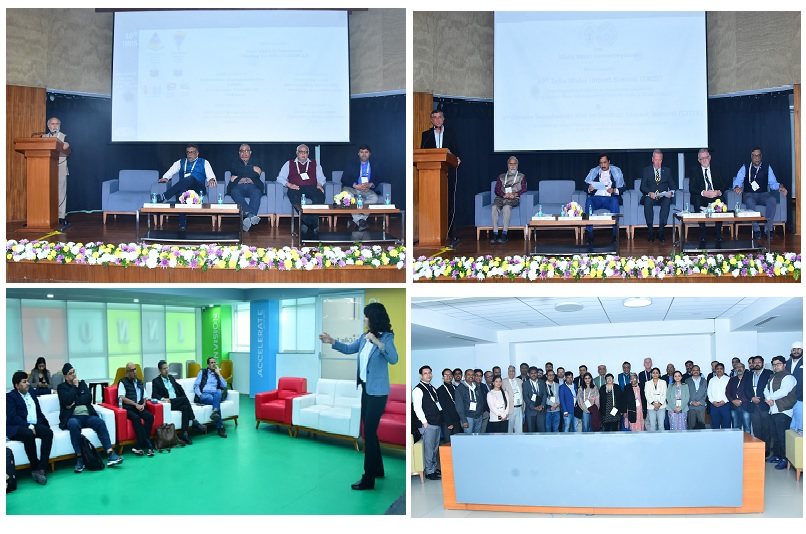
New Delhi, 13 December 2025: The 10th India Water Impact Summit, held from December 9–11, 2025, concluded on Thursday at the Auditorium of FITT, Indian Institute of Technology (IIT) Delhi, with a strong call for district-level river management across the country.
Organized by the Centre for Ganga River Basin Management and Studies (C-Ganga), IIT Kanpur, the three-day summit brought together ambassadors, policymakers, scientists, administrators, industry leaders, and leading experts and researchers in water resources, river science, groundwater management, climate, and environmental sustainability from across IITs, NITs, and other institutions to discuss critical environmental and river-management challenges.
Throughout the summit, participants engaged in high-level deliberations on the sustainable management of India’s river systems. On the final day, expert speakers and delegates unanimously emphasized that strengthening river systems at the district level is essential for ensuring India’s long-term water security and food security. They noted that small, focused interventions at the local level can collectively bring about transformational change.
Distinguished guests at the summit included the Ambassadors of Iceland and Slovenia. Shri Sunil Dattatreya Tatkare, Member of Parliament from Raigarh district, addressed the gathering and shared valuable insights from a public representative’s perspective while engaging with scholars, students, and stakeholders from various government and non-governmental organizations.
The Pre-Summit session was chaired by Rajiv Ranjan Mishra, former Director General of the National Mission for Clean Ganga (NMCG). Dr. Vinod Tare, Founding Head of C-Ganga, delivered a crisp and an insightful address highlighting the relevance of the summit’s central theme. Dr. A. K. Gosain, Former Professor at IIT Delhi and Founder of INRM, Mr. Suresh Babu, Director, WWF-India, and Ms. Laura Sustersic, GIZ also shared important perspectives on the scientific and policy dimensions of river management.
Recognized as one of India’s prominent platforms on water, environment, and climate, the India Water Impact Summit continues to shape policy conversations and actionable frameworks. Several recommendations from past editions have been adopted by Central and State Governments, underlining the summit’s role as a catalyst for sustainable water governance in the country.
Speaking during the fifth session on the concluding day, Dr. Sridhar Cherukuri, District Collector of YSR District, Andhra Pradesh, highlighted the importance of preserving rivers that do not originate in the Himalayas. He emphasized that while Himalayan rivers remain perennial, rivers originating in the plains and other mountain regions support millions of people across central, western, and southern India. He stressed that effective district-level river management is essential to secure their future.
Reflecting on the outcomes of this year’s summit, Dr. Vinod Tare, Founder of C-Ganga, underscored how the platform fosters collaboration among diverse departments, organizations, and stakeholders. He noted that such integrated dialogue is vital for addressing India’s urgent water-management challenges. Also present at the closing ceremony were Dr. Purnendu Bose, Head of C-Ganga, Dr. Manoj Kumar Tiwari, and Mr. Sanmit Ahuja, Expert Member, along with several distinguished guests and delegates.
The 10th India Water Impact Summit concluded with a renewed commitment to advancing district-level river management plans, reaffirming the collective goal of ensuring a water-secure and environmentally resilient future for India.
About IIT Kanpur
The Indian Institute of Technology Kanpur, established in 1959, holds the distinction of being recognized as an Institute of National Importance by the Government of India through an Act of Parliament. Renowned for its excellence in science and engineering education, IIT Kanpur has made significant contributions to research and development over the decades. Its expansive, lush green campus spans 1,050 acres and hosts a rich array of academic and research resources. The institute comprises 19 departments, 20 centers, three interdisciplinary programs, and three specialized schools across engineering, science, design, humanities, and management disciplines. With over 590 full-time faculty members and more than 9,500 students, IIT Kanpur remains a leader in fostering innovation and academic rigor.
For more information, please visit: www.iitk.ac.in
