

After West Africa, Europe and the Americas, IIT Kanpur–PAS Summit Brings Global Climate-Resilience Dialogue to the Indo-Gangetic Plains
After West Africa, Europe and the Americas, IIT Kanpur–PAS Summit Brings Global Climate-Resilience Dialogue to the Indo-Gangetic Plains
Kanpur/Lucknow , 22 October 2026
Source: Information and Media Outreach Cell, IIT Kanpur
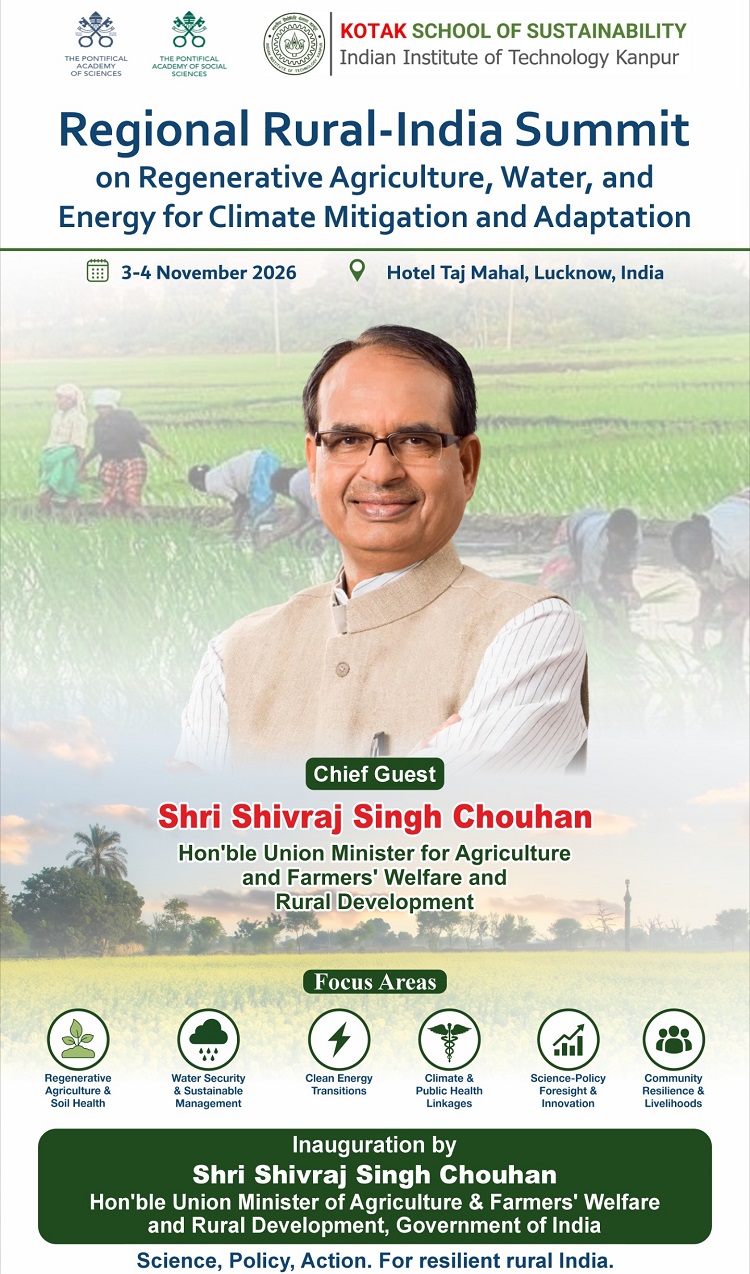
Kanpur/Lucknow, 22 October 2026: The Indian Institute of Technology Kanpur (IIT Kanpur), in partnership with the Pontifical Academy of Sciences (PAS) and the Pontifical Academy of Social Sciences (PASS), Vatican City, will convene the Regional Rural-India Summit on Regenerative Agriculture, Water and Energy for Climate Mitigation and Adaptation on 3–4 November 2026 in Lucknow, Uttar Pradesh. Organised through the Kotak School of Sustainability (KSS), established with the support of Kotak Mahindra Bank at IIT Kanpur, the Summit will focus on science- and policy-led pathways to strengthen climate resilience, agricultural sustainability and rural livelihoods, with particular emphasis on the Indo-Gangetic Plains. Shri Shivraj Singh Chouhan, Hon’ble Minister for Agriculture & Farmers’ Welfare and Rural Development, will be the Chief Guest.
The Summit comes at a critical juncture for rural India, where rising temperatures, monsoon variability, groundwater stress, soil degradation and extreme weather are placing interconnected pressures on agriculture, water, energy, public health and livelihoods. It will seek to move beyond sectoral responses towards integrated approaches connecting soil health, water stewardship, clean energy, climate-responsive agriculture and resilient rural communities.
The Summit is part of the international climate-resilience initiative of PAS and PASS, anchored in the MAST framework—Mitigation, Adaptation and Societal Transformation. Following the PAS–PASS Global Summit on Climate Resilience at the Vatican in 2024, regional dialogues have been convened across California and Massachusetts in the US, Nairobi, Vienna, Brasília and Dakar. The India Summit will bring this global framework to the distinctive challenges of rural India and the Indo-Gangetic Plains.
A central focus will be regenerative agriculture as a pathway from resilience to restoration- rebuilding soil health, improving water retention and groundwater recharge, integrating biodiversity, increasing resource efficiency and reducing greenhouse-gas emissions. The Summit will examine how advances in soil science, hydrology, precision agriculture, clean energy and digital monitoring can translate into scalable agricultural and climate solutions.
The two-day programme will bring together leading scientists, policymakers, practitioners and innovators from India and around the world. The opening plenary will feature Prof. Joachim von Braun, President, PAS; Prof. Manindra Agrawal, Director, IIT Kanpur; Prof. Shekhar Mande, President, INSA; and Prof. Sachchida Nand Tripathi, Dean, KSS, IIT Kanpur, alongside the Chief Guest.
A Spotlight Session will feature Dr. Anil Prakash Joshi, Padma Bhushan; Prof. Ashok Gulati, Padma Shri; and Dr. Rajendra Singh, the “Jal Purush” and Ramon Magsaysay Award recipient. The Summit will also feature MAST – A Universal Protocol for Climate Resilience, with video contributions from Prof. Veerabhadran Ramanathan, Council, PAS, and Prof. Marcelo Suárez-Orozco, Chancellor, UMass Boston and Council, PASS.
International experts including Prof. Örjan Gustafsson, Dr. Ashish Jha, Dr. Soumya Swaminathan, Dr. Rattan Lal, Prof. Cecilia Tortajada and Prof. Raghu Murtugudde will contribute to discussions spanning monsoon science, regenerative agriculture, climate and public health, water security, clean energy, climate-driven migration and science–policy foresight. The programme will also highlight community-led adaptation, women-led initiatives and state-level experiences from Uttar Pradesh and Bihar.
Prof. Joachim von Braun, President, PAS, said: “India offers an important opportunity to bring the MAST framework to a region of immense agricultural and human significance. The Summit will connect global science with India’s knowledge and grassroots experience to strengthen climate resilience and sustainable livelihoods.”
Prof. Manindra Agrawal, Director, IIT Kanpur, said: “The climate challenge facing rural India requires an integrated scientific understanding of agriculture, water and energy. The Summit will bring global expertise and India’s scientific and field experience together to develop practical, scalable solutions for the Indo-Gangetic Plains.”
Prof. Sachchida Nand Tripathi, Dean, Kotak School of Sustainability, IIT Kanpur, and Conference Chair, said: “The Indo-Gangetic Plains are a critical intersection of climate, agriculture, water and livelihoods. The Summit seeks to develop integrated pathways that strengthen resilience while restoring the ecological foundations of rural prosperity.”
The Summit is expected to generate actionable insights for policy and implementation at the state and national levels, while connecting India’s experience with the wider global movement for climate resilience led by PAS and PASS.
About IIT Kanpur
The Indian Institute of Technology Kanpur, established in 1959, is recognised as an Institute of National Importance by the Government of India. Renowned for excellence in science, engineering, and interdisciplinary education, IIT Kanpur spans a 1,050-acre lush green campus and comprises 21 departments, 27 centres, three interdisciplinary programmes, and three specialised schools. With over 580 faculty members and more than 9,500 students, the institute continues to lead in innovation, research, and holistic development.
For more information, please visit: www.iitk.ac.in
