- IIT Kanpur and NCRA Pune Astrophysicists Develop a New Method to Measure Pulsar Distances.
Ashish Kumar, a doctoral student in the Physics department working under the supervision of Prof. Pankaj Jain (SPASE department), in collaboration with Prof. Avinash Deshpande (SPASE department), developed a novel method to measure distance to pulsars. Pulsars are compact stars that emit periodic pulses of electromagnetic waves. Measuring astronomical distances is a very challenging problem, and the traditional parallax method works only for stars that are not too far away. The new method makes effective use of the observables, dispersion measure and temporal broadening to reliably extract an estimate of the distance. The authors applied their technique to pulsars in the direction of the Gum Nebula. Dr. Ashish Kumar is currently a postdoctoral fellow at NCRA, Pune.
https://doi.org/10.1093/mnras/stag057 (Paper Link)
https://www.thehindu.com/sci-tech/science/indian-scientists-find-new-way-to-measure-distances-in-deep-space/article70837490.ece (complete article)
https://www.iitk.ac.in/develop-new-method-to-measure-pulsar-distances
https://www.etvbharat.com/hi/state/iit-kanpur-and-ncra-pune-scientists-discovered-measure-distance-between-stars-uttar-pradesh-news-ups26022600573
https://researchmatters.in/news/astrophysicists-develop-novel-distance-measuring-model-correct-cosmic-map-gum-nebula
https://www.ptinews.com/story/national/iit-k-ncra-pune-scientists-develop-new-method-to-measure-pulsar-distances/3413743 - Discovery of a new Feature in Cosmic Ray Spectrum
Dr. Fahim Varsi, doctoral student in Physics department working under supervision of Prof. Pankaj Jain (SPASE department) discovers a kink in the cosmic ray spectrum. It is generally expected that cosmic rays originate from a supernova explosion and display a simple power law spectrum up to energies of order of a million GeV. The presence of a kink challenges this understanding and indicates the presence of another source. The discovery may provide some important clues which may help in unravelling the mystery of the origin of cosmic rays.
The corresponding paper is published in Physical Review Letters:
Phys. Rev. Lett. 132, 051002 (2024) - Evidence of a Hardening in the Cosmic Ray Proton Spectrum at around 166 TeV Observed by the GRAPES-3 Experiment (aps.org) [1]Some popular articles on the discovery:
A new kink in proton spectrum to enhance our knowledge of cosmic ray origin (phys.org) [2]
A new kink in proton spectrum will enhance ou | EurekAlert! [3]
A new kink in proton spectrum will enhance our knowledge of cosmic ray (scienmag.com) [4]
A new kink in proton spectrum to enhance our knowledge of cosmic ray origin - Tech and Science Post [5]
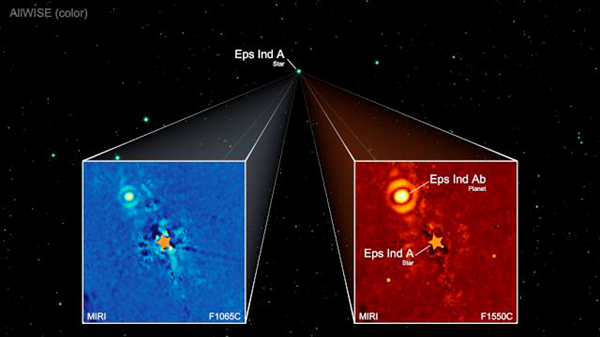
Proton Spectrum Kink Boosts Understanding of Cosmic Ray Origin | Mirage News [6] - Dr. Prashant Pathak, faculty member in the Department of SPASE, discovers a new giant planet named Epsilon Indi Ab orbiting a nearby star similar to Sun. The corresponding paper in Nature, titled "A temperate super-Jupiter imaged with JWST in the mid-infrared" is available at:
https://www.nature.com/articles/s41586-024-07837-8. A newspaper article on the paper is available at: https://timesofindia.indiatimes.com/city/kanpur/iit-kanpur-assistant-professor-part-of-team-that-discovered-exoplanet/articleshow/112030744.cms
- Department of SPASE, along with the Department of Aerospace, has signed an MoU with Manastu Space, an emerging space tech company based in Mumbai. This partnership offers exciting opportunities for IIT Kanpur, especially in expanding our research into space-based services and technologies. Collaborating with a space-tech company like Manastu Space allows us to explore cutting-edge areas such as space robotics and propulsion systems. Additionally, our students will gain invaluable experience through internships and placements in a fast-growing sector. The collaboration will also enhance the skills of our researchers and faculty through exchange programs, making this a mutually beneficial relationship.
Manastu webpage: https://www.manastuspace.com/about - The outreach project from Dept of SPASE has been selected for the International Astronomical Union - Office for Astronomy Development (IAU-OAD) has been selected for a grant of 7000 Euros (P.I. Dr. Tejpreet Kaur & Amitesh Omar).

Space, Planetary & Astronomical Sciences & Engineering (SPASE)
Indian Institute of Technology Kanpur