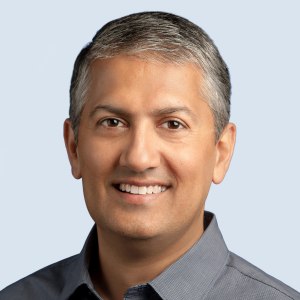
Dr. Tushar Deepak Chandra
(BT/CSE/1988)
Dr. Tushar Deepak Chandra is a Distinguished Engineer at Google, where he works on AI transformation: rethinking how major business lines should operate as next-generation frontier models arrive, and charting the path from where they are today to where they need to be.
He received his B.Tech. in Computer Science from the Indian Institute of Technology, Kanpur, in 1988 and a Ph.D. in Computer Science from Cornell University in 1993. His doctoral thesis, advised by Sam Toueg, introduced unreliable failure detectors, a foundational concept in fault-tolerant distributed computing. He was awarded the 2010 Edsger W. Dijkstra Prize in Distributed Computing, together with Vassos Hadzilacos and Sam Toueg, for research arising from his Ph.D. thesis.
Dr. Chandra began his career at IBM Research, working at both the T. J. Watson and Almaden Research Centres. There, he designed Phoenix, the cluster technology that became the foundation of IBM's Reliable Scalable Cluster Technology (RSCT), and initiated Gryphon, one of the earliest internet-scale publish/subscribe systems. He subsequently served as Lead Development Architect in IBM's Tivoli Software Division before joining Google in 2004.
At Google from 2004 to 2020, he worked on some of the company's foundational systems. He founded and led Google's Paxos implementation, the fault-tolerance foundation beneath Chubby, the Google File System master and other mission-critical systems, and worked on Bigtable, Google's distributed storage system for structured data. He co-founded Sibyl, a large-scale machine-learning platform that powered more than 300 launches across most of Google and whose architecture became the basis for TFX, Google's production machine-learning platform. As a Distinguished Engineer, he also pioneered conversational recommendation, deployed across Google Assistant, Search and YouTube.
From 2020 to 2023, Dr. Chandra was Distinguished Engineer and Head of Onboard Software at Waymo, the software that drives the car: it enables Waymo's vehicles to perceive their surroundings, anticipate the behaviour of other road users and plan the car's own path through traffic. He led the team through a major revamp of the onboard software stack, the foundation of the Waymo Driver today, and through its first nine releases: from one car in a two-square-mile area of San Francisco, operating from 10am to 4pm, to round-the-clock, all-weather driverless paid rides across all of San Francisco and about 200 square miles of Phoenix, with early-rider service in Los Angeles. He also helped build the release engine behind those launches.
Returning to Google in December 2023, he led the Applied Machine Learning organisation. His team brought state-of-the-art research into Google's products, including model selection, prompt engineering, supervised fine-tuning and LoRA, model distillation and upgrades, small language models and AI agents, delivering multi-billion-dollar business value. In June 2026, he moved into his current role.
Dr. Chandra's career represents a distinctive combination of foundational research in distributed computing and large-scale engineering leadership in machine learning, autonomous driving and AI. His work has contributed both to the theoretical understanding of fault-tolerant distributed systems and to the deployment of machine-learning technologies serving products at global scale.
Honouring his pioneering contributions to Distributed Computing, Machine Learning, Autonomous Vehicles and Large-Scale Systems, and his distinguished impact on the development and deployment of AI and distributed technologies at global scale, IIT Kanpur confers upon Dr. Tushar Deepak Chandra the Distinguished Alumni Award 2026 under the category of Professional Excellence.