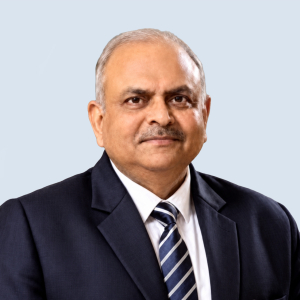
Mr. Ravi Agrawal
(BT/MT/EE/1986/1988)
Mr. Ravi Agrawal is the Chairman of the Central Board of Direct Taxes (CBDT), the apex administrative and policy-making body for India's direct tax system under the Ministry of Finance, Government of India. With a career spanning more than three decades in public service, he has worked across taxation, e-governance, environmental governance, education, disinvestment, enforcement and policy-making. His work has consistently focused on using technology, process reform and stakeholder participation to make public administration more efficient, transparent and citizen-centric. He received his B.Tech. in Electrical Engineering from the Indian Institute of Technology, Kanpur, in 1986 and his M.Tech. in Electrical Engineering from IIT Kanpur in 1988. He subsequently pursued a Post Graduate Diploma in Financial Management from Indira Gandhi National Open University and a Bachelor of Laws from Chaudhary Charan Singh University. Mr. Agrawal joined the Income Tax Department in 1989 and has spent approximately three decades in the department, complemented by assignments across other ministries and government institutions. In the early stages of his career, he served in various assessment, investigation, administration and adjudication roles. As Additional Commissioner of Income Tax, he conceptualised and implemented the 'Model Range' in Ludhiana, introducing digital receipt of tax returns, standalone processing and digital record maintenance. He also led investigations into financial transactions with implications for direct taxation and received four CBDT awards for investigative work. One of his significant areas of contribution has been the digitisation and re-engineering of India's tax administration. As Additional Director General (Systems) and Commissioner of Income Tax (Systems-CPC-TDS), he conceptualised and implemented the digitisation of the Tax Deducted at Source system and rolled out the Tax Credit Statement and online generation of TDS certificates. He also led the computerisation of the Income Tax Department, including the Centralised Processing Centre for income-tax and TDS returns, the Refund Banker Scheme for electronic refunds, tax-payment modules and the expansion of Aaykar Seva Kendras across more than 700 offices nationwide. His public-service contributions have extended beyond taxation. At Guru Gobind Singh Indraprastha University, he served as Controller of Finance and Controller of Examinations and spearheaded the digitisation of degree scrolls. As Director in the Ministry of Food and Public Distribution, he worked on warehouse mapping, warehouse policy and the determination of economic costs for food and sugar subsidies. As Joint Secretary in the Ministry of Finance, he conceptualised and implemented an online bid-submission platform for strategic disinvestment of public-sector enterprises and contributed to the listing and minority stake sale of government holdings. As Additional Secretary in the Ministry of Environment, Forests and Climate Change, Mr. Agrawal contributed to the conceptualisation and development of PARIVESH 2.0, an integrated platform for environmental and forest clearances. The initiative significantly reduced the time taken for environmental clearances, while his wider work in the ministry included the Wetlands of India portal and initiatives relating to wetland conservation and spring rejuvenation. Returning to senior leadership in the Income Tax Department, he served as Principal Chief Commissioner of Income Tax, where he conceptualised and established a Cyber Forensics Lab in the Investigation Directorate, Delhi. He subsequently served as Member, CBDT, before assuming the chairmanship of the Central Board of Direct Taxes in July 2024. In this role, he has led initiatives in tax administration, legislative reform, digital transformation, taxpayer services and institutional capacity building. His tenure was extended in 2025 and, most recently, he was re-appointed as Chairman, CBDT on a contractual basis from July 1 through December 31, 2026, or until further orders. Under his leadership, major recent initiatives have included the drafting and implementation of the Income Tax Act, 2025, together with associated Rules and Forms, with an emphasis on simpler language, technology alignment and reduced litigation. He also conceptualised and implemented the SAKSHAM-NUDGE framework, a behavioural tax-governance approach designed to encourage voluntary compliance through trust, clarity, participation and targeted interventions. His work has also encompassed the development of digital tax infrastructure supporting large-scale processing of returns, refunds and taxpayer information, as well as capacity-building initiatives across a workforce of more than 55,000. Mr. Agrawal's contributions to public administration have been recognised through several honours, including the Prime Minister's Award for Excellence in Public Administration for the projects steered by him, the Finance Minister's Certificate of Merit, the Gold Medal for National E-Governance Award under the Government Process Re-engineering and Certificates of Merit for Best Practices, Citizen Charter and Perspective Plans. Across his career, Mr. Agrawal has combined technological innovation with administrative reform, applying digital systems, process re-engineering and behavioural approaches to improve the delivery of public services at scale. His work has contributed to the modernisation of tax administration as well as broader reforms in environmental governance, public-sector disinvestment and government service delivery.
Honouring his distinguished contributions to Public Administration, Tax Administration, E-Governance and Policy and Legislative Reform, and his sustained impact on the digital transformation and modernisation of government systems in India, IIT Kanpur confers upon Mr. Ravi Agrawal the Distinguished Alumni Award 2026 under the category of Professional Excellence.