
Address:
Hall I, 103 Northern Laboratories, UG Lab Complex
Overview:
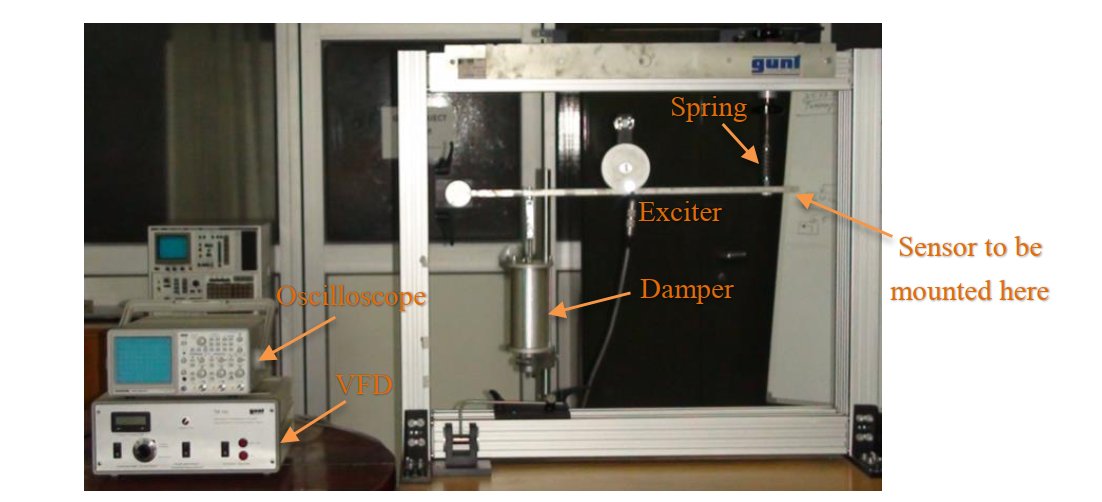
A Vibration and Control Laboratory is an advanced engineering laboratory used to study the system like "rigid" hinged beam, with a single degree of freedom, oscillating about its hinge. A spring and a damper are attached to the beam at two different locations. The free vibrations are generated by displacing the beam from its equilibrium position and the forced vibrations are generated by an electrical motor-driven imbalance exciter. Further study in:
- Mechanical vibrations
- Dynamic systems
- Stability and damping
- Sensors and actuators
- Feedback control systems
- Structural health monitoring
- Signal processing
- Mechatronics and automation
It is widely used in:
- Mechanical Engineering
- Aerospace Engineering
- Civil Engineering
- Automotive Engineering
- Robotics
- Railways
- Industrial automation
- Défense and space research
Equipment:
- Mechanical Shaker – Transmissibility
- Electrodynamic Shaker
- TMD Setup
- Universal Vibration Setup
- Pendulum Setup
Sensors:
- Accelerometers
- Displacement sensors
- Proximity probes
- Strain gauges
- Load cells
- Gyroscopes
Experiments:
- Vibration Experiments:
- Free Vibration of Spring-Mass System
- Forced Vibration Experiment
- Torsional Vibration Setup
- Beam Vibration Experiment
- Multi Degree of Freedom (MDOF) System
- Control System Experiments:
- PID Control
- DC Motor Speed Control
- Inverted Pendulum
- Active Vibration Control
- Current Experiments:
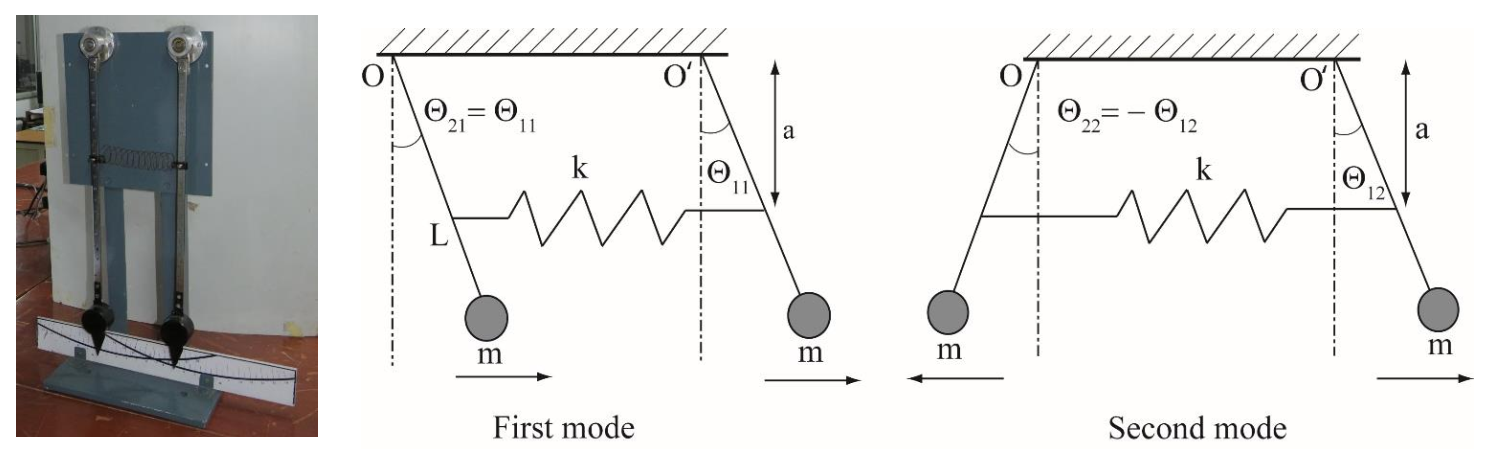
- Study of a beat phenomenon of a coupled pendulum
- Determination of effective radius of gyration of an irregular body through torsional oscillation of trifilar suspension
- Determinations of natural frequencies of beams under simply supported and cantilever boundary conditions
- Study of dynamic vibration absorber
- Active vibration control
- DC motor speed control with various sensors
- Measurement of linear displacement by potentiometer
- Speed torque characteristics of DC servomotor
- Balancing of ball and beam system through PID control
- Balancing of Rotary Inverted pendulum through feedback control
Relevant Information: Overview of Experiments
Faculty: Dr. Pankaj Wahi
Contact Person:
1. Rohit Kumar Singh, MDES, IIT Kanpur
Department of Mechanical Engineering
Indian Institute of Technology Kanpur, Kanpur 208016, Uttar Pradesh
0512-679-2163 / 6097 / 7508 (Lab)
This email address is being protected from spambots. You need JavaScript enabled to view it.
2. Gyanendra P Tripathi
Department of Mechanical Engineering
Indian Institute of Technology Kanpur, Kanpur 208016, Uttar Pradesh
0512-679-7913
This email address is being protected from spambots. You need JavaScript enabled to view it.
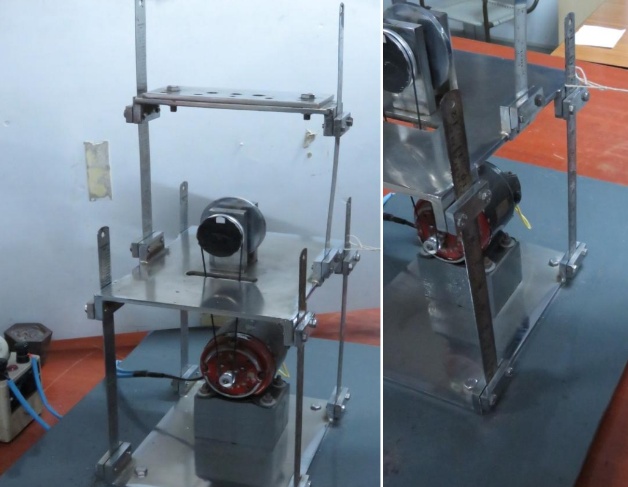
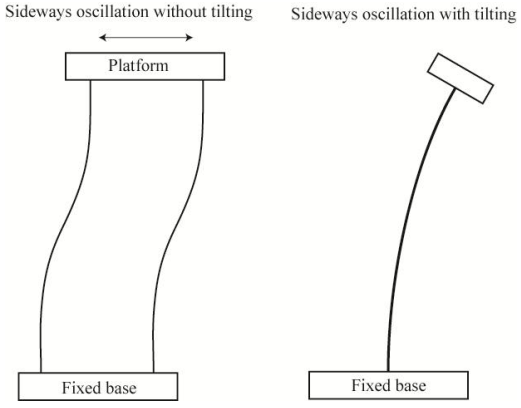
Platform supported by two strips allows lateral vibration without tilting (tilting would require one of the strips to either lengthen, shorten, or buckle). Two strips make the single degree of freedom model appropriate. With one strip, there would be lateral displacement as well as tilting, requiring a two degree of freedom model
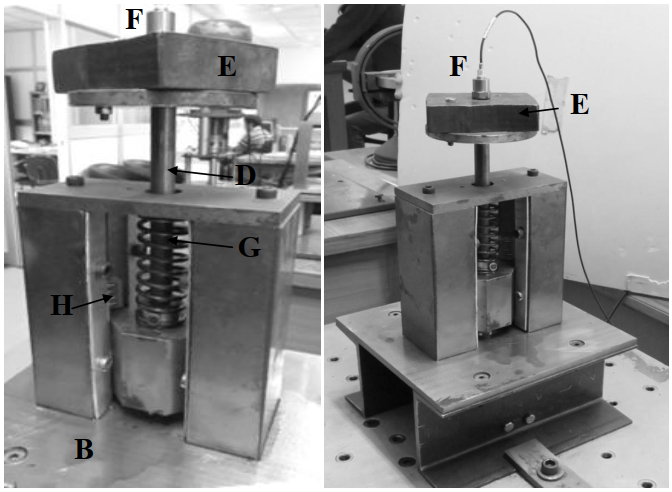
Experimental setup. (B) Base (D) Primary system (E) Added extra mass (F) Piezo sensor (G) Spring (H) Linear bearing.
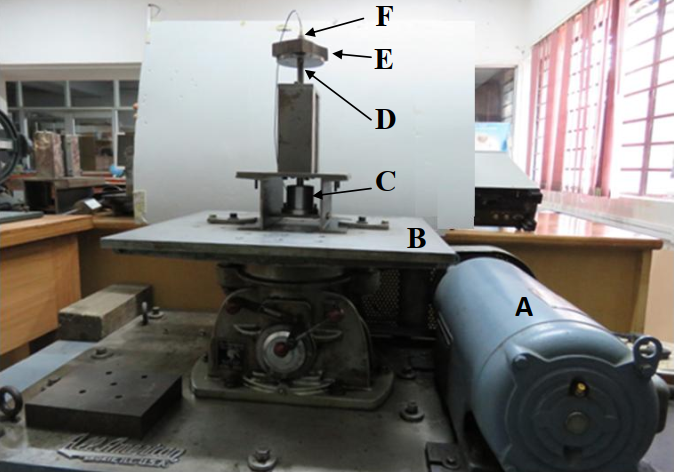
Experimental setup. (A) Motor (B) Base (C) Viscous damper (D) Primary mass system (E) Added extra mass (F) Piezo sensor.