


Abstract: In a celebrated paper in 1971, Serrin studied the overdetermined problem for the Laplacian operator. The proof relied on a powerful technique, now known as the method of moving planes, a refinement of a reflection principle conceived by Alexandrov. Later this idea of reflection principle was picked-up by Gidas, Ni and Nirenberg in 1979 in their landmark work on the symmetry of positive solutions of elliptic problems. The overdetermined problems were then extended for annulus as well as for unbounded domains. These problems are also related to the parallel surface problems. Recently, similar problems have been studied for nonlocal operators. In this talk, we shall give an overview of these problems and its extension.
Abstract: We consider the action of the semigroup of$n\times n$ nonsingular integral matrices, on the space of $p$-tuples of $n$-vectors, where $p < n$. Then the orbit of a $p$-tuple is dense whenever the coordinates are not all contained in a proper rational subspace. We discuss the aspects of effectiveness of approaching a general target point, in terms of the sizes of the matrices involved. The critical exponents of the behaviour will be discussed.
Abstract: Group actions on bundles have interesting consequences. I will introduce the notion of connection on principal bundles both in the analytic and algebraic settings. I will try to explain how certain types of connection are related to the existence of group actions on a bundle.
Abstract: Studying excursion sets of random fields has a long history with motivations coming from statistical hypothesis testing, cosmology, stereology, and integral geometry, to name a few. Questions pertaining to the characterisation of excursion sets are often considered very relevant, and very challenging. For instance, one is often interested in obtaining precise statistical description of the volume, (cumulative) surface area, perimeter of excursion sets of random fields. In this talk, we shall present an asymptotic description of (some) such geometric functionals of excursion sets of random fields in different scenarios.
Abstract: 
Abstract: Just as is the case for a stretched guitar string, for which any deformation can be viewed as a combination of sines and cosines of multitude of amplitudes and frequencies (that is, it can be expressed as a combination of "pure oscillations", or "pure vibrations", or "eigenfunctions"), physics seems determined that the same should happen with absolutely everything: from sound and light, to matter and time, and including laws that govern them, our understanding of the physical world is based, at a fundamental level, on consideration of eigenfunctions. With this motivation in mind we explore some areas in the mathematics of the world of vibrations, and we consider, in particular, a certain special combination of eigenfunctions: the Green function. After reviewing basic ideas concerning eigenfunctions, we will mention recent numerical methods in which the eigenfunctions are computed precisely using the aforementioned Green function. Based on Green's functions, we will build, study and use eigenfunctions related to various physical problems, including, for example, oscillations describing disturbances on the surface of water in a glass (which are given by Steklov eigenfunctions), the interaction of light with nano-optical devices and the design of such devices (Maxwell eigenfunctions), quantum mechanics and sound propagation (Schrodinger and Helmholtz eigenfunctions), problems related to probability theory (eigenfunctions of Laplace and fractional Laplacian operators), and, notably, the temporal sinusoidal vibrations themselves.We will also briefly consider certain geometric characteristics of the eigenfunctions, such as the distribution of the corresponding eigenvalues (oscillation frequencies) and their "nodal curves"--that is, the points in space where the eigenfunctions vanish--including a discussion, with some details, of the intriguing nodal lines of the Steklov eigenfunctions related to the aforementioned glass of water.
Abstract: This will be a survey talk on the subconvexity problem. After a brief historical introduction, we will discuss the several aspects of the problem and the different techniques that are used to tackle them. At the end we will mention some recent results.
Abstract: 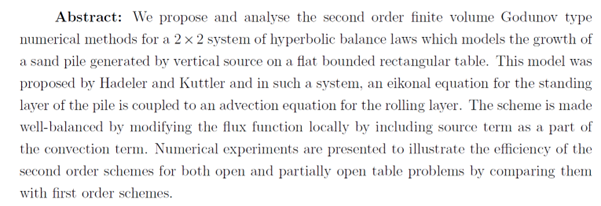
Abstract: Starting with the definition of conditional probability we shall discuss some examples of Markov Chains. Shall explain how they model practical phenomena. Briefly discuss how Markov chains can be used for simulation.
Abstract: Classical permutations are symmetries of sets with finitely many points. In the matrix representation, classical permutations are specific square matrices with entries of either 0 or 1. This perspective was generalised by Shuzhou Wang in 1998, and he introduced the notion of quantum permutation group. This talk primarily aims to motivate Wang's pioneering idea and discuss a few properties of the quantum permutation group.
Abstract: In this talk, we shall provide a broad overview of the models used in India and their capabilities. We will examine instances of successes, failures, and the reasons for these outcomes. Then we will focus on some of the work done for Government of Karnataka. We shall conclude with a road map of how generated data could be stored, presented, and shared so that the expertise of the broader modelling community can be fully tapped for better pandemic preparedness.
Abstract: The inhomogeneous multispecies PushTASEP is an interacting particle system with multiple species of particles on a finite ring where the hopping rates are site-dependent. (The homogeneous variant on Z is also known as the Hammersley–Aldous–Diaconis process.) In its simplest variant with a single species, a particle at a given site will hop to the first available site clockwise. We show that the partition function of this process is intimately related to the classical Macdonald polynomial. We also show that large families of observables satisfy the property of interchangeability, namely they have the same distribution even in finite time when the hopping rates are permuted. For some reason, Schur polynomials seem to appear as expectations in the stationary distribution of important observables. This is a joint work with James Martin and Lauren Williams and based on the preprints arXiv:2310.09740 and arXiv:2403.10485.
Abstract: Abstract Self-adjoint unitaries on Hilbert spaces are known as symmetries. These symmetries have a very simple structure as they have their spectrum contained in {-1, 1}. In 1958 Halmos and Kakutani showed that every unitary on an infinite dimensional complex Hilbert space is a product of four symmetries. We show that in type II von Neumann algebras every unitary is a product of six symmetries. In this setting at least four symmetries are needed but we don’t know whether four are enough. This talk is based on a joint work with Soumyashant Nayak and P. Shankar.
Abstract: There is a well observed philosophy in Mathematics that studying subobjects of a given object (e.g., a group, a field, an algebra, etc) is a very effective methodology employed to obtain a good understanding of the ambient object. Over last 4 or 5 decades, this philosophy has been employed very effectively in understanding certain families of normed algebras, called operator algebras. And among the tools available for this study, various notions of distance between subalgebras have had very significant impact on the theory.
In the same context, in a recent article with Keshab Chandra Bakshi, we introduced the notion of angle between appropriate intermediate subalgebras of an inclusion of some 'fascinating' algebras. In this talk, we shall try to acquaint the audience with this notion and, if time permits, we shall also present some calculations and applications achieved so far. An attempt will be made to keep a good portion of the talk accessible to the students.
Abstract: The plan of the talk is to give a gentle introduction to some aspects of the relative Langlands programme. The interest here is in understanding representations contributing to harmonic analysis on symmetric spaces (or more generally spherical varieties). For a symmetric space G/H, such representations of G are said to be H-distinguished. There are local (“p-adic”) and global (“adelic”) notions of distinction and questions of interest may be local or global or local-global. Analogous questions are often studied also over finite groups of Lie type. In this talk, we touch upon some of these topics in a few specific contexts.
Abstract: Click Here
Abstract: I will introduce two notions of non-positively curved spaces - hyperbolic spaces and CAT(0) spaces and look at properties of groups acting 'nicely' on such spaces. I will also introduce two groups - the mapping class group of a surface and the group of automorphisms of a finitely generated free group. These groups unfortunately are neither hyperbolic nor CAT(0). However, we will see some spaces on which these groups act 'nicely enough' and explore the geometry of these spaces.
Abstract: We shall explore properties of moments and cumulants, their interrelation (via Mobius function), and their relation to the concept of probabilistic independence. Then we shall connect convergence in law (distribution) to convergence of moments or cumulants. This will lead us to moment or cumulant based proofs of the central limit theorem and the convergence of the binomial to Poisson.
The lecture is targeted towards a broad audience consisting of undergraduate students and graduate students from math-stats. Department and across departments as well.
Abstract: I am happy that IIT Kanpur is celebrating the birth centenary of Harish-Chandra. In this talk I will outline a biography of Harish-Chandra and say something about his mathematics in as non-technical away as possible. I am among the small number of living Indian mathematicians who had the privilege of knowing. I will take this opportunity to talk about some of my interactions with him.
Abstract: In this presentation, I will first define what is Statistical Science and then discuss about Statistical Science in action through various examples. Then move to the topic on Statistical Science and Machine Learning (ML) and formally define Statistical Learning (SL) which leads to Artificial Intelligence (AI). Through examples, I will go over two important concepts, margin of errors and Uncertainty Quantification (UQ). We will talk about notions of clustering, classification and Predictive Analytics as examples of AI. Finally, example will be provided from Randomized ClinicalTrials (RCT), Social Network, Disease Mapping for Spatial and Temporal Data indifferent application domains.
Abstract: Gram matrices are ubiquitous in the literature,from theoretical to applied settings. This talk will showcase(non-chronologically) some of these appearances: they are covariance/correlation = positive semidefinite matrices, they are useful in understanding GPS trilateration, and they appeared as Cayley-Menger matrices in understanding metric embeddings into Euclidean space [Schoenberg, Ann. of Math. 1935]. We will also see the entry wise transforms that send the class of Gram matrices into itself [Schoenberg, Duke Math. J. 1942], and will end with then-dimensional version of the well-known (and 2000-year old) Heron's formula.
Abstract: The basic ideas of Calculus started with Archimedes and reached a highly developed form in the 17th Century with Newton and Leibniz often being credited as its inventors. What was not so well-known until only a few decades ago is that between the 14th and 17th Century there was an unbroken lineage of profound mathematicians working in Kerala who had independently discovered many of the great themes of Calculus. This talk is an introduction to the lives and works of some of the prominent members of the Kerala School of Mathematics. Most of the talk will be accessible to a general audience. Only towards the end of the talk some elementary mathematics will be assumed to explain a few of their contributions.
Abstract: We classify all possible configurations of vectors in three-dimensional space with the property that any two of the vectors form a rational angle (measured in degrees).
As a corollary, we find all tetrahedra whose six dihedral angles are all rational. While these questions (and their answers) are of an elementary nature, their resolution will take us on a tour through cyclotomic number fields, computational algebraic geometry, and an amazing fact about the geometry of tetrahedra discovered by physicists in the 1960s.
Joint work with Sasha Kolpakov, Bjorn Poonen, and Michael Rubinstein.
About the speaker: Kiran S. Kedlaya is a Professor of Mathematics at the University of California San Diego. He received his Ph.D. from the Massachusetts Institute of Technology in 2000. Before joining UC San Diego, he held positions at the Institute for Advanced Study, the University of California Berkeley, and the faculty of the Massachusetts Institute of Technology. His research is in number theory and arithmetic geometry, with a focus on p-adic methods. He was an invited speaker at the International Congress of Mathematicians (ICM 2010) in Hyderabad.
More about him: https://kskedlaya.org/
https://en.wikipedia.org/wiki/Kiran_Kedlaya
Abstract: Topological Data Analysis (TDA) offers a geometric and algebraic lens for understanding the shape of complex data. A central tool in this framework is persistent homology, which associates to a dataset a graded family of homology groups that record how topological features—such as connected components, loops, and higher-dimensional cavities—appear and disappear across scales. These invariants can be organized as graded modules over polynomial rings, and many questions in persistence theory reduce to understanding these modules up to isomorphism. This perspective connects data analysis to familiar concepts from algebraic topology (such as Betti numbers) and to the structure theory of finitely generated modules.
In this talk, we will introduce the basic ideas of persistent homology, emphasizing how classical algebraic constructions translate into tools for real-world data exploration. We will describe the algebraic classification of persistence modules, explain the role of barcodes and persistence diagrams, and discuss key theoretical results such as the stability theorem, which ensures robustness under noise. Along the way, we will highlight concrete applications in medicine, illustrating how abstract algebraic techniques can illuminate the geometry hidden in high-dimensional data.
About the speaker: Prof. Thomas Brüstle is a leading expert in Representation Theory with over 1800 citations. He is an active member of the prestigious Centre de Recherches Mathématiques (CRM) in Montréal, and currently holds Maurice Auslander Chair at Bishop’s University. He has successfully led efforts to bring together Topological Data Analysis (TDA) and Representation Theory communities through publications, organization of BIRS, ISM and upcoming Lorentz center workshops on this theme, as well as through collaborations with Quantum Institute (Sherbrooke) on Quantum TDA, and with Optina Diagnostics (Montreal) on TDA and ML methods applied to medical imaging.
Abstract: Given a metric space (X, d), there are several notions of it being negatively curved. In this talk, we single out a consequence of negative curvature in Riemannian manifolds that can be adapted to the complex-analytic setting. This adaptation turns out to be very useful in proving results about holomorphic maps. We shall illustrate what this means by sketching a new proof of a classical result called the Wolff-Denjoy theorem. (This theorem says that given a holomorphic self-map f of the open unit disc, exactly one of the following holds true: either f has a fixed point in the open unit disc or there exists a point p on the unit circle such that ALL orbits under the successive iterates of f approach p.) This talk is intended to be accessible to a broad mathematical audience. In particular, no knowledge of curvature will be assumed -- the notion of negative curvature will only serve as an analogy for the specific concepts that we shall see. Indeed: for most of this talk, we shall focus on metric spaces and basic complex analysis. Towards the end, I shall present a very brief overview of some recent research that relies on the above perspective on negative curvature.
About the speaker: Prof. Gautam Bharali is a mathematician working in the field of Several Complex Variables. He obtained his Ph.D. in Mathematics from the University of Wisconsin–Madison in 2002 and is an alumnus of IIT Kanpur, where he completed his Integrated M.Sc. in Mathematics in 1997.
He was awarded the Swarnajayanti Fellowship in 2015 and is a Fellow of the Indian Academy of Sciences.
Abstract: For a finite group $G$, the number of irreducible complex characters of $G$ is equal to the number of conjugacy classes of $G$. When $G$ is a finite group of Lie type, (say $G={\rm GL}_n(\mathbb{F}_q)$), the conjugacy classes of $G$ are parametrized by Jordan decomposition. The works of J.A. Green or Deligne--Lusztig construct, for a given conjugacy class in $C$ of $G$, a complex irreducible character $\chi_C:G\rightarrow \mathbb{C}$ such that the values of $\chi_C$ are explicitly related to $C$.
A conjugacy class in ${\rm GL}_n(\mathbb{F}_q)$ gives a unique conjugacy class in ${\rm GL}_n(\mathbb{F}_{q^m})$ (a simple fact from linear algebra). The analogue of this map of conjugacy classes on the spectral side, i.e., the corresponding map from the set of irreducible complex representations of ${\rm GL}_n(\mathbb{F}_q)$ to the set of irreducible complex representations of ${\rm GL}_n(\mathbb{F}_{q^m})$ is called Shintani lifting.
After reviewing some of these basic results, we will discuss a curious congruence relation between character values of a representation of ${\rm GL}_n(\mathbb{F}_q)$ and the character values of its Shintani lifting to ${\rm GL}_n(\mathbb{F}_{q^\ell})$ mod-$(\ell)$ where $\ell$ is a prime number with $(\ell, q)=1$. I will indicate some connections with local Langlands correspondence and the conjectures of D.Treumann and A. Venkatesh.
About the speaker: Prof. Nadimpalli is a mathematician working in the field of Representation theory. He obtained his Ph.D. in Mathematics from University of Leiden and University of Paris Sud. in 2015.
More about him: https://home.iitk.ac.in/~nsantosh/
Abstract: Mathematicians have studied the interpolation problem for a long time. A well-known version, going back to Euclid himself, asks the following: given a finite set of points in the euclidean plane, is there a polynomial of prescribed degree in two variables having them as roots? A variant which is of interest to us requires the polynomial to vanish at the given points up to a certain “multiplicity”. We will first introduce this problem by looking at some examples and then discuss some techniques to study the problem. Later we will talk about connections with interesting recent work in commutative algebra and algebraic geometry, beginning with the famous “Nagata Conjecture”.
Abstract: A principled approach to cyclicality and intransitivity in paired comparison data is developed.
The proposed methodology enables more precise estimation of the underlying preference profile and facilitates the identification of all cyclic patterns and potential intransitivities.
Consequently, it improves upon existing methods for ranking and prediction, including enhanced performance in betting and wagering systems. Fundamental to our development is a detailed understanding and study of the parameter space that accommodates cyclicality and intransitivity. It is shown that identifying cyclicality and intransitivity reduces to a model selection problem, and a new method for model selection employing geometrical insights, unique to the problem at hand, is proposed. The large sample properties of the estimators and guarantees on the selected model are provided. Thus, it is shown that in large samples all cyclical relations and consequent intransitivities can be identified.
The method is exemplified using simulations and analysis of an illustrative example.
Abstract: We extend the results of Serre on non-lacunarity of prime and integral coefficients of L-functions attached to l-adic Galois representations to linear combinations of such L-functions. One application is to Fourier coefficients of L-functions attached to modular forms.
Another application is to the study of rational points of algebraic varieties defined over number fields: here we recover some of Serre's results proved in his lectures N_X(p). This is ongoing joint work with Rishabh Agnihotri and Mihir Sheth.
Abstract: One method to understand compact finite dimensional complexes is to break it up into simpler pieces. In this context, one of the most useful results is that up to homotopy, these can be built up from disks. Stronger decomposition results can be proved when one considers either the loop space or a suspension. In this talk, I will discuss some of these results and some geometric consequences of them.
Abstract: We consider the family of cyclic coverings of the projective line with fixed ramification data, and degree. The monodromy representation associated to these data is closely related to the "Gassner representation" of the pure braid group, and we characterise the cases when the monodromy group is a product of non-uniform higher rank arithmetic groups.
Abstract: With the advent of modern technologies, it is increasingly common to deal with data of multi-dimensions in various scientific fields of study. In this context Gaussian Process is a very attractive approach of modeling such data. In this presentation, we first develop a generative Gaussian Process and then apply to spatial statistical concept to explain a curvature process. Analyzing the resulting random surface provides deeper insights into the nature of latent dependence within the studied response. We develop Bayesian modeling and inference for rapid changes on the response surface to assess directional curvature along a given trajectory. Such trajectories or curves of rapid change, often referred to as _wombling_ boundaries, occur in geographic space in the form of rivers in a flood plain, roads, mountains or plateaus or other topographic features leading to high gradients on the response surface. We demonstrate fully model based Bayesian inference on directional curvature processes to analyze differential behavior in responses along wombling boundaries. We illustrate our methodology with a number of simulated experiments followed by multiple applications featuring the Boston Housing data; Meuse river data; and temperature data from the Northeastern United States.
Abstract: A partial order on the set of reals is locally countable if the set of predecessors of every real is countable. A long-standing problem of Sacks asks if every such partial order embeds into the Turing degrees. He showed that the answer is yes under the continuum hypothesis but the problem remains open (in ZFC) even for partial orders of finite height. It turns out that to be able to embed such posets, one would need to construct large Turing independent set of reals with some additional features. This has recently motivated developing new methods for constructing Turing independent sets. Many of these involve set-theoretic ideas like forcing. We will discuss these and several related recent results.
Abstract: We consider two examples of statistical inference for two related populations. In one example we characterize two patient populations that are relevant in the construction of a clinical study design, and propose a method to adjust for detected differences.
The second example is about comparative immune profiling under two biologic conditions of interest when we identify shared versus condition-specific homogeneous cell subpopulations.
Bayesian inference in both applications requires prior probability models for two or more related distributions. We build on extensive literature on such models based on Dirichlet process priors. Models are commonly known as dependent Dirichlet processes (DDP), with many variations and extensions beyond the Dirichlet process model.
The special feature in the two motivating applications is the focus on differences in the heterogeneity of the related populations, with one application aiming to adjust for such differences, and the other application aiming to identify and understand immune cell subtypes that are characteristic for one or the other condition.
We briefly review the extensive literature on DDP models and then introduce variations of DDP priors suitable for these inference goals. In both applications the underlying model structures are common atoms mixture models with highly structured priors on the weights.
Abstract: Random processes with strong memory arise naturally in various disciplines including physics, economics, biology, geology, etc. Memory can be multifaceted and can arise due to interactions of more than one underlying phenomena. Many of these processes exhibit superdiffusive growth due to the effect of memory. A class of one-dimensional, discrete-time such models called “random walk with m memory channels” was introduced and discussed in a recent paper on statistical physics by Saha (2022). In these models, the information of m independently chosen steps from the walker’s entire history is needed to decide the future step. The aforementioned work carried out heuristic calculations of variance, and conjectured phase transitions from diffusive to superdiffusive and from superdiffusive to ballistic regimes in the m=2 case. We have proved these conjectures rigorously (with mild corrections), and discovered a new regime at one of the transition boundaries. These results will be presented along with several open problems. (This talk is based on a joint work with Krishanu Maulik and Tamojit Sadhukhan.)
About the speaker: Dr. Parthanil Roy is a Professor in the Department of Mathematics at Indian Institute of Technology Bombay.
He joined IIT Bombay in 2024 after serving as a Professor at the Indian Statistical Institute (ISI), Bangalore, where he held various positions from Assistant Professor to Professor over more than a decade.
He obtained his Ph.D. from Cornell University in 2007 under the supervision of Gennady Samorodnitsky and held a postdoctoral position at ETH Zurich before beginning his academic career at Michigan State University.
His research interests lie in probability theory and related areas, including stable random fields, extreme value theory, ergodic theory, and stochastic processes. He is also a recipient of the SwarnaJayanti Fellowship (2017) in mathematical sciences.
More about him: https://sites.google.com/view/parthanilroy/
Abstract: Fix integers g, n, d and consider the space of all degree d maps from smooth projective curves of genus g to projective n-space. A theorem of Gromov and Kontsevich says that, in order to compactify this space, it suffices to allow the domains of our maps to be at-worst-nodal projective curves of arithmetic genus g. After recalling this theorem, I will discuss some results in the converse direction (obtained in joint work with Fatemeh Rezaee), i.e., given a map from a nodal curve, how can we tell if it actually arises as the limit of a sequence of maps from smooth curves?
About the speaker: Dr. Mohan Swaminathan is a Reader at the School of Mathematics at the Tata Institute of Fundamental Research, Mumbai.
Previously, he was a Szegö Assistant Professor at Stanford University (2022-2025), a graduate student at Princeton University (2017-2022) and an undergraduate at Chennai Mathematical Institute (2014-2017). His research interests are in Symplectic Topology and Enumerative Geometry.
More about him: https://sites.google.com/view/mohanswaminathan/home
Abstract: Subfactors arise naturally in the study of symmetries in mathematics and mathematical physics.
While a single subfactor already carries rich structure, considering two subfactors inside the same system leads to new and subtle questions: how do they interact, and how can this interaction be measured?
In this talk, I will describe two complementary viewpoints. One uses a notion of entropy to quantify the amount of information shared between subfactors. The other uses diagrammatic tools, known as planar algebras, to describe their structural compatibility. I will explain how these approaches illuminate each other and lead to a clearer picture of how subfactors relate and interact.
No prior background in subfactor theory will be assumed.
About the speaker: Dr. Keshab Chandra Bakshi is an associate professor at IIT Kanpur specializing in $C^{*}$-algebras and von Neumann algebras; more specifically in Jones' theory of subfactor and planar algebras. He received his Ph. D. from the Institute of Mathematical Sciences under the supervision of Professor V. S. Sunder. More about him: https://sites.google.com/view/keshab-bakshi/home
Abstract: Click here
About the speaker: Dr. Swarnendu Sil is an assistant professor at IISc Bangalore, specializing in geometric analysis, partial differential equations and calculus of variations. After transitioning from a background in engineering at Jadavpur University to a Ph. D. at EPFL, he held postdoctoral positions at both EPFL and ETH Zürich. More about him: https://math.iisc.ac.in//~ssil/
Abstract: Increasingly large and complex spatial datasets pose massive inferential challenges due to high computational and storage costs. Our study is motivated by the KAUST Competition on Large Spatial Datasets 2023, which tasked participants with estimating spatial covariance-related parameters and predicting values at testing sites, along with uncertainty estimates. We compared various statistical and deep learning approaches through cross-validation and ultimately selected the Vecchia approximation technique for model fitting. To overcome the constraints in the R package GpGp, which lacked support for fitting zero-mean Gaussian processes and direct uncertainty estimation, two features necessary for the competition, we developed additional R functions. Additionally, we implemented subsampling-based approximations and parametric smoothing for estimators with skewed sampling distributions. Our team, DesiBoys, comprised of Rishikesh Yadav, currently an Assistant Professor at IIT Mandi, Pratik Nag, currently a Postdoctoral Fellow at the University of Wollongong, and I from IIT Kanpur, secured first place in two of the four sub-competitions and second place in the other two, validating the effectiveness of our proposed strategies. Moreover, we extended our evaluation to a large, real-world spatial satellite-derived dataset of total precipitable water, comparing the predictive performance of different models using multiple diagnostics. If time permits, we will discuss additional experiences with various data challenge competitions that we successfully participated in over the last few years.
About the speaker: Dr. Arnab Hazra is an assistant professor at IIT Kanpur. He received his Ph. D. in 2018 from North Carolina State University, Raleigh. His research interests are too numerous to list in such a short introduction; please see his webpage for more details: https://sites.google.com/view/arnabhazra09/home
Abstract: Round Surgery Diagrams for 3-manifolds.
In this talk, we introduce round surgery diagrams in S^3 as a natural analogue of Dehn surgery diagrams for constructing 3-manifolds. We establish a precise correspondence between a natural class of round surgery diagrams and Dehn surgery diagrams in S^3. Consequently, every closed connected oriented 3-manifold can be obtained by round surgery on a framed link in S^3, recovering Asimov’s result. Different round surgery presentations can yield the same 3-manifold. We define four local moves on round surgery diagrams and prove that any two diagrams presenting the same 3-manifold are related by a finite sequence of these moves, yielding a Kirby Calculus for round surgery. As an application, we show that 3-manifolds obtained by round 1-surgery on two-component fibred links in S3 admit taut foliations, hence carry tight contact structures. This is a joint work with Dr. Prerak Deep and part of his doctoral thesis.
About the speaker: Dr. Dheeraj Kulkarni is an assistant professor of mathematics at IISER Bhopal. He received his Ph. D. in 2012 from IISc Bengaluru under the supervision of Professor Siddhartha Gadgil. His research interests are in Geometry and Topology, and in particular Contact and Symplectic Topology.
More about him: https://sites.google.com/iiserb.ac.in/dheerajkulkarni
Abstract: The routes to chaos and the global bifurcations leading to chaotic behavior are two fascinating areas of research in nonlinear dynamics.
Chaotic dynamics are observed in a wide range of mathematical models across various disciplines of science and engineering. In recent years, the structural sensitivity of models with respect to their bifurcation structures leading to chaos has received increasing attention. The main objective of this talk is to discuss the structural sensitivity of the bifurcation structure associated with the classical Hastings–Powell model and the global bifurcations that give rise to chaotic regimes in the modified Lorenz system. A systematic bifurcation analysis, incorporating both local and global bifurcations, provides deeper insights into the routes to chaos and the nature of transient dynamics. The techniques discussed here can also be applied to problems arising in other areas of science and technology.
About the speaker: Dr. Malay Banerjee is a Professor in the Department of Mathematics and Statistics at IIT Kanpur, where he has served since April 2008. His research interests include: Mathematical Ecology, Nonlinear Dynamics, Mathematical Epidemiology, Spatio-temporal Pattern Formation. Dr. Banerjee earned his Ph.D. in Applied Mathematics from the University of Calcutta in 2005.
Abstract: Life is full of complex, evolving systems — from markets to environmental systems. Using tools from mathematics, statistics, physics, and AI, scientists can unravel patterns hidden within large datasets. This talk would offer a glimpse into how we decode real-world complexity using data science.
About the speaker: Dr. Anirban Chakraborti is a Professor at Jawaharlal Nehru University and a Fellow of the World Academy of Sciences (FTWAS). He is a founding member of the Centre for Complexity Economics, Applied Spirituality and Public Policy at O. P. Jindal Global University, and an International Member of the Centro Internacional de Ciencias AC. His work focuses on complexity science, econophysics, and computational approaches to social and economic systems.
More about him and his group: http://www.jnu.ac.in/Faculty/anirban/index.html