Abstract: A classical fact from group theory asserts that every perfect group admits a universal central extension. Celebrated results of Steinberg, Matsumoto and Brylinski-Deligne give a complete description of the universal central extension of certain algebraic groups, which has lead to a lot of interesting developments. We will describe these classical results and discuss how all these results can be uniformly explained and generalized using motivic homotopy theory. The talk is based on joint work with Fabien Morel.
All interested are cordially welcome. Tea will be served at 16:45.
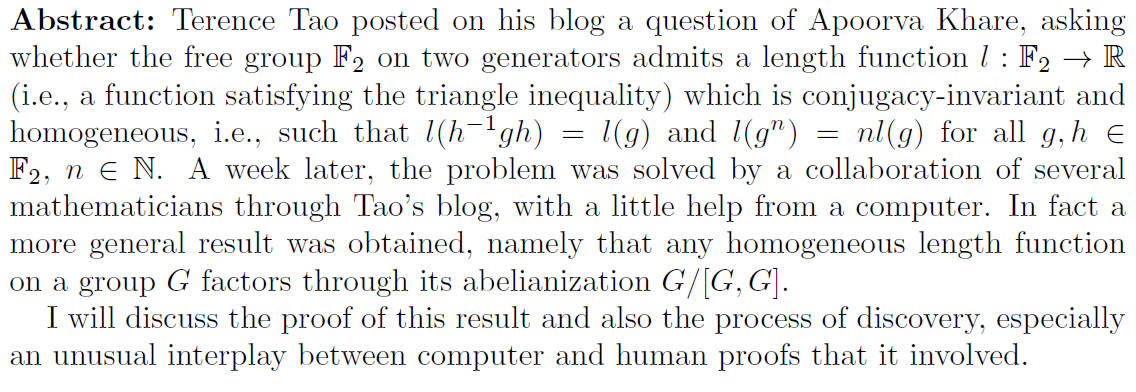
Abstract: In the first part of this talk I shall recall what the Hot spots conjecture is. Putting it in mathematical terms, I shall provide a brief history of the conjecture. If time permits I shall explain a proof of the conjecture for Euclidean triangles.
Abstract: In this talk we will introduce several algebraic and topological invariants associated with affine space C^n. Most of them are classical invariants that we have seen in basic algebraic topology or differential geometry which can be associated to any complex algebraic variety. We will also see that these invariants can be used to characterise C^2. We will then universalize these invariants to construct a very good algebraic topology theory for algebraic geometry. We will end the talk with important open problems associated with this new algebraic topology
Abstract: The techniques of Riemann and Riemann-Stieltjes integration, developed in the nineteenth century, are one of the basic tools of real analysis. To address deficiencies in the notion of Riemann integration, the theory of Lebesgue integration was introduced in the early twentieth century and had since become one of the mainstays in a wider band of analysis. In this talk, we shall discuss two lesser known extensions of Riemann-Stieltjes integration. The first one is due to L. C. Young (1930s) and uses fractional order (`Holder') regularities. Rough path integration, a more recent development (1990s) and a further extension of Young integration, is the second one and is developed by the efforts of Terry Lyons, Martin Hairer, Massimiliano Gubinelli and their co-authors.
Abstract: It is well-known fact in Functional Analysis that the results such as the Open mapping Theorem, Bounded Inverse Theorem and Closed Graph Theorem are equivalent. We show how the continuity of a suitably defined seminorm for each of these and the Banach -Steinhaus Theorem leads to unified approach to proofs of these results. The talk will be accessible to all students of mathematics.
Abstract: The Schur class, denoted by S(D), is the set of all functions analytic and bounded by one in modulus in the open unit disc D in the complex plane.
The elements of S(D) are called Schur functions. A classical result going back to Issai Schur states: A function f is a Schur function if and only if f admits a linear fractional transformation (or transfer function realization). Linear fractional transformations are attached with colligation matrices or scattering matrices on Hilbert spaces. Schur's view to bounded analytic functions is one of the most used (and useful) tools in classical and modern complex analysis, function theory, operator theory, electrical network theory, signal processing, linear systems, operator algebras and image processing (just to name a few).
In the first part of this talk we will give a brief (but within the span of little more than a century) historic perspective and introduction to Schur theory and discuss its interactions with some classical problems in function theory and operator theory (like Nevanlinna-Pick interpolation). In the second part of the talk, we will review Schur's approach (ubiquity and its complications) to functions of several complex variables from linear analysis point of view.
The talk is intended for a general audience, and it only requires a basic background in analysis and linear algebra.
Abstract: This is joint work with N. Prabhu (Queen's University Kingston) and K. Sinha (IISER Pune). We derive new bounds for moments of the error in the Sato-Tate law over families of elliptic curves. As an application, under the Riemann Hypothesis for a suitable class of L-functions, we obtain a Central Limit Theorem on the distribution of these errors. Our method builds on recent work by N. Prabhu and K.Sinha who considered this problem for families of cusp forms. In addition, identities by Birch and Melzak play a crucial rule. Birch's identities connect moments of coefficients of Hasse-Weil L-functions for elliptic curves with traces of Hecke operators. Melzak's identity is combinatorial in nature.
Abstract: In this talk, we shall discuss existence issues associated to a nonlinear conservation laws from numerical point of views. In particular, we look for a simple way to construct numerical approximations to the solution of the underlying equation and prove convergence for such approximations. Finally, we discuss about the uniqueness for such solutions.
Abstract: Stationary processes are characterized by the fact that the associated time shift operator is an isometry. If one modifies this process by rotating the real axis non-randomly in the complex plane, then the associated time shift operator can be identified with the so-called Brownian isometry. The later one is a operator block matrix and may be realized as a rank one perturbation of an isometry. In this talk, we attach a commuting pair of positive operators to a class of operator matrices which contains Brownian isometries. Although these pairs are far from being a complete invariant, they can be used effectively via the Taylor spectrum approach to understand this class. This talk is based on a joint work with Z. Jablonski, Il B. Jung, and J. Stochel.
Abstract: In this talk, we will establish a connection between random recursive tree, branching Markov chain and urn model. Exploring the connection further we will derive fairly general scaling limits for urn models with colors indexed by a Polish Space and show that several exiting results on classical/non-classical urn schemes can be easily derived out of such general asymptotic. We will further show that the connection can be used to derive exact asymptotic for the sizes of the connected components of a "random recursive forest", obtained by removing the root of a random recursive tree.
Abstract: In the last fifteen years there has been several major developments in the area of topology of three dimensional manifolds, including the resolution of Poincar\'e conjecture and the geometrization conjecture due to Perelman.
In my talk, after briefly recalling the classification of surfaces, we will list the eight geometries that are relevant to the geometrization conjecture and see examples of compact three-manifolds arising from them.
Finally we will state the geometrization conjecture.
No specialized knowledge of topology will be assumed.
Abstract: We say a number x in [0,1] is normal if for any positive integer b, all finite words of same length with letters from the alphabet {0, 1, ... , b-1} occur with the same asymptotic frequency in the representation of x in base b, or in simple words, its digital expansion is uniformly random in any base. Now the question is `if the number x is chosen randomly then how normal it is for x to be a normal one?'. This is answered by the famous Normal number theorem of E. Borel which says that almost every number possesses this phenomenon.
It is generally believed that some naturally defined subsets of [0,1] also inherit the above property unless the set under consideration displays an obvious obstruction. This talk is about the study of Borel's theorem on fractals; cantor type sets for instance. We show that for certain fractals how the property of being normal can be related to the behaviour of trajectories under some random walk on the circle, and consequently can be settled studying measures which are `stationary' with respect to the walk.
The talk is based on a recent joint work with Yiftach Dayan and Barak Weiss.
Abstract: Which functions preserve positive semidefiniteness (psd) when applied entrywise to psd matrices? This question has a long history beginning with Schur, Schoenberg, and Rudin, and has also recently received renewed attention due to applications in high-dimensional statistics. However, effective characterizations of entrywise functions preserving positivity in a fixed dimension remain elusive to date.I will present recent progress on this question, obtained by: (a) imposing rank and sparsity constraints, (b) restricting to structured matrices, and(c) restricting the class of functions to special families such as polynomials or power functions. These constraints arise in theory as well as applications, and provide natural ways to relax the elusive original problem. Moreover, novel connections to symmetric function theory and combinatorics emerge out of these refinements.(Based on joint works with Alexander Belton, Dominique Guillot, Mihai Putinar, Bala Rajaratnam, and Terence Tao.)
Abstract: We consider Riemannian symmetric spaces $X$ of noncompact type, which accommodates all hyperbolic spaces. We characterize the eigenfunctions of the Laplace-Beltrami operator on $X$ with arbitrary complex eigenvalues through an asymptotic version of the ball mean value property as the radius of the ball tends to infinity. We also relate this problem with large time behaviour of the action of the heat operator.
Abstract: I will start by recalling some classical formulae that one usually encounters in a first course in Calculus. For example, Euler proved in the 1730's that the sum of reciprocals of squares of positive integers is one-sixth of the square of \pi. Such formulae are the prototypical examples of an entire of research in modern number theory called special values of L-functions. The idea of an L-function is crucial in the work of Andrew Wiles in his proof of Fermat's Last Theorem. The aim of this lecture will be to give an appreciation for L-functions and to convey the grandeur of this subject that draws upon several different areas of mathematics such as representation theory, algebraic and differential geometry, and harmonic analysis. Towards the end of the talk, I will present some of my own recent results on the special values of certain automorphic L-functions.
Abstract: There are good classification theorems for vector spaces over a field and for finitely generated modules over a principal ideal domain. But, over general rings, with very few exceptions, there is no classification of all modules and, over most rings, there is not even a classification of the finitely generated modules.In practice, we lower our sights and aim for classification only of certain types of module, or are content to achieve a less detailed (than complete classification) view of the category of modules.I will discuss these questions with particular reference to representations of algebras and from a viewpoint that uses ideas from model theory.
Abstract: 
Abstract: In this talk, we introduce modular forms of integral and half-integral weights and discuss about the Shimura correspondence between these spaces. We also discuss some applications of this correspondence.
Abstract: This talk is about the excitement around the Sphere Packing problem in the last two decades. I will talk about the history and the story of the solution of Kepler's Conjecture by Thomas Hales through the years 1998-2014. Next, we will look at the Poisson Summation Formula and as an application prove a theorem due to Cohn and Elkies. This was the starting point of the solution of the Sphere Packing Problem in Dimension8 (and subsequently in dimension 24). The breakthrough result of Maryna Viazovska, announced on March 14, 2016, involves finding a 'magic function', which comes from Number theory, to be a particular eigenfunction of the Fourier transform.
Abstract: 
Abstract: