
Abstract: One of the main goals of number theory is the study of Diophantine equations. Even the elementary attempts at solving Diophantine equations quickly led to questions of unique factorisation in number fields. I will explain this through some examples. Failure of unique factorisation in number fields is measured by ideal class groups. I will present some classical results on ideal class group and then talk about their generalisations.
Abstract: 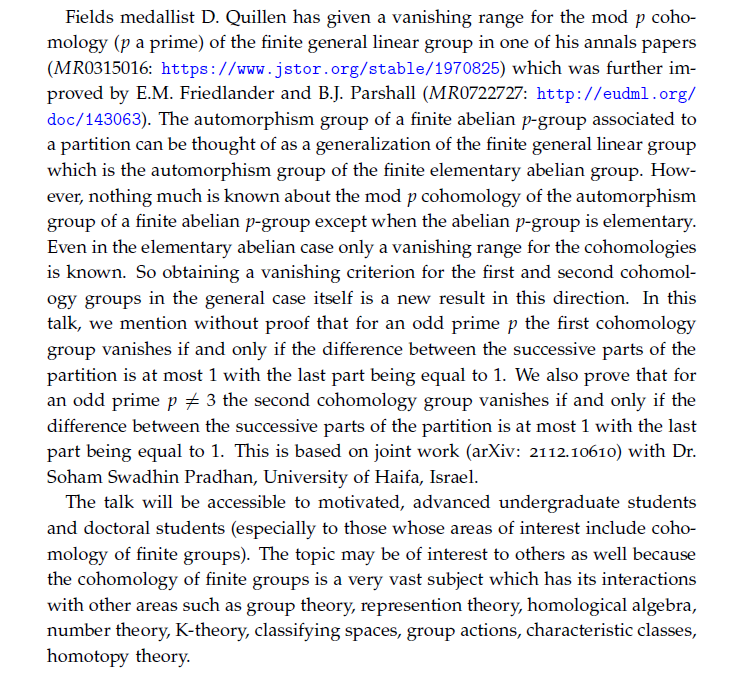
Abstract: It all started with understanding and finding a unique solution to the incompressible Navier Stokes equation in three dimensions. It is still open. Burger considered the problem in one dimension (now called Burgers equation). In general this equation do not admit classical solution even if the data is very smooth. It exhibits many solutions and picks up one solution representing the actual physical problem. It was Lax and Olenik and in general the case was resolved by Kruzkov.
They introduced the concept of "entropy solution" and showed that there exists a unique entropy solution. Main questions are
(i) behaviors of these entropy solutions?
(ii) what happens if the underlying equation is discontinuous?
This sort of equation occur in modelling of many physical problems, example in Extraction of Oil from the ground, Sedimentation problem, ion etching etc. I will discuss some of these questions starting from elementary observation.
Abstract: 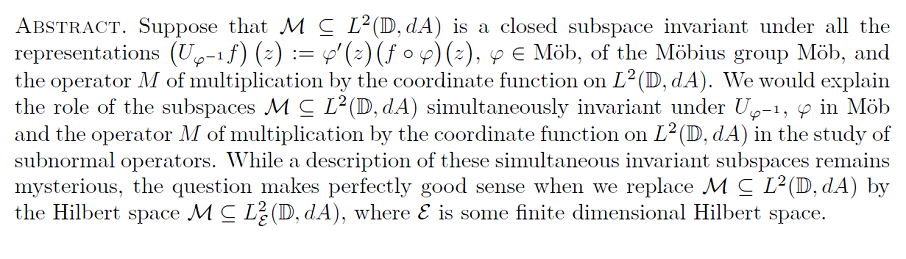
Abstract: 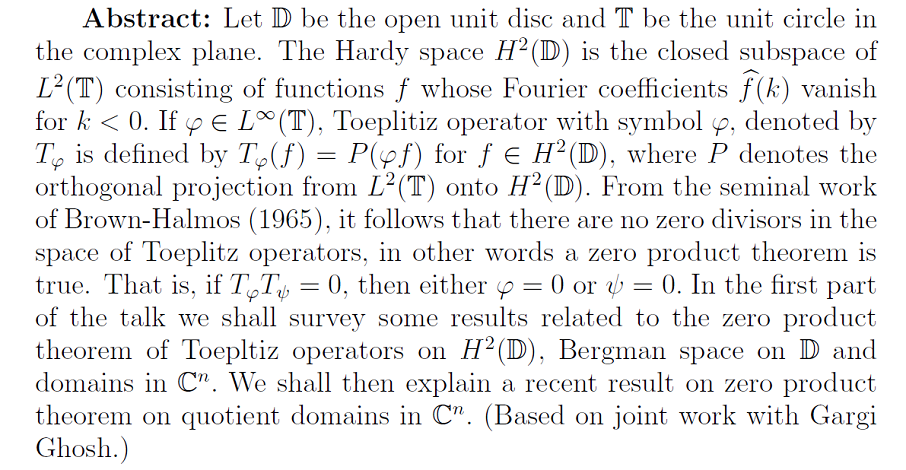
Abstract: Annual air safety analyses mandated by the International Civil Aviation Organization (ICAO) require the estimation of the risk of collisions between aircrafts flying over oceanic airspace, where no radar coverage is available. Although a broad modeling framework is available, the analysis requires estimation of various components of the model from observed data. One particularly interesting and important component is the probability that an aircraft on a particular route and flight level is overtaken by another aircraft that is initially behind it. This can happen if the initial separation is small and the second aircraft is faster, but ATC personnel will usually recognize the risk in such cases and take corrective action, leading to a form of random truncation in the observed data. We will discuss the modeling challenges introduced by this truncation, and some possible ways forward.